Drama Term Tuesday #18

Gestus

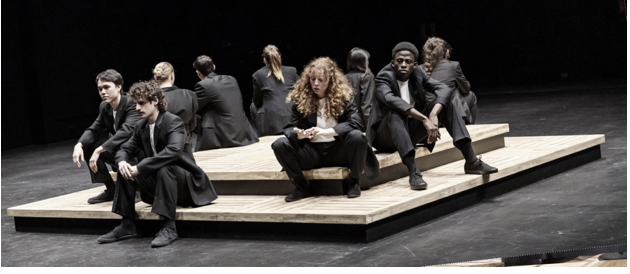
Sometimes referred to as the social gest, gestus is a theatrical technique created by Brecht, which combines gesture and social meaning in one movement, stance or vocal display. It is the embodiment of an attitude or aspect of a character, it is never cliché but very specific and can only come out of a deep exploration of character, context and story. In performance it serves to alienate the audience in order to show them the bigger picture.

Excerpt from Drama Key Terms and Concepts

Drama Term Tuesday #17

Feldenkrais

Feldenkrais Method

The Feldenkrais Method, originated by Dr Moshé Feldenkrais (1904 - 1984) is an educational movement system designed to facilitate greater awareness of the body; particularly posture, movement, co-ordination and flexibility. It is used in actor training to build mindfulness of the body so that it can be accessed to create character.

Excerpt from Drama Key Terms and Concepts

Drama Term Tuesday #16

Bedroom Farce

Popular broad comedy focusing on sexually compromising situations, mistaken identités and bedrooms. As with all farce, authority, order; and morality are at risk and apparently ordinary people are caught up in extraordinary goings on. Involves much comic stage business. Originated in France though elements can be found in Roman comedies.

Excerpt from Drama Key Terms and Concepts

Drama Term Tuesday #15

Willing suspension of disbelief

Phrase coined by Samuel Taylor Coleridge to describe the conscious acceptance of the illusion or unreality of drama by audiences; although it is clearly an actor on a performance space, members of audences suspend or hold at bay their scepticism or sense of reality in favour of believing the imagined dramatic action.

Excerpt from Drama Key Terms and Concepts

Drama Term Tuesday #12

Censorship

Censorship of Drama

Censorship sets out to define, control and restrict individual or group freedom and access to ideas or expression.

In the long history of drama there has been strong recognition of its power to influence thought and to change action amongst audiences. As such a powerful force in society, drama has attracted the attention of many who wanted to control it, curb its influence or to use it for their own purposes. Censorship has been undertaken on the basis of religious belief, political ideology and propaganda, sexual or personal morality. Censorship can be undertaken by individuals, groups, governments or religious groups.

Self censorship is another common example of how individual playwrights and actors limit ideas or dramatic action.

Optimistically, wherever there has existed censorship, there has been ingenuity and resilience in drama which questioned or countered the deadening influence of censorship and ensured the power of drama continued to have an impact on society.

Excerpt from Drama Key Terms and Concepts

Drama Term Tuesday #11

Text-based approaches

Drama that works from a text written by a playwright through exploring and interpreting ideas and themes, solving practical problems of directing and staging including placing the text in contexts through dramaturgy.

Excerpt from Drama Key Terms and Concepts

Drama Term Tuesday #9

Tension

Dramatic Tension

Conflict

Sense of strain, excitement, anticipation or suspense used to animate and sustain interest and forward movement in drama.

Obstacle for a character to overcome.

A sense of ‘what’s at stake’ in a particular dramatic situation. Tension and dramatic tension are sometimes used interchangeably with conflict but the concept is more than simple arguments or differences of opinion.

Excerpt from Drama Key Terms and Concepts

Drama Term Tuesday #8

Theatre of the oppressed

T.O.

Brazilian director Augusto Boal (1931 - 2009) developed a method of forum theatre for, about and by the oppressed, who act as “spect-actors” (rather than spectators) to examine and change the existence in which they live, through drama.

Boal’s key practices:

  • Forum theatre

  • Image theatre: where the “spect-actors” are asked to sculpt their bodies and other participants’ bodies to create images (tableaux) representing particular situations, emotions or ideals. Boal encouraged the images to be created spontaneously so as to articulate raw emotions and ideas.

  • Invisible theatre: where a rehearsed play is performed in a public space without the public knowing that they are seeing a performance. This form was used to focus on social themes and to incite debate within society.

  • Legislative theatre: similar to forum theatre except the theme of the drama is based on local government.

  • Newspaper theatre

Extract from Drama Key Terms and Concepts