
Drama Tuesday - A Muse of Fire … 1991

 How our schools are being transformed by "the brightest heaven of invention"
Not so long ago,. there was little room in the school curriculum for drama and theatre studies apart from the occasional enthusiastic rendering of the "school play". In rosy hazy memory, the "school play” was a major occasion on the school calendar - triumphs of chaos and art wrought from the temperament of the teacher/ director. the nervous energy of young performers, the long suffering patience of school administrators and the fond forbearance of parents. Whatever the critical response to these occasions might have been, it is worth noting that often for those involved, the experience was remembered long after other subject content has been forgotten.

As the educational framework of our schools has expanded, drama and theatre studies have found a place as a subject discipline in their own right. Students in our schools have on offer a range of drama and theatre experiences.

In the early years of schooling, when students take part in creative play, they are using part of the language of drama. Through their experiences of make believe and pretending they are exploring different roles. A group of pre-school students at the dress up box or pretending to be a dragon with roaring noise and faces contorted are acting out roles beyond their own lives. Sometimes such games and creative play is formalised into a performance for someone else, an audience, but mostly the focus of this play is on the enjoyment of the moment for the particular students involved. The importance of these early experiences in creative play is now widely recognised; capacity for risk taking, for lateral thinking, for imaginative exploration are just some of the important life skills that are developed in these early games.

As students in our schools progress, there are increasing opportunities for them to develop a broader understanding of drama. Other areas of the curriculum such as understanding society can be explored through role playing and simulation games. Language can be developed through a love of words, exploring their textures and character. An understanding of changing physical development can be explored through movement, mime and characterisation work. The are few bounds for imaginative teachers using drama as a tool for learning content material, and as a means of developing student awareness of themselves and their own development. Increasingly, students in primary school have the opportunity of performing for an audience: sometimes a small performance to another group of students in the class, or an assembly item or an end of year concert or a performance for the people at the local Senior Citizens Centre are all ways of developing in students a sense of self confidence, of working in a group, and enjoying acting in roles.

In the secondary school, courses in drama and theatre are offered at a more formal level. In the Unit Curriculum students can explore improvised drama (plays without pre-written scripts). mime and movement. developing self-devised performance pieces. Gradually the focus of their studies takes them beyond drama as a tool for self development and exploration of the aspects of theatre and performance. The technical aspects of theatre, developing the voice, understanding something of the history of theatre and its place in society. In the post compulsory years of schooling students can take a more specialised course in theatre which broadens their understanding of the place of theatre and drama in the cultural life of our society. Further opportunities for performance develop self-confidence, commitment. self-image and group interaction skills. In the Senior Secondary we have both ATAR and General courses in Drama for the WACE the Western Australian Certificate of Education. (ATAR. An Australian Tertiary Admission Rank (ATAR) represents your rank amongst all the other year 12s in Western Australia.)

Naturally, there are links to life beyond school. Some students take further studies at a tertiary level or enter the professional theatre; some develop a love for theatre as a form of entertainment and argument; some others use the techniques of rehearsal and visualisation developed in drama and theatre studies in a wide variety of other careers. It is safe to claim that ( although they mightn’t always realise it ) all students who have been involved in drama and theatre are enriched in ways that they barely dream of.

In all recorded societies there have been forms of drama and theatre. Some people argue that the health of a society is reflected in its capacity for reflecting and exploring the values and concerns through this imaginative world. As Hamlet in the play by Shakespeare reminds us

" ... the purpose of playing ... is to hold ... 

the mirror up to nature ..."


Scenes from around the state

South Hedland

In one end of a teaching block, cocooned from the searing heat outside, a class of Year 5 students are telling their version of the story of the dragon and the damsel in distress. An aboriginal boy with an infectious smile has dressed as the dragon's mother and is berating the dragon for being " ... so mean to the poor girl. .. " and for" … getting dragons a bad name ... " He concludes" ... is it any wonder that we are almost:-extinct ... ". Toe rest of the students in the class are laughing and teacher Rhonda Brentnall is enjoying his performance. These students are one step beyond playing "dress ups" and "pretending" ¢ they are learning to shape a performance for the enjoyment of others listening.

Belmay Primary School

A circus is in progress - not a traditional circus under tent with lions and high flying aerialists under the Sole Brothers' banner, but a group of students from a primary school are making their own circus. Working for five weeks with Reg Bolton from Suitcase Circus this group of students have discovered in themselves a wealth of talent that they barely suspected existed. Stilt walkers, acrobats, clowns, unicyclists and performers of all kinds have shaped a circus where before there was nothing but the idea. Under the guidance of teacher, Graham Baxter and with the help of tutors such as Reg, these students have worked as a team to make a satisfying and enjoyable performance.

Geraldton
At the local shopping centre students from Standing Room Only the performing group from John Willcock Senior High, have drawn a crowd of shoppers to them with their short impact drama with a road safety message. Later that same group of students will take their play oto a receptive audience at the Senior Citizen's village. Here drama is being used to communicate a health message and is part of a joint project undertaken with the local office of the Department of Health.

Fremantle

For many years now, John Curtin Senior High School has had a reputation as centre for students specially gifted in theatre. Students from this program have distinguished themselves through making memorable theatre. 1991 is an important year - a breakthrough
What would we report from around the state in 2021?

Drama Tuesday - Drama Teaching in action in the Media

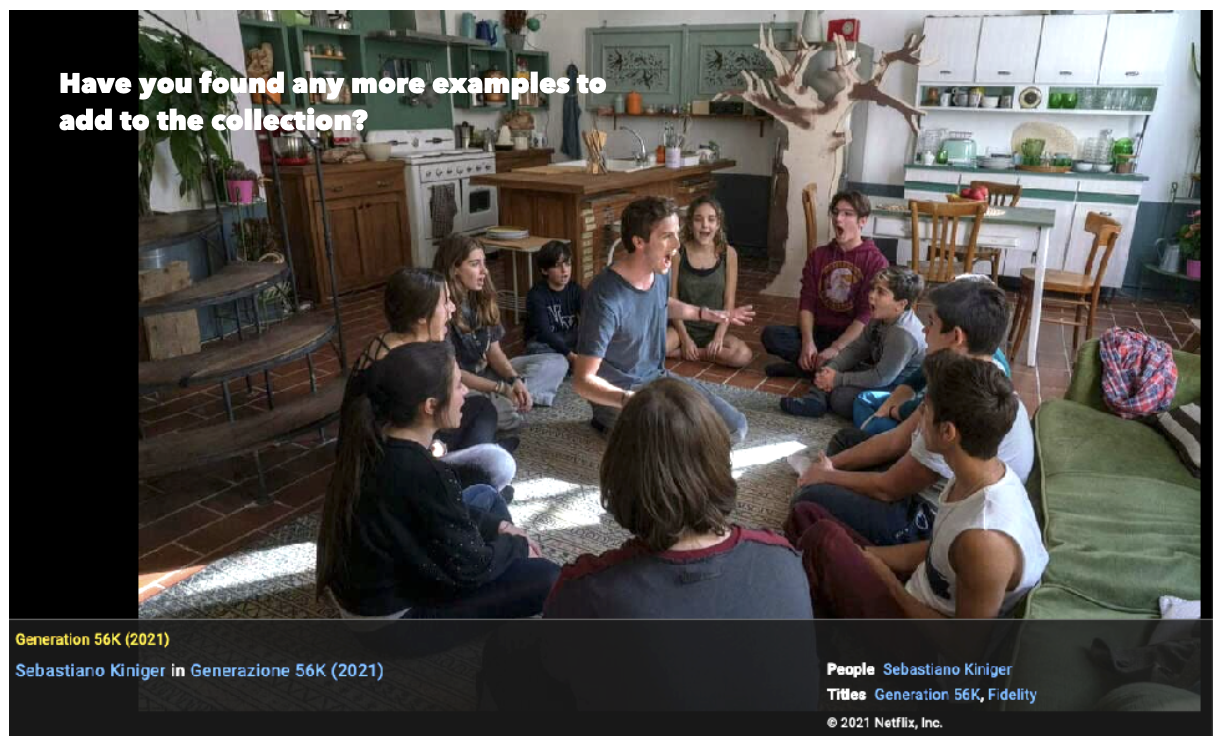
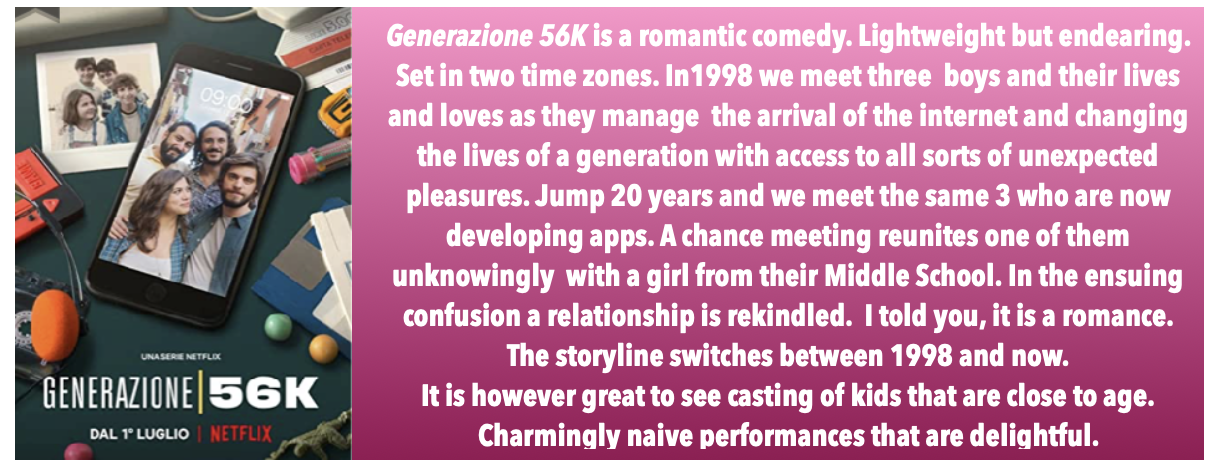
Part of my ongoing quest is to find examples of drama teaching happening – in novels, stories, television and films. In Generazione 56K – a show on Netflix produced in Italy – one of the secondary characters runs a drama group for underprivileged young people. We see scenes of him working with them on a production of Midsummer Night’s Dream. There are scenes of warming up with vocal exercises; behind the scenes teen romance between actors playing Titania and Bottom; and, the obnoxiously sweet kid whose answer to everything is to give the finger. and the production that we see scenes from sends the audience into polite slumbers.

Yes, its’ a secondary story and likely to be of interest in passing. But it’s yet another example of contemporary interest in drama teaching. 

Have you found any more examples to add to the collection?

Drama Tuesday - The Drama Teaching Space

Spaces of learning/Spaces of Performance

Screen Shot 2021-10-12 at 8.48.48 AM.png

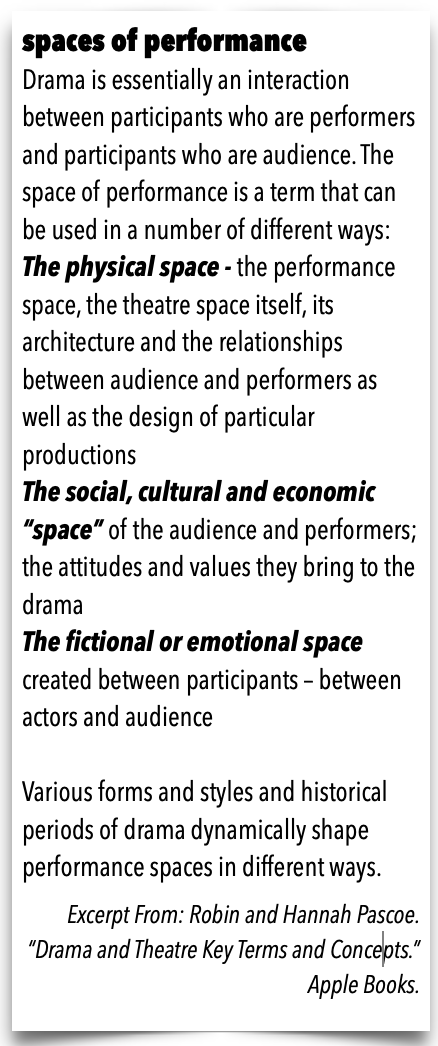
 We take for granted that students understand how the elements of Space and Time are crucial building blocks for making drama. But we usually think of this in terms of the performance spaces we use – our theatres and performance venues. In this post I shift our thinking to consider that every drama room – whether it’s a purpose built space or a classroom rearranged - in the same terms as we do in making drama: the physical space,, the social space and the imagined emotional space. 

The space of performance is essentially an interaction between participants who are performers and participants who are audience. We can think of the drama teaching space as the interaction between participants – students and teacher – and the physical, social and imagined emotional space. 

I am thinking about this having read an interesting post from TheatreFolk in Canada and a new publication they have put out called Return, restore, rebound: Post-Pandemic Resource.. In that post they discuss the challenges of being a teacher who has been teaching online and remotely as they return to their physical classrooms. (https://www.theatrefolk.com/products/return-restore-rebound-post-pandemic-resource) . In particular, they set out to support the beginning teacher who is moving into the physical space of teaching for the first time after their graduation – a delayed taking up of a teaching position because of the Pandemic. 

Screen Shot 2021-10-12 at 8.48.54 AM.png

In that resource, they pose useful questions for teachers – fresh to the space or returning to the space – reflecting on the potential of the teaching space. The physical strengths and limits as well emotional reactions to being in the space. The potential for doing things differently. 

In my work with drama teacher education students I include a module on thinking about setting our “perfect” drama teaching space (as part of a workshop on Managing Drama Teaching). At one level there is no “perfect” drama teaching space – and at another level the “perfect teaching space” is the one you are in the process of making. It is always in a state of becoming.

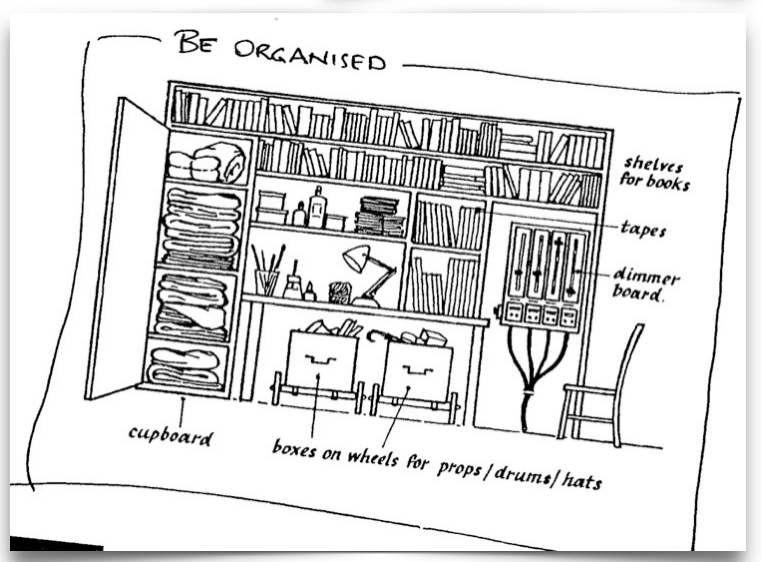
There are some important principles though: be organised. I have lost track of where this image comes from – the antiquated dimmer board takes it back somewhere into the dim dark past. But the notion of managing the space is important. 

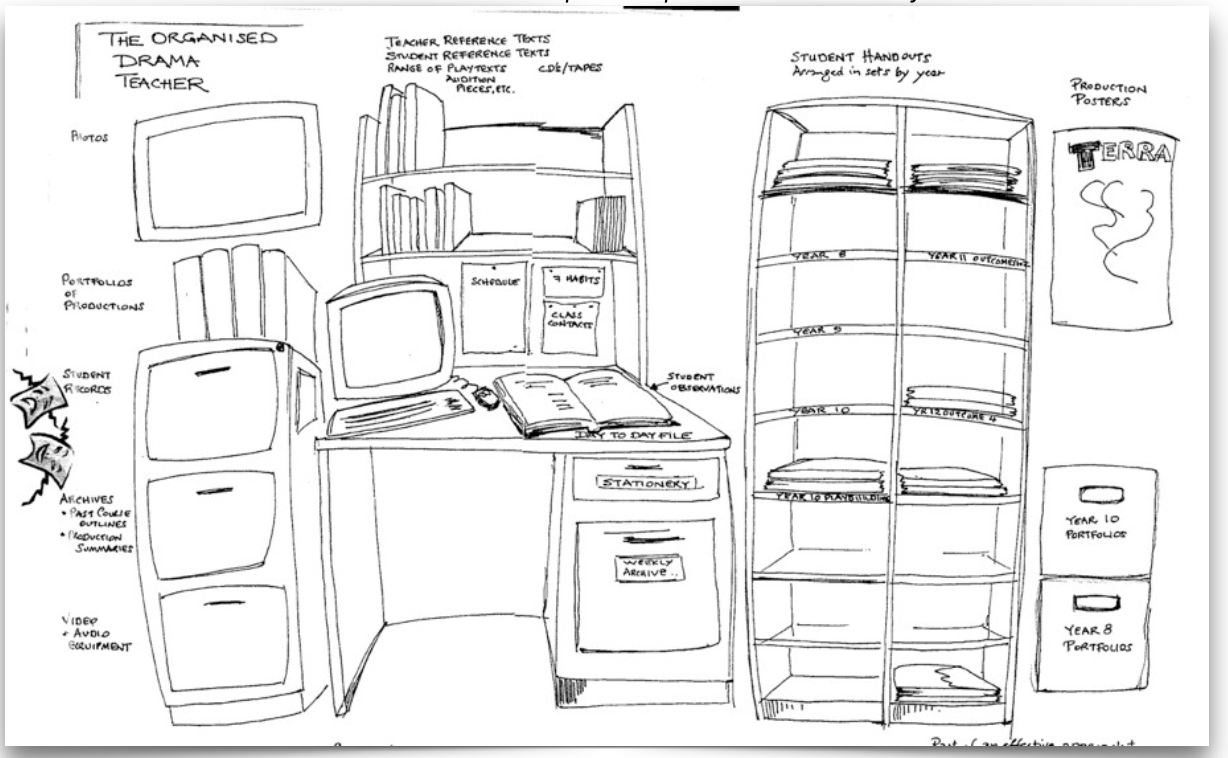
The second image was something I drew after visiting a successful teacher’s space. Christina is thoroughly organised. For example, students know that if they missed a class, the can always go into the shelf where notes from each workshop are kept and find what they missed. 

The other thing about this teacher’s work, is that each student had their own portfolio which they added to systematically with each lesson. This provided both organisation of accumulating learning, it also made explicit metacognitive processes of articulating learning through writing and journal entries. (Of course, nowadays, we might not have a physical portfolio but keep a digital one). There is more to teaching drama than being able to lead a process drama. 
Screen Shot 2021-10-12 at 8.49.08 AM.png

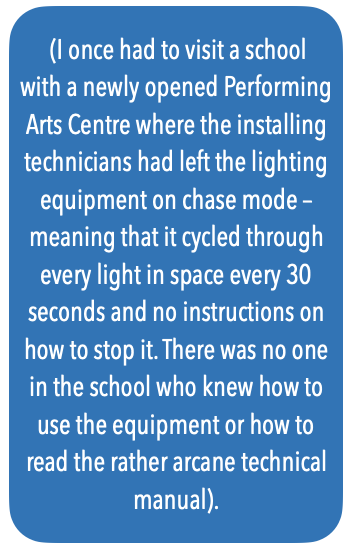
If you work in most secondary schools in Western Australia there is likely to be a purpose built Performing Arts Centre. They vary but are basically a workshop space of about 14 metres by 114  metres with associated dressing room/green room (that is also another teaching space). They are equipped with lighting bars and lights, sound systems. Most are carpeted. They are in. effect black box theatres. But if you are the drama teacher, most likely the only drama teacher in the school, you will wind up being responsible for a facility that costs over a million dollars to build and a school community that don’t quite understand the complexity of being responsible for it. There is the technical side – sound and lighting that requires specialised knowledge. There is the security side where there is equipment that is highly desirable that can be easily stolen or misappropriated. There is the maintenance and air conditioning and all the Occupational Health and Safety requirements when it comes to audiences and not having students push each other around on the scaffolding for the lighting. 

That’s a huge amount of financial and professional responsibility for a beginning teacher. And, sadly, so little time in a teacher education course to provide the necessary background for managing. Part of the work of drama teachers is to manage their teaching and learning space.

What are the necessary knowledge and skills to step into the drama teaching and learning space? What do you need to know to teach drama – apart from a knowledge about the art form itself?

Drama Tuesday - Generosity of Spirit

Screen Shot 2021-08-17 at 9.54.08 AM.png

Don't come to my production if you there to point score, to redirect it or to criticise it unreasoningly.

Come to enjoy, to share, to discover along with us the joy and rough magic of theatre, to understand why we are performing, to share what we are saying ( or trying to say!)

Come to share our sense of achievement, to understand what it is we can now do as a result of the process of discovery we have explored.

I am not going to apologise or pretend that it maybe couldn't ( and shouldn't ) be better. I can be critical as the next person (honest!) I try to have a real sense of what should be on the stage - but I also know that in schools we are working with theatre in an educational context - the learning is as important ( perhaps even more important ) than the production.

Having said that I don't advocate using that thinking as an easy excuse or escape clause. (My old mother, ever a realist, taught me to never apologise for what might have been or to blame someone else, but to cop it sweet whatever happens.)

There can be a lack of generosity of spirit in the barely suppressed commentary of carping criticism I sometimes overhear. This is more than just sad (or hurtful), It damages and diminishes the rest of us.

They sometimes say that the theatre is the natural resort of bitches but I question whether that ought to be the case in theatre in educational settings. If we saw or heard our students rubbishing other performers, we would do something about it, wouldn’t we! Surely we wouldn't join in. ( Which isn't to say that the application of critical frameworks as part of understanding the role of the critic isn’t part of the theatre going experience - but that is something different from the mood of picky and personalised knifery that sometimes seems to pervade the audience of our peers. )

I know that it is easier to laugh at something than to think about it; it is easier to wreck rather than to feel; it is easier to snigger than to understand. If theatre is truly to move us - and move us in more than a simple cathartic burst of emotion - to make us think and feel and, therefore, to change, then we cannot afford to rely on the easy response, to use a quick laugh at someone else’s expense as a substitute for a genuine reaction. Are we so insecure about our own work and abilities that we have to prove our worth at the expense of someone else’s work?

Screen Shot 2021-08-17 at 9.53.59 AM.png

When I go to see someone else’s production, I try to see the production in its context. I try to see its successes and strengths. I try to find something positive to say. I try to base any comments that I make on the production - particularly in discussion with my students - focus on the specific, avoiding the personal or the cheap Jibe. I aim to make my comments balanced, clear and thoughtful. And the amazing thing I have discovered, is that it isn't so difficult to take this world view because often what I see when young people perform is wonderful, amazing and awe inspiring. so it is not effort to focus on the positive.

I am not claiming to be some plaster saint - or to say that sometimes I am not tempted to think a few cheap and nasty thoughts. But I am saying that I have learnt to bite my tongue when the carping starts. And I think we all should do that.

So, when you come to my production, come knowing what to expect. It will be the best that I can do with the talent and the resources that I have at the moment. We have set out to make a production which is the best that we can achieve at this moment in time. We are what we are. Whatever our deficiencies, we don't excuse them but then we don’t let them diminish our sense of achievement.

Screen Shot 2021-08-17 at 9.53.53 AM.png

Drama Tuesday - Drama Teaching and the School Production

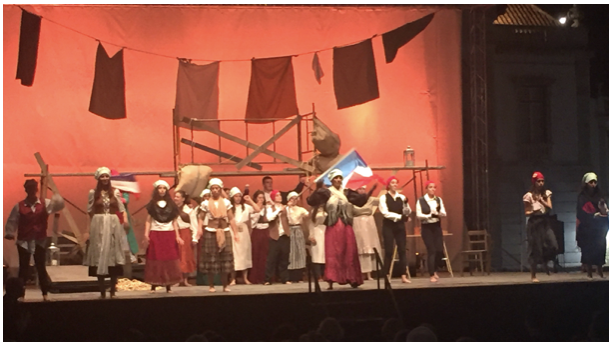
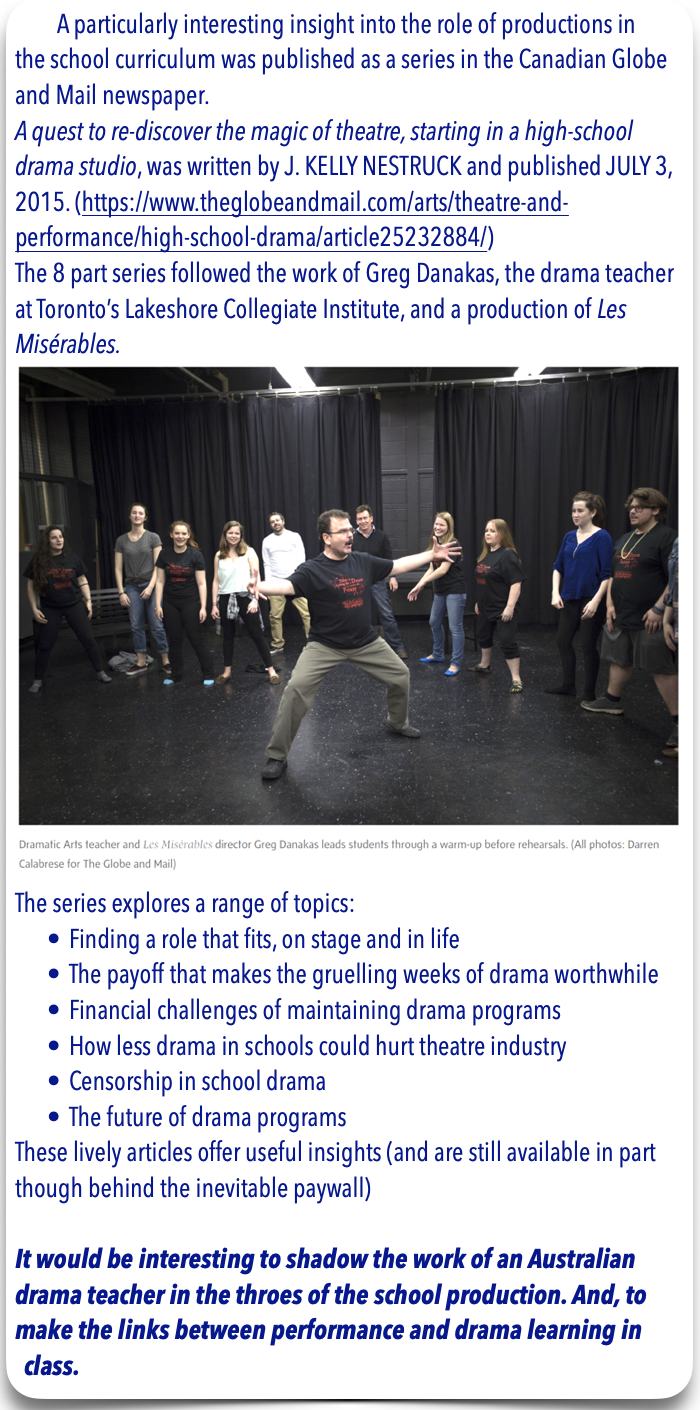
High School production of Les Miserables, Evora, Portugal 2017

High School production of Les Miserables

Evora, Portugal 2017

 Scratch a little below the surface of why young people study drama in schools and almost always they’ll say they do it because they love and want to perform – to be in productions*. The allure of costumes, lights, sets, learning lines, rehearsals, stepping onto the stage in front of an audience, applause. 

I share with students an affinity for the “smell of the greasepaint and roar of the crowd” (as the song goes). Going to a school that did not offer drama as a curriculum subject when the annual production was the only drama opportunity, I grew into a love of drama from that model. But the curriculum (eventually) caught up. Drama became a part of the offerings of schools – though sometimes that is being held onto by our toenails in some schools. For some students (and for some teachers maybe) the focus of drama in the school is less the formal curriculum and more the chance to put on the play or musical. Many schools value the performance for its PR value, for presenting the school in a positive light. According the the gossip, some schools spend huge budgets on these annual extravaganzas. 

What is the role of the school production?

What is the relationship between the drama in the curriculum and the school production?

Don’t get me wrong. There can be many curriculum and co-curricular benefits from a school production. Students learn the discipline of rehearsal, the deferred rewards of working towards a shared goal. They learn about working and learning collaboratively as a member of a team. They work on the nuts and bolts of voice and movement role and characterisation. They learn lines and work on memorisation. The learnt the values of setting personal goals and achieving them. They understand the sense of personal satisfaction of achieving something challenging.

In co-curricular terms, Students from across the years and cliques can be brought together. School identity and cohesion can be fostered (in many of our productions in schools we had students and teachers working alongside each other on stage, sharing dressing rooms and the anguish and pain of learning lines).

But behind the glamour and the sweat, the focus is less on the curriculum content and more on the show. This is not just a problem for the drama teacher. I am reminded of the music students who want only the “glory” of the performance and not the hard slog of so called “classroom music”. 

We cannot overlook the issues that accompany an approach that focuses on a performance-only drama education. Competitive auditioning and casting of favourites; using professionals or outsiders to “bolster” local talent (there is a story going around of the school that spends the equivalent of one year’s teacher salary on hiring professional musicians to “sweeten” the orchestra!); choosing from a limited known repertoire – the crowd pleasers! Censorship. Relentless drilling for perfection. The production as a vehicle for the teacher’s starring role (vanity project 101). The list goes on.

Let’s put the performance schedule of drama in schools in perspective. 

Performance is important in drama education. Gone are the days when the concept of performance in the drama classroom was anathema. Unless we want to return to the days of what I sometimes call Kleenex Tissue Drama – we make drama and then throw it away barely realised, like we do with too many paper hankies!. 

Screen Shot 2021-08-17 at 9.49.57 AM.png

At its heart, drama education is about providing students with opportunities to express ideas and share them – communicate them with and for an audience. To that end, what we do in our drama classes – our class drama – provides the foundations of knowledge and skill for effective performance. 

What is your balance of performance in drama education in schools?

Drama Tuesday - Once More unto the Breach …

Screen Shot 2021-09-14 at 11.09.21 AM.png

into WAAPA for production of Human Cannon by Edward Bond.

 We are in the Enright Studio at WAAPA for the production of Edward Bond’s Human Cannon by Second Year actors. 

The twelve scenes provide a sweeping portrait of social oppression, struggle during the years of the Spanish Civil War. Our focus is Agustina, mother, wife, revolutionary, symbol. At the play’s opening she is burying her dead new born unbaptised child in the face of the implacable power of Church. At the play’s closing, as she is about to face a firing squad, as she is shown the face of her daughter’s new born, she finds comfort and can smile. In between, bloody events of revolutionary savagery, acts of war, terrorism and betrayal on a foundation of love and loyalty. She becomes the human cannon aimed at the heart of inhuman cruelty.

The audience flank the acting space on two sides. We entered through a scatter of hard backed chairs, a door frame, a wooden table and minimal props; suspended from the ceiling are broken chairs. Light haze filters the lighting. Atmospheric music underscores the action.

The cast plays more than sixty roles. Sometimes generic revolutionaries or soldiers or cardboard cutout caricatures of power – Priest, Franco look alike, Vendors – sometimes named roles. The use of minimal props is noteworthy for students of drama – sticks and lumps of wood pressed  into action as rifles and guns; a piece of fabric is pummelled as kneaded bread; wagon wheels and wood are shaped into a cannon. The use of sound effects was interesting – the loading and re-loading of the cannon – over the mimed actions using improvised props. The manipulation of minimal props and the easy transitions of locations was deftly handled (though I did feel that the weaving of chairs overhead was now a tired and overused theatrical commonplace – institutionalised to the point of overuse in Billy Elliot for example).

Edward Bond continues to have a throat-hold on theatrical power. The many inheritances of Brecht are evident. Announcing the titles of each section in handwritten chalk scrawled by the actors (but spell the title of the play correctly, please); the explicit telling of the fable of the play in the opening scene; the use of shadow puppetry; each scene presenting polemic dialectical discussion of themes embodied in human interactions. The push-pull of distancing us from the horror while also engaging us with gut-level action, worked. The broader socio-political purpose is foremost: the events from the Spanish Civil War serve as a template for wider struggles. This is a primer in recognising the broad purpose of theatre. 

The production moves rapidly from scene to scene even though the sweep of words and dialogue is ever present. Not a short production (we have become so used to bite size theatre that maybe we have lost the stamina required!). There is richly evoked poetry. Agustina’s lament for her country – the long lyrical heart of the play – is powerfully evoked. It finishes with the ironical question: who could not be happy in such a land?

According to a 1987 source (Debusscher), Human Cannon is unproduced. It makes me wonder if this production is a first. It presents an interesting challenge if it is. As a vehicle for acting students, there is plenty of challenge and scope. I was uncomfortable with the accent work, which sometimes verged on cartoon or parody. But, overall, the production proved to be a a successfully managed challenge. And, sometimes, the well-intentioned movement work and Spanish clapping, was under-developed. 

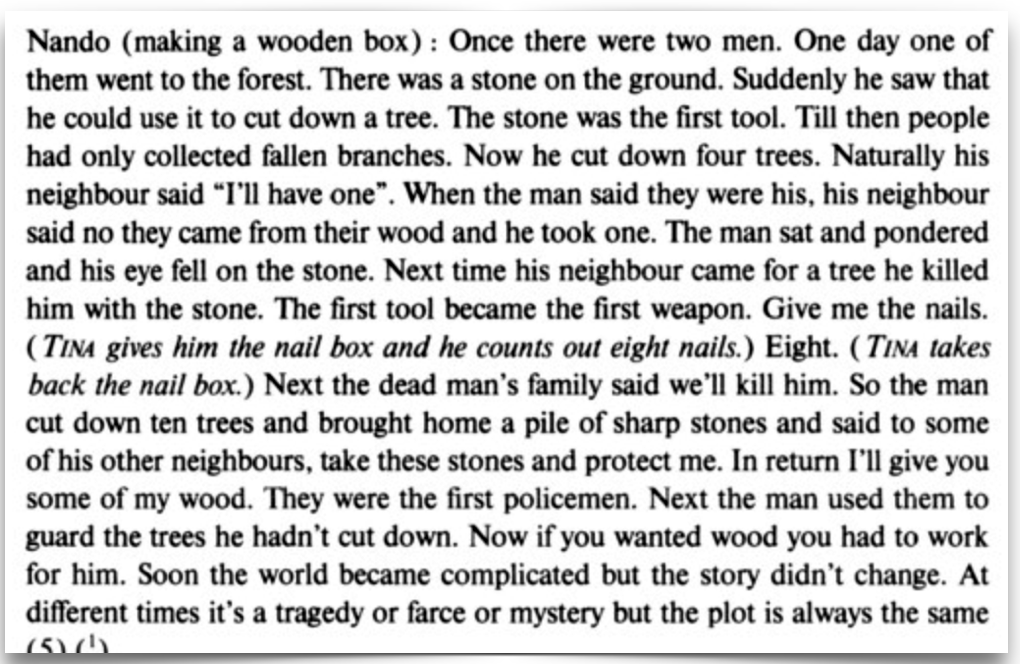
The fable of the piece is powerfully captured in the story of the stone and the tree. Again, Bond’s  nimble and practised handling of his craft shows the strength of his writing as it was realised in this production.

Overall, a strong production with an interesting (and diverse) group of actors. 

There is an excellent discussion of the play’s themes and contexts in Debusscher, G. (1987).

Screen Shot 2021-09-14 at 11.09.15 AM.png

Bibliography

Debusscher, G. (1987). Human Cannon ·: Edward Bond's Vision of the Spanish Civil War. Revue belge de Philologie et d'Histoire, 65(3), 604-618. Retrieved from https://www.persee.fr/doc/rbph_0035-0818_1987_num_65_3_3598

Drama Tuesday - A Challenge for Drama Teachers

 In conversation before the show with Mitch, the Principal, an interesting question came up. What are the equivalent performance challenges for the drama students? 

This is a really important question. 

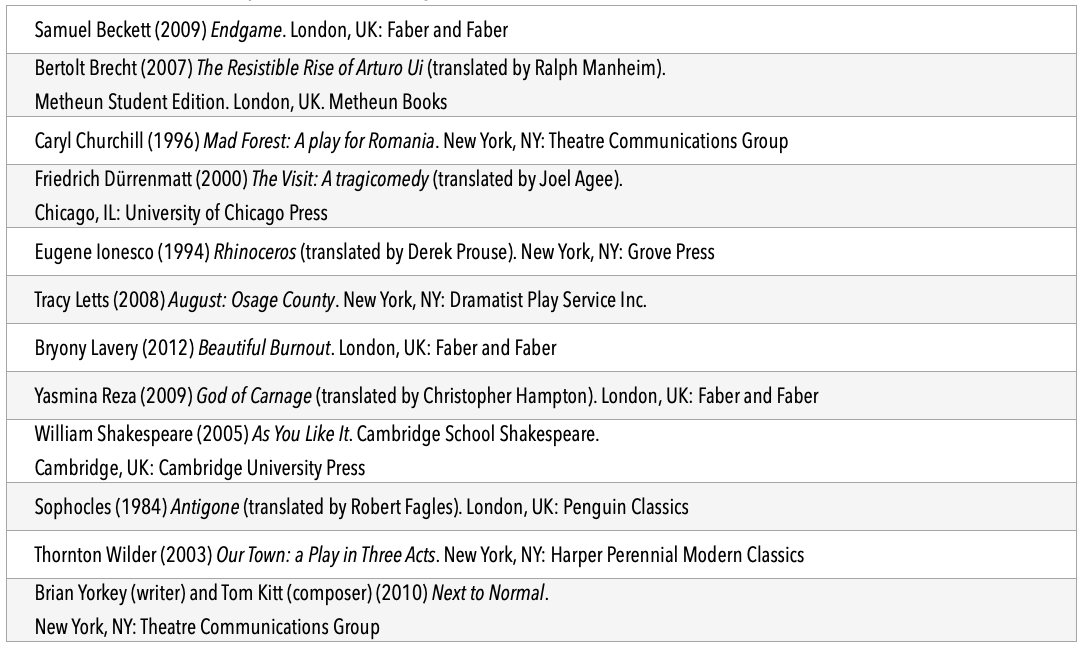
While we may want all our students to experience the “high” repertoire – the most challenging and thought provoking repertoire, are those scripted drama choices age appropriate? What valuable learning would year 8 and 9 students find in the set texts lists of Year 11 and 12. Consider the example of set texts for Year 12 below; even with that repertoire there are legitimate interrogations (see discussion in Lambert, Wright, Currie, & Pascoe, 2016) ). 

What will we have our Years 8 and 9 drama students perform?

That’s my challenge. 

  • Where are the plays that are age appropriate have sufficiently large casts with solid acting challenges?

  • Where are the plays with brand recognition for parents?

  • How do we find plays that will also be accessible to younger audiences that will be the next generation of students for John Curtin.

  • What would or could be workable repertoire for Years 8 and 9? And not be twee or unchallenging.


There’s a danger of trying to find the watered down classics. That’s not a solution. There’s a whole publishing industry based on inconsequential and trivialised scripts for so-called younger people.

But what will our students perform? And not every production needs to be from the high repertoire. There’s a place for popular plays to be included in the list.

Some suggestions to start the conversation

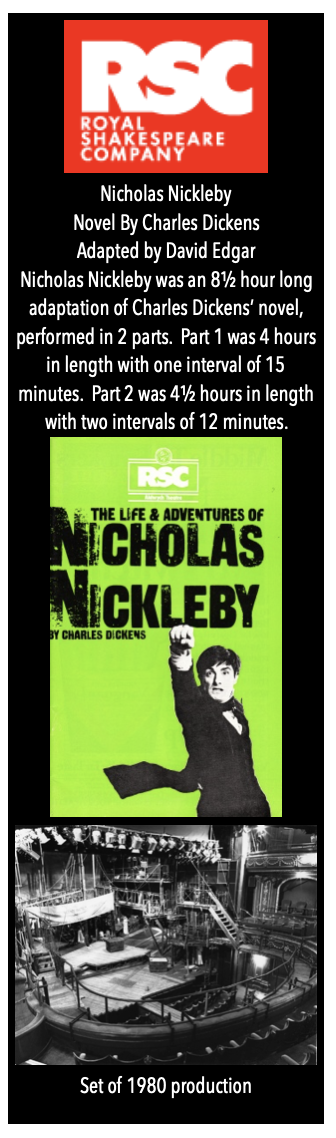
One (perhaps outrageous) idea could be the adaptations of Dickens such as the Royal Shakespeare Company’s The Life and Adventures of Nicholas Nickleby

Before you think I am off my rocker because it’s a monumental work running for 8.5 hours, played usually over two nights. Think about it though. 

The scope of and style of this version presents a challenge. Played on open stage, with the ensemble cast playing multiple roles and moving rapidly from scene to scene, in the right director’s hands, this could be suitably challenging. 

There are multiple roles. You could even have one cast (and director) do Part 1. Another Part 2. 

There is a recognition factor. 

There is scope and ambition. 

Or you could do others last in a similar mould. Edgar has also a version of Christmas Carol.

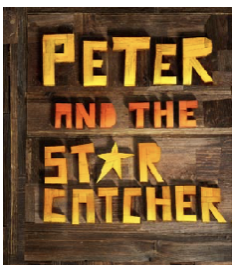
The actor who played Nicholas Nickleby had an illustrious career as a director and he collaborated on another favourite of mine: Peter and the Starcatcher. 

Like the RSC production this adaptation of a 2004 novel by Dave Barry and Ridley Pearson, adapted for the stage by Rick Elice is open-ended and age appropriate. 

An ensemble of actors enters a bare stage. After some bickering, they welcome the audience to the world of the play and describe what's in store: flying, dreaming, adventure and growing up. It is wildly exciting and open ended with scope for imagination. 

What other ensemble shows could work?

Screen Shot 2021-08-17 at 9.42.15 AM.png

I hesitate to suggest The Grapes of Wrath because of some of the materials but the version by Frank Galati could work. Originated at Steppenwolf in Chicago and using innovative open staging, the production has scope and vision. There are scenes that may be a bridge too far for schools, though. 

Then there’s plays like The Children’s Crusade and The mask of Agamemnon or Gunslinger shows of that ilk that were popular in the 1980s (and produced by the WA Youth Theatre Company. 

More contemporary, ATYP. –Australian Theatre for Young People – Also offer some good scripts for younger actors. (https://atypondemand.com.au) But they don’t have the cachet if established scripts and productions. 

But what are your suggestions for plays that will work for Year 8 and 9 students?

Screen Shot 2021-08-17 at 9.42.25 AM.png

Example of set texts from the Western Australian ATAR Drama course (2021). Which of these would be suitable for performance by Years 8 and 9?

Screen Shot 2021-08-17 at 9.42.32 AM.png

Scripts 

Edgar, D. (1992) The life and adventures of Nicholas Nickleby, Dramatists Play Service, New York, N.Y.

Elice, R. , 2012, Peter and the Starcatcher: The Annotated Script of the Broadway Play, Disney Editions ISBN13: 9781423174059

Galati, F (1995) John Steinbeck’s The Grapes of Wrath, Eichosha. 9784268002266

Bibliography

Lambert, K., Wright, P. R., Currie, J., & Pascoe, R. (2016). Performativity and creativity in senior secondary drama classrooms. NJ Drama Australia Journal, 40(1), 15-26. 

Drama Tuesday -  Every Brilliant Thing – Black Swan State Theatre Company

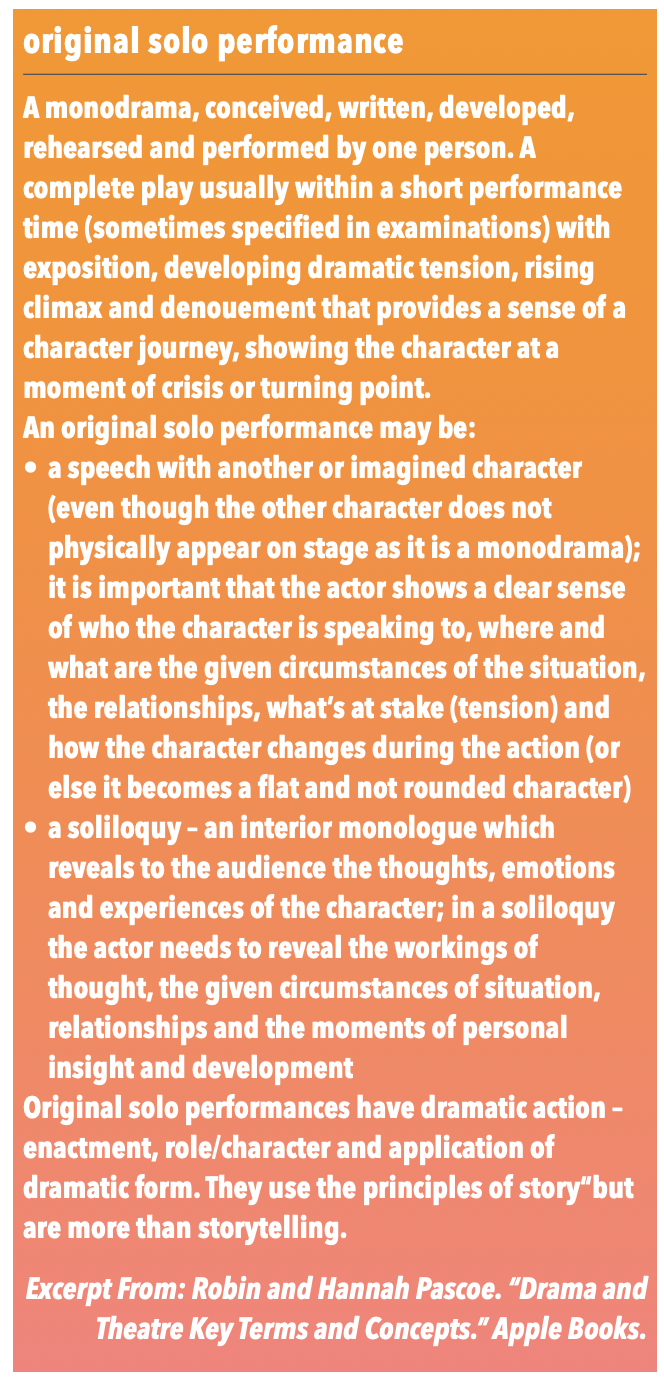
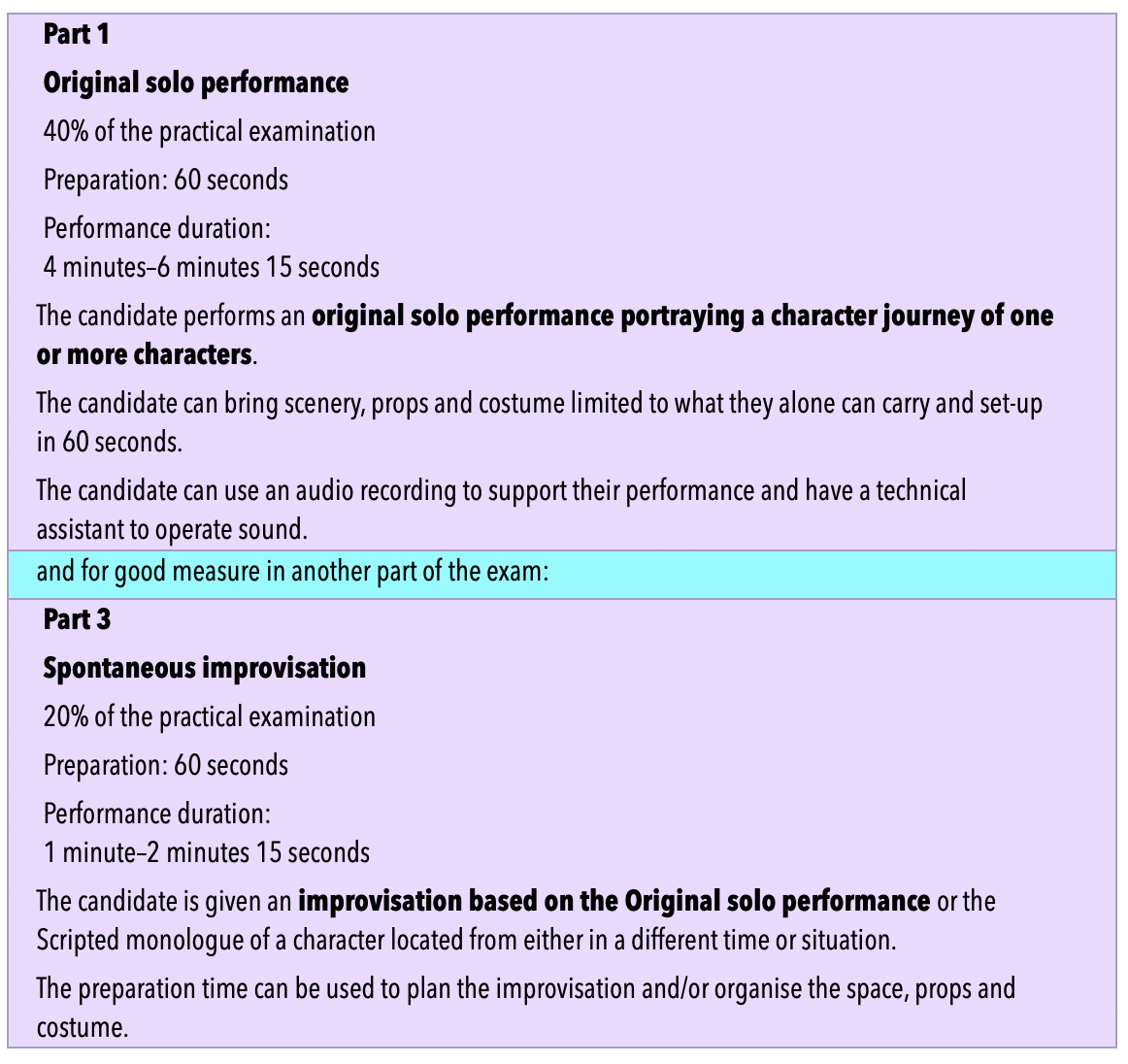
One of my least favourite theatre forms is the one person show. Too often it is the refuge of theatre companies stretching their budgets. And as a Drama Marker I have seen literally hundreds of Original Solo Performances (a required component of Year 12 Drama in Western Australia). It is therefore great to report that I left this production with a sense of up lifting enjoyment and admiration for the skilful performance that engaged the audience.

Staged in the Underground Theatre, in the round (a more successful configuration than end stage), the audience are close to the action. As they enter, Luke Hewitt welcomes them into the space and hands out cards: some have a number and a single word like ice cream; others have longer words or phrases. During the show, when the actor calls a number, the audience member calls out what’s on the card. 

The action eases in. We meet a six year old who has to take his old dog, Sherlock Bones, to the Vet to be put down. A member of the audience is invited to be the Vet; the audience member’s coat becomes the dog. A pen is borrowed from another audience member to become the syringe. The empathy from the audience is immediately established. Quickly we move to a little while later in the boy’s life when his mum tries for the first time to commit suicide and his dad picks him up from school to go to the hospital. A different audience member is called on to be dad and they sit on two chairs added to the space. In a quick role reversal the actor tells the audience member to be the boy and to keep asking one question: why? The actor then becomes the dad inarticulately trying to answer the stream of why questions about what has happened.  

The boy’s response to his mother’s attempted suicide is to start a list of good things. Cue the call outs from audience members. The list helps his mother when she comes home from hospital. But is then forgotten until a later attempted suicide. Then squirrelled away. Then as a young man at University, he meets a girl and through the list shared, finds a life ordinary and suburban until she too leaves him. She leaves him the growing list and he continues until there are a million brilliant things on the list. 

This was a joyous production (joyous is not a word I often use). It creates a sense of community inside the theatrical event as audience members call out contributions to the growing list or are called on to become the Vet or the Dad or the Girlfriend. It fits within the current vision of Artistic Director of Black Swan, Clare Watson’s commitment to “promoting empathy and building community through collaboration”. 

As I said, I left the theatre feeling good. 

There is such skill in the way that the audience were gently and warmly led into the life of the action and how their responses were shaped and nurtured. Skilled acting (Luke Hewitt) and direction (Adam Mitchell). The audience bonded and collaborated and contributed in an unforced way (so often not the case in collaborative performances). Obviously, each performance will have a unique flavour and I hope that each audience member leaves with a similar sense of the power and satisfaction of theatre played well.  

Screen Shot 2021-08-31 at 12.09.05 PM.png

There is much for Year 12 students to keep in mind for their Original Solo Performance. Of course, it is not possible in an exam situation to create that sense of collaborative bonding (it is after all, an exam). But they can pay attention to:

  • Building an immediate sense of place and space in role and situation with minimal props or setting

  • Bringing to life moments in time that make an audience (examiner) share emotion and identification – co-creating drama

  • Creating and managing dramatic tension powerfully and tangibly

  • Shaping dramatic action (within the time limits) to give a satisfying sense of rising action moving towards satisfying conclusion

  • Applying skills, knowledge of form and style – the bread and butter of their learning in the course

Above all, stepping over the limits of being one person alone in the space. Most drama we see is not monologue, it is dialogue. It builds on the interactions between people and the dynamic of action created by ideas, circumstances and personalities. What Year 12 students do – and we forget at our peril what a demanding task this is – is to bring to life before our ideas a complete drama in a short span of time. When it happens, it is what theatre always does best – bring to life an enacted experience for an audience’s wonder and delight. 

It’s important to remind ourselves what we ask our Year 12 students to do in Drama. It’s a big ask and each year students respond by showing us their capacity to amaze. Every bit as challenging as Year 12 Physics (if I can climb onto that soap box for a moment). The power of drama and theatre reminds us, again and again, of why it enriches our lives.

Excellent and supportive resources for teachers and audience members are provided. https://bsstc.com.au/learn/resources

Just a  reminder about what our Year 12 Drama students are required to do.

Drama Tuesday - Stating the obvious

What is the starting point of any drama teacher education course?

A drama teacher begins with a love and knowledge of drama as a way of making meaning, expressing ideas and stories and communicating with an audience. They begin with drama in their own lives. On that basis we begin to build an understanding of drama as learning, drama as curriculum. 

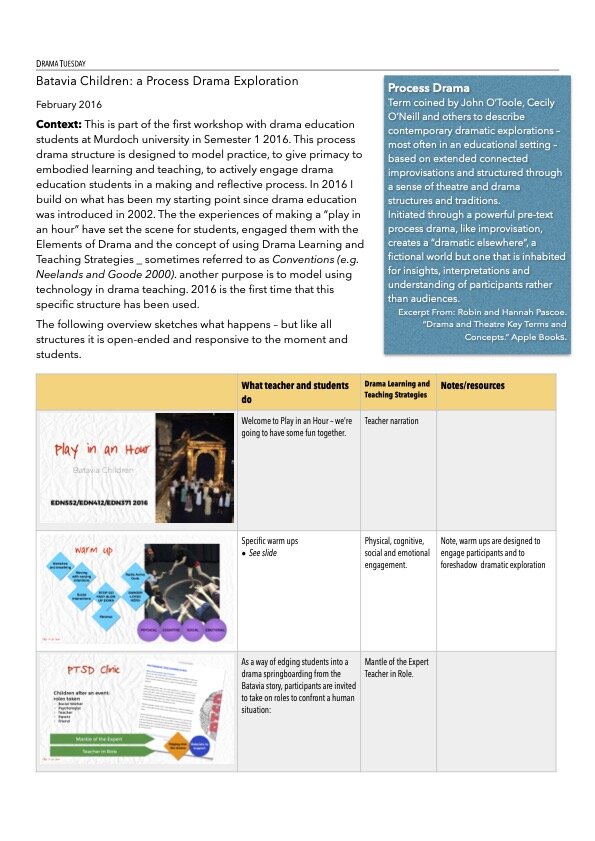
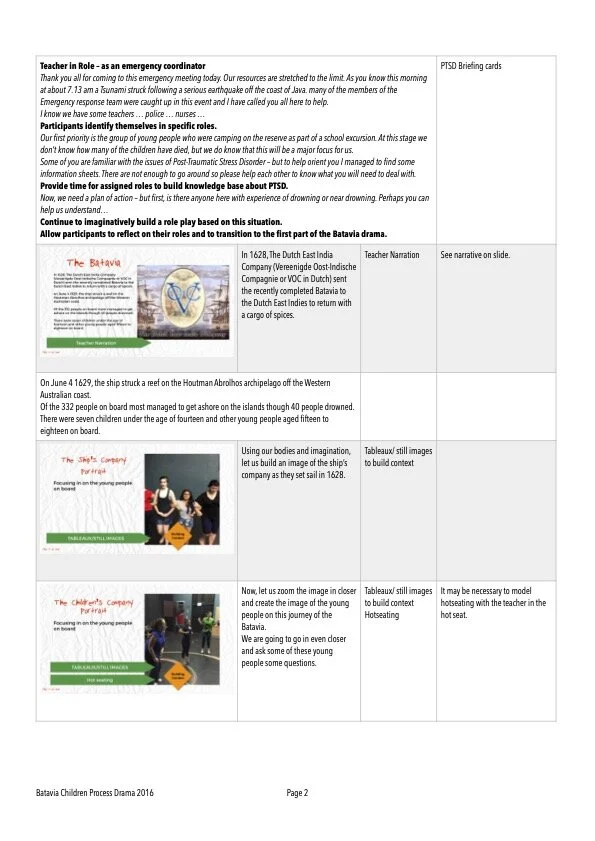
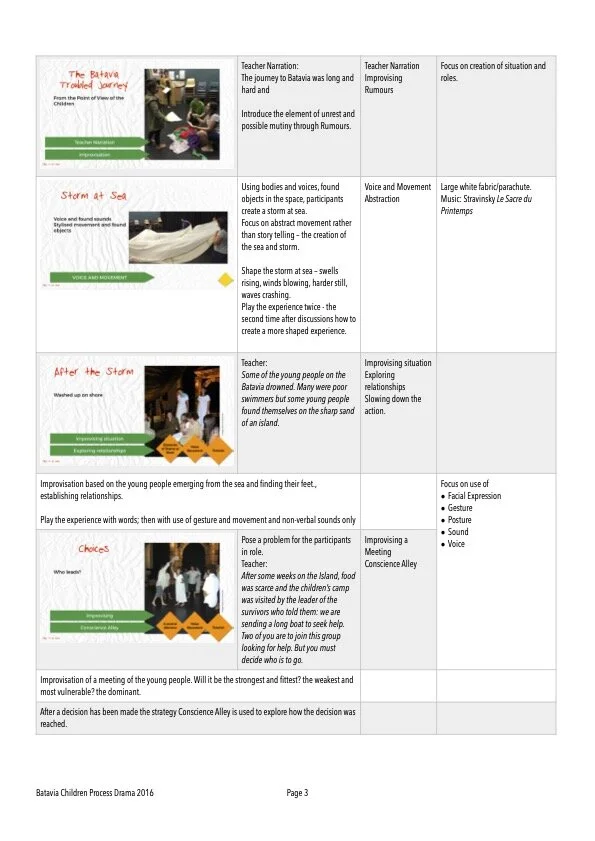
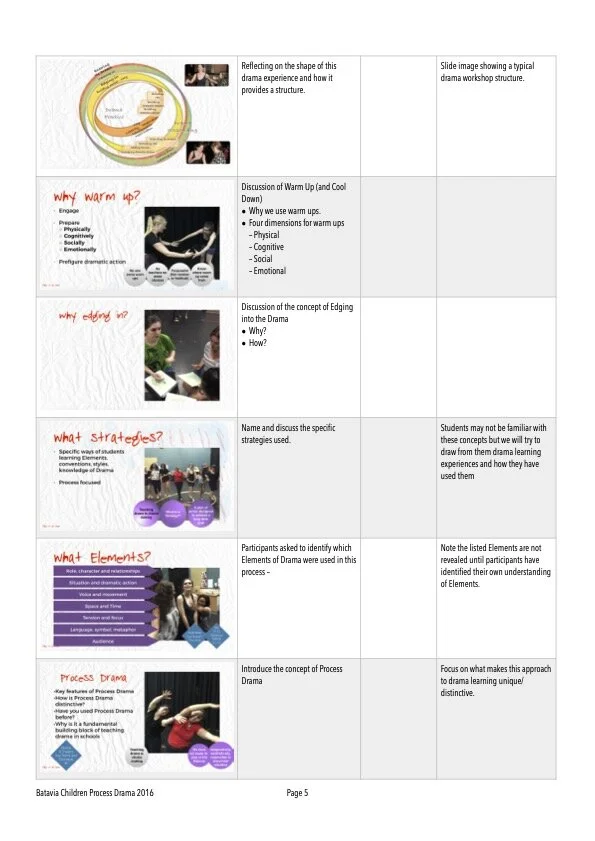
Each year I begin by making drama – a collaborative process drama experience loosely called Play in an Hour – and spring boarding from that to ask drama teacher education students to reflect on their own drama learning in schools and the drama curriculum. 

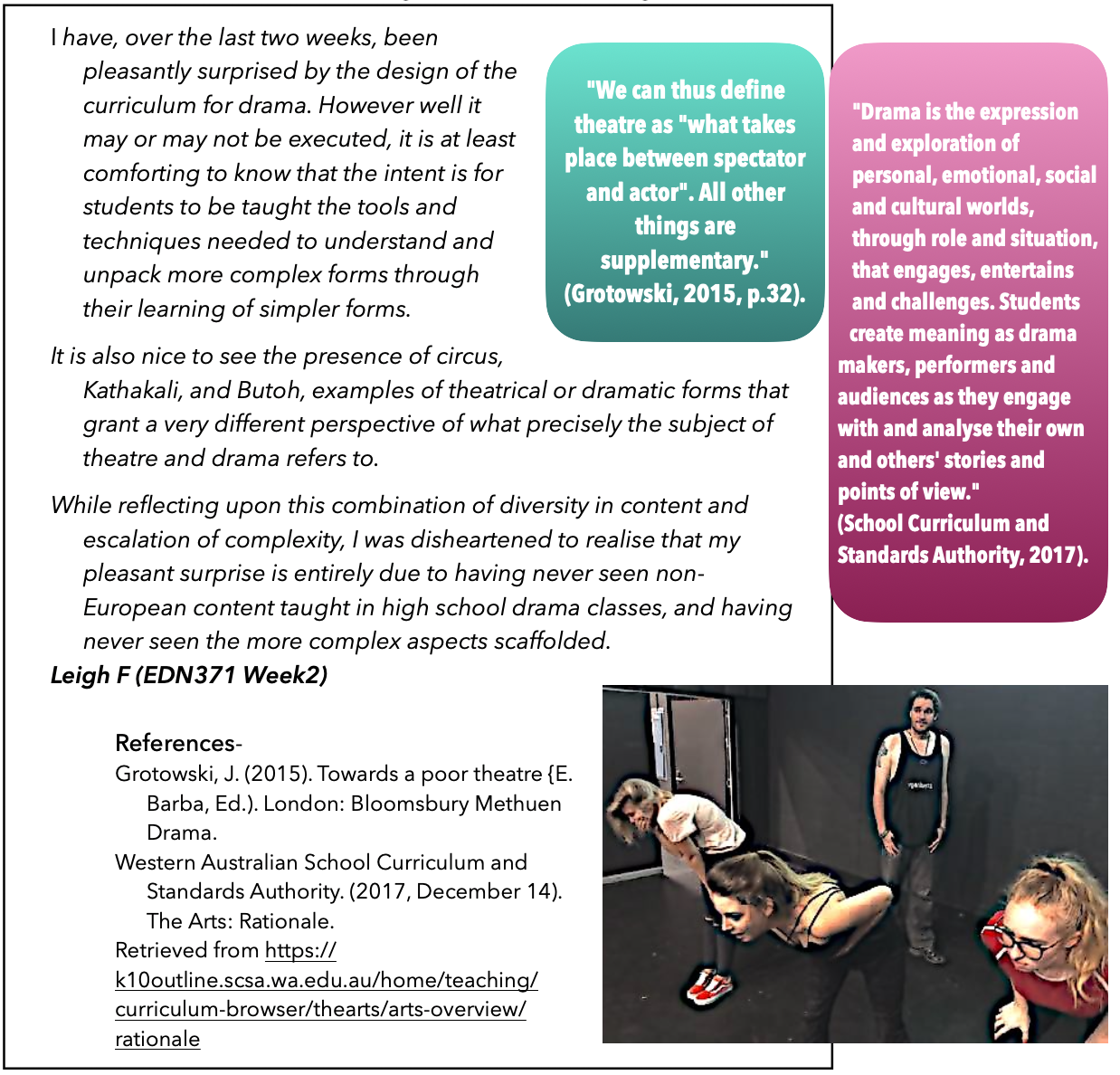
In a Week 2 reflection in 2018, Leigh wrote the following.

What would be your reflection if you reflected on 1) your own experiences of drama in schools; and, 2) your drama curriculum?