Drama Term Tuesday #31

Alexander Technique

A movement technique developed by Australian actor, F.M. Alexander in the late 19th century. Alexander Technique is a method designed to educator, or re-educate, people on physical ‘habits’ which limit movement, and help correct these in order to help the body move with ease, freedom and balance.

An important element of the Alexander Technique is the way thoughts influence movement and how ideas can be expressed in movement, e.g. by thinking about loosening a muscle it will loosen.

Excerpt from Drama Key Terms and Concepts. Continue the conversation on facebook and twitter.

Media Term Thursday #30

XTML

Excel Table Mark-up Language. If you have data in a Microsoft Excel table, XTML is a program that can convert the data into a table ready to be included on a website. You can use normal excel formatting commands and XTML will convert the data to HTML.

Excerpt from Media Key Terms and Concepts. Continue the conversation on facebook and twitter.

Drama Term Tuesday #30

Revenge tragedies

Drama based on retribution and avenging wrongs. Derived from the Roman playwright Seneca and influential in Elizabethan and Jacobean drama (e.g. Kyd’s The Spanish Tragedy); Shakespeare’s Hamlet is an example of revenge tragedy (though interestingly, it also challenges many of the conventions of this form).

Excerpt from Drama Key Terms and Concepts. Continue the conversation on facebook and twitter.

Music Monday

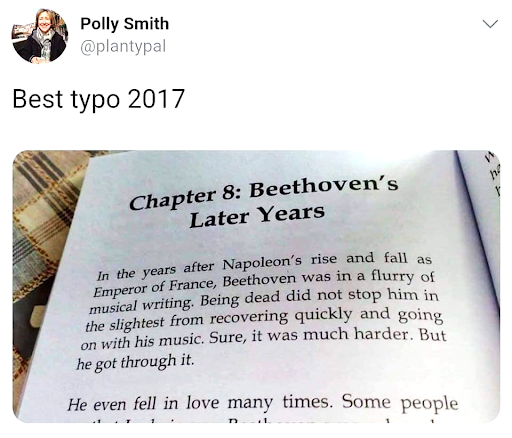
With so many of our music teachers preoccupied with end of year report-writing, concerts, assemblies, preparing students for university auditions and a myriad of other tasks, it seemed like a good Monday to share a laugh – and also a reminder of how important the proof-reading and editing process is in everything we do.

unnamed.png

Continue the conversation on facebook and twitter.

Media Term Thursday #29

Soap Opera

Soap operas are narratives without a resolution (as opposed to television dramas). Continuing stories with many interwoven plots.

Soap operas are about the everyday lives of a group of people living in a close-knit community. They have a very defined formula, multiple story lines, catchy theme songs, cliffhanger endings, down-to-earth characters, informal language and themes of love, infidelity, jealousy, moral dilemmas and betrayal.

Structural features include short scenes from previous episodes to remind viewers what is happening, high points that happen just before each commercial break and a preview of tomorrow’s episode at the end.

Soap operas started as radio serials before television came about. They are so named because the soap manufacturer, Procter and Gamble were the major sponsors of these early shows.

Excerpt from Media Key Terms and Concepts. Continue the conversation of facebook and twitter.

Drama Term Tuesday #29

Kosky (Barrie Kosky)

(1967 - )

Influential Australian born theatre and opera director. Eclectic in approach often borrowing from European Expressionism, Kosky works in a layered, excessive presentational style.

Excerpt from Drama Key Terms and Concepts.

Continue the conversation on facebook and twitter.

Music Monday - The Bassarids

The Bassarids

Music Drama in One Act by Hans Werner Henze

Berlin 

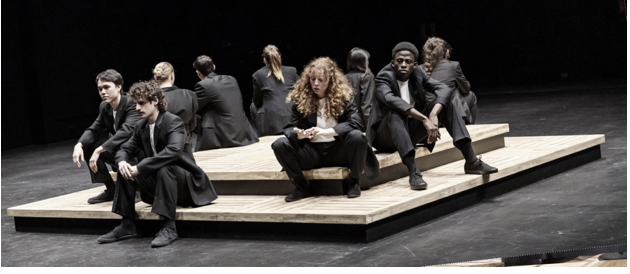
On a recent brief visit to Berlin we wanted to see at least one piece of theatre and hear some music. In the end we got both on one ticket at The Bassarids; ironically at the Komische Oper, (ironic since there was nothing comic about what we saw). However, what we did experience was a powerful piece of opera, and along the way made some interesting observations about the differences between our theatre-going experiences in Australia and our night out in Berlin.

The Bassarids was written in 1966 by Hans Werner Henze with libretto by WH Auden and Chester Kallman. It is inspired by Euripides’s “The Bacchae” and it is sing in English (with that very rounded form of the language often heard in opera.)

This production has been directed by Barrie Kosky.

It is a complex and gruesome story concerning the conflict between Pentheus, newly appointed king of Thebes, and the god Dionysus;  and Pentheus’s subsequent murder at the hands of Dionysus’s intoxicated followers (including Pentheus’s mother, Agave). These intoxicated followers of Dionysus are the Bassarids. It has been described as a drama of extremes.

We were lucky enough to get reasonably priced tickets on the day of the performance. Our seats were in a centrally placed box in the part of the theatre we would call the dress circle. We assumed that ticket sales were not going well and were therefore surprised to find the theatre almost full.

The performance ran for 2.5 hours without interval. Would an Australian audience cope with that?

We counted over 60 musicians, both in the orchestra itself and in other parts of the theatre and on stage. Would any Australian theatre budget cope with this?

The chorus numbered more than 100 – with the majority involved in movement on a heavily raked stage. Quite a physical and vocal challenge. And again, an indication of a healthy budget.

The soloists were of a very high order indeed, both vocally and as actors.

The music is compelling, moving between moments of  heart-wrenching lyricism and moments of spiky drama. 

The final scene builds to a blood-soaked and horrific ending. The blood on the stage floor was discretely covered by a black mat before the bows started.

The bows went pretty much as we do here in Australia – but what we had forgotten was that in Germany, once the bows have finished and the audience keeps on applauding, they start right over again and take the bows’ sequence from start to finish once more. Only then do they move to whole company bows until the rapturous applause subsides. 

As we moved out towards the foyer after an amazing night, there was one more surprise. Huge platters piled high with little single chocolate truffle boxes. And here’s the thing – in order to open the box and get to the yummy German chocolate inside, you pretty much had to read the company’s contact and social media details. Brilliant!

Professional theatre is alive and well in Berlin.

Continue the conversation on facebook and twitter

Media Term Thursday #28

Intellectual property

A product of the intellect that is intangible such as ideas, patents, business methods, songs, literature, graphic designs or other artistic works that might have commercial value. These ideas need to be legally registered so that the originator gets financial and personal recognition.”

Excerpt from Media Key Terms and Concepts. Continue the conversation on facebook and twitter.

Drama Term Tuesday #28

Expressionist Theatre

Expressionism

A 20th Century theatre movement that seeks to show inner psychological reality through the distortion of scenery, lighting, costuming and acting styles; key playwrights include Strindberg and Wederkind; major influence on design and conceptualisation of silent films such as The Cabinet of Dr Caligari.

Excerpt from Drama Key Terms and Concepts. Continue the conversation on facebook and twitter.

Music Monday - Remembrance Day

Today in Australia it was Remembrance Day. 

At the 11th hour of the 11th month the whole country stops for a minute’s silence to honour and remember those who lost their lives in war. Red poppies are worn on this day. 

It is also customary to have a bugler play The Last Post before the minute’s silence and Reveille at the end. Both pieces are heavily based on the intervals of the perfect 4th and 5th – intervals which are notoriously challenging to sing exactly in tune.

It happened that today I was working at my school and so, along with the whole school population, joined the short memorial at 11am.

As at previous Remembrance Day services I was again struck by how very silent the students are on this day. It is a different kind of silence than an ordinary school assembly silence – a complete silence. A respectful silence.

 And then out of this pristine silence comes the bugle playing the Last Post - the repeated upward 5th - with a pause on the 5th each time. The minute’s silence follows. Then again out of complete silence comes Reveille – more upward fifths then an upward 4th. The focus of the whole crowd is on those sounds. There is no background noise. Then the Remembrance service is over for this year. We return to class.

My year 9 group are identified as gifted and talented in music theatre but they are mixed ability in aural and music skills. Interestingly, today all the students can sing the Last Post back to me with correctly centred pitch. And yet when we encounter the same intervals within their song repertoire, they are no longer all exactly in tune.

Why is this so? They hear the Last Post only once per year. Is it the iconic nature of the annual memorial which imprints itself in them? Is it because it is one of the few times in a year that they listen to a single line of sound with no background noise whatsoever?

How can we transfer this learning to other aspects of their musical education?