
Music Monday - ANZAC Day

Anzac Day

Anzac Day 2020 was like no other before it in the many years since 1915.

In Australia, with gatherings banned due to covid-19, the usual services and parades were cancelled  - except for one at the Australian War Memorial in Canberra attended by only the few dignitaries who conducted it, telecast to the nation.

Instead, at the tops of suburban driveways across the country, Australians gathered just before dawn, holding lighted candles, and sometimes waving to acknowledge their neighbours without approaching or speaking to them.

 In quiet reflection Australians remembered their Anzacs  - and all who have suffered and perished in war – and as the skies softly lightened with the dawn, the morning chorus of magpies and crows was augmented by players of music – student brass players, music teachers, amateur and professional musicians and singers – each contributing to an extraordinarily moving tribute.

On my own driveway I could hear from the next street the hesitant sounds of a student trumpeter playing “Lest We Forget”. Further away there was the faint sound of the Last Post with its tricky high notes for beginner players. 

In the couple of days since Saturday the papers have carried letters from Australians suggesting that the dawn driveway tradition be kept and commenting on how moving it was to have their own silent contemplation accompanied by the sound of live music. My music teacher friends as well as non-muso neighbours have all said much the same.

Music is SO important in our many life rituals. When we work on the tedium of music theory, or teaching the singing and playing of scales, it is worth remembering how important our job is. We are contributing in our way to the rich tapestry of our country’s unique culture.
Media Term Thursday #43

Hypodermic Needle Theory

Magic Bullet Theory

The theory suggests that a media message is injected straight into the mind of a passive audience who are immediately influenced by the message (or a ‘’bullet’ from a ‘media gun’’). Therefore, the mass media can influence a large group of people directly and immediately and trigger a desired response.

It is a negative perception of the media as being dangerous and suggests the audience is powerless to resist.

Excerpt from Media Key Terms and Concepts. Continue the conversation on facebook and twitter.

Music Monday - COVID 19

I’ve been joining many online meetings and discussion groups for the past week in the quest of finding the most effective ways to structure teaching and learning in music during these pandemic days.

What follows is this week’s discoveries. Use them, add to them, discard them. Whatever works for you:

  1. Zoom seems to be the universally favoured platform for music classes, especially for sound quality. (Of course not all institutions or systems use zoom so we are all bound by our individual situations.) By checking out the various functions on zoom (especially the ‘disable background noise’) you can greatly enhance its capability.

  2. Microphones which plug straight into your laptop greatly enhance your sound quality. One example is the Yeti Blue (about $AUD180). (It doesn’t need an audio interface.)

  3. Many studio music teachers are speaking very highly of the My Music Staff app. 

  4. Group classes which involve any unison singing are best done with the participants’ microphones on mute. Not ideal I know but they can model from your singing.

  5. Call and response has become my new best friend. In normal face to face teaching I use it with younger students and in group classes. Now I find that I am using it in almost every situation, particularly when teaching new song repertoire. I play a phrase. I then sing the phrase. The student sings back and I can check musical accuracy and tone placement and technique. I imagine this would work with most instrumental teaching too. In group classes, although I would have the students sing ‘back’ with mics on mute, they could then email individual performances of the material (audio or video) for checking by the teacher.

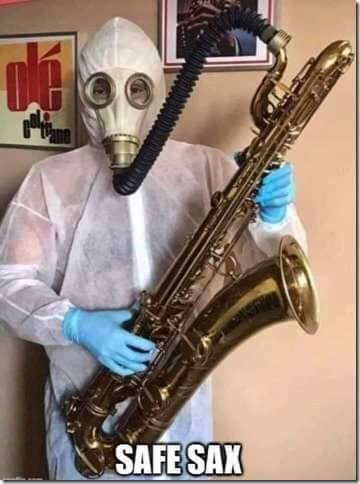
And to finish this week’s post, something to make you smile – with thanks to drama teacher John Foreman.

Music Monday - COVID 19

Well what a fortnight it has been. As the Covid-19 pandemic escalates, schools have closed across Australia and higher levels of social distancing brought into force across the country. Stores have lines and markers on the floor to indicate where the customers can move and stand.  All of society is impacted. When I visited a music store last week the entrance was secured until the staff member had asked me the reason for my visit. 

And in the midst of this, music teachers at primary, secondary and tertiary levels are on a very steep learning curve as they try to figure out ways of teaching their classes, individual instrumental and vocal lessons, vocational courses and everything else in between.

One of my primary music specialist friends shared that she had taken all day to figure out a plan for online pre-primary music learning – in a school where a number of families do not have access to internet at home.

My singing teaching colleagues are finding that the lag on platforms such as Zoom, Webex, Facetime etc means that the standard practice of playing warmups and song accompaniments live while the student sings simply doesn’t work anymore. (It seems that instrumental teachers have more success where they are less reliant on an accompanying instrument.)

My teacher friends who are also parents of school-aged children now find themselves juggling music lessons online with their own kids’ schoolwork.

There is also a real risk of a further social divide during these times – students of more affluent parents being more likely to have greater access to online resources while at the other end there will be students who slip through the net.

Here at StagePage we are committed to bringing you a weekly update on what we have learned and sharing any resources we think might help during the pandemic.

We welcome your contributions too- either through the comments section below or by email or private message. We will always acknowledge you.

Many musicians and music teachers have lost all or part of their income. Let’s look out for their presence online and support it where appropriate.

We look forward to hearing from you. 

Stay safe and well – and keep making music.

Media Term Thursday #42

Authority figure

A character ‘type’ used in media narratives and advertising who the viewer/consumer is positioned to relate to positively and ’look up to’.

Examples include doctors or scientists in advertisements, standing in their white coats in a laboratory setting, endorsing a particular shampoo and the hours of research behind its production. We believe in the authority of that person.

Others would be newsreaders, experts, religious leaders and long-established/ much-loved characters in a television drama.

Excerpt from Media Key Terms and Concepts. Continue the conversation on facebook and twitter.

Media Term Thursday #41

News

Information about recent important events. Reported in newspapers, radio, television and the Internet. Events may be local, national or international and are usually investigated and presented or written by journalists or reporters.

As a television genre, the news follows conventions in structure, language and visual presentation. The news begins with recognisable and often dramatic theme music followed by the newsreaders introducing themselves and giving a brief summary of the news items to be covered. The most dramatic and important stories (with vision) are shown first, followed by local interest stories, sports and weather.

News reports need to be accurate, concise and objective and often include quotes, statements from experts, emotive words and phrases, and descriptive language.

News stories are constructed to give the facts about who, what, when, where, why and how, in the order of most important information down to the least important.

Excerpt from Media Key Terms and Concepts. Continue the conversation on facebook and twitter.

Drama Term Tuesday #42

Applause

The clapping of hands as an expression of approval. Conventionally there is a round of applause at the end of a play so as to acknowledge and thank the actors and production team for their work.

Excerpt from Drama Key Terms and Concepts. Continue the conversation on facebook and twitter.

Music Monday

Covid 19. It is impossible to open a newspaper, turn on the television, scroll through social media or visit a supermarket without being confronted by the fear being experienced by so many in communities across Australia and the world.

As music teachers we face our own challenges- Our teaching is very hands-on. Many of us teach in relatively confined spaces – in which it is very difficult to implement the recommended 1.5 metres of separation between students. In the primary music classroom musical instruments are shared. Our students are increasingly anxious. And there is uncertainty about whether schools will close with online lessons a possibility.

While all the above is understandably stressful for music teachers, spare a thought for our freelance, sessional and gigging musician colleagues. Usually unsalaried, our colleagues in this sector (along with other performing artists) face months of cancelled gigs and significant loss of income.

If you are a salaried music teacher please consider:

1. Instead of claiming refunds for cancelled concerts, donate your ticket money instead.

2. Use the opportunity to hire a freelance musician to record backing tracks for your classes.

3. Ask your freelance musician friends and colleagues if they are okay; if there is anything you can do.

Stay well everyone. Wash your hands and don’t touch your face!