
Drama Term Tuesday - A modest book proposal

Drama Learning and Teaching Theories Untangled – and how to use them
Screen Shot 2020-08-04 at 8.28.25 AM.png

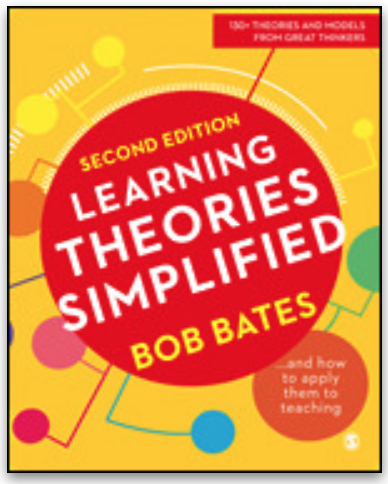
With tongue in cheek I make a serious proposal for a new book about Drama Learning and Teaching.  I am inspired to do so because I came across, a book by Bob Bates with an intriguing  title Learning theories simplified : and how to apply them to teaching (2019). In a couple of pages, he sketches succinct summaries of key theories and theorists of education. It’s a roller coaster ride through over 100 theories organised around Classical Learning Theories and Contemporary Thinking About Teaching and Learning. The reader switchbacks through Socrates, Plato (Shadows of reality), Descartes, Locke, Rousseau, Nietzsche, Dewey, Sartre, Freire and many more. Theories of Behaviourism, Cognitivism, Humanism, Neurolism and more rattle by. It’s not quite the comic book style, but it is a quick and useful reader with focused, point-by-point summaries for understanding and applying the array of approaches used in education. It explains and uses analogies to help understand concepts.It encourages critical engagement and  further reading. It’s worth a look.
My book proposal is to identify the key learning and teaching approaches for drama education.

Who are the people who have shaped drama teaching and learning?

What are the theories of drama education?

What is a theory in this context?

A theory is a systematic explanation of an approach; a set or principles; sometimes a justification.

Why are theories important?

If drama teaching is to be something more than collection of activities, tricks of the trade, games or schemes of work, it needs to be underpinned by a coherent explanation. That is not to make the case for the “theory of everything” – a single all encompassing master framework. We have come to realise that there are many ways of conceptualising and applying drama education as a field (As Hamlet reminded us: There are more things in heaven and earth, Horatio, Than are dreamt of in your philosophy.). When you think about it, the cross currents of approaches have shaped our contemporary practice.

It is however, important that we work in our drama workshops with an informed sense of context and history. We need to be something more than teacher technicians, following patterns set by others without thinking or understanding why we do what we do. What are the Big Ideas? Whose practice shifted conventional ways of doing things, set trends, gave us seminal concepts and even specific strategies? What are the dominant practices and their counterpoints?

Each drama teacher needs to articulate their philosophy or approach of drama teaching and how they understand their students learn drama. They need to acknowledge the influencers and forces that shape their day-to-day practice. They need to name and explain their drama teaching.

Why would this be a good idea?

There’s nothing like it that I have come across that provides a panoramic view of drama education.

But, there are some important cautions to this proposal.

  • Naming theories and knowing them for their own sake doesn’t help make us great drama teachers. Nor is putting some particular theorists on a pedestal (or consigning some of them to Dante’s Inferno) isn’t helpful. What we need is reflective, critical engagement with theories.

  • A theory exists in the context of practice – knowing and doing are hand-in-hand in the sort of embodied learning that we value in contemporary drama education. It makes little sense to treat theory and practice as mutually exclusive.

  • Theories and theorists are not set in stone (or reducible to slogans). We need to remember that people and their drama practice change and develop over time. We need to ovoid ossifying ideas and practice. We need to let theories breathe, grow, change, adapt and emerge.

Who is on my initial list of theorists and theories?

That opens a can of worms, when you ask that question.

But to start the conversation I suggest the following knowing that there will be some important ones missed. In no particular order:

Dorothy Heathcote. Brian Way, Winifred Ward, Viola Spolin, Cecily O’Neill, Richard Courtney, David Booth, Comenius, Harriet Findlay Johnson, Henry Caldwell Cook, Brecht, Stanislavski, Gavin Bolton, Jonathon Neelands, Juliana Saxton, Carole Tarlington, John O’Toole, Keith Johnstone, Pam Bowell, Patrice Baldwin, Brian Heap? Madonna Stinson? Peter Duffy, Peter Wright?

And what of the types of practice we should include:

Improvisation, Process Drama, Story Drama, Script Interpretation. Verbatim Theatre, Chamber Theatre…? What about Children’s Dramatic Play? Teacher-in-role? Mantle of the Expert?

But, where are the European voices? The Scandinavian leaders? The voices from North and South America? USA? Canada, Australia, New Zealand? Where are the voices from history? 

Is it even possible to assemble a starting list? 

We won’t know until we start.

There’s a heap of work to go on developing this proposal. But it would be an interesting challenge. 

Who would you nominate as seminal theorist/practitioners for drama education?

What theories, theorists and practices are important?

How much do we need to know about each?

Join me in this new adventure.

Bibliography

Bates, B. (2019). Learning theories simplified : ....and how to apply them to teaching (2nd Edition). London: Sage.
Music Monday - Thinking about friends and colleagues in Melbourne and Victoria

Of all aspects of my teaching and arts practice, vocal coaching is the one that gives me the greatest satisfaction – the biggest buzz. Over many years I think I have got better at it; mainly due to working with some outstanding singing teachers in my own training and also being lucky enough to work alongside a number of stellar speaking voice teachers in my tertiary teaching. There is nothing quite like the buzz of being part of a team putting on a show.

For the past weeks since being allowed to return onto campuses in Western Australia, I have relished being back in the rehearsal room for a performing arts high school production of Chicago. Our director was herself in the West End show for 5 years, so our lucky music theatre students are getting a genuine experience of Bob Fosse’s style as well as invaluable personal insights into Kander’s intentions. I have tried to replicate the precision of the Fosse choreography in the vocal calls and have been impressed by the performers’ willingness to engage in very detailed work on the music. These are specialist and highly motivated kids but some of their focus this time seems to come from our shared relief to be back in the rehearsal room.

And so this Monday, as Melbourne goes back to a stage 4 lockdown and regional Victoria faces stage 3 restrictions as well as mandatory mask wearing, I am musing on how easily our return to normal could backfire here in the West. 

In Australia we have been lucky that government responses to the pandemic have been based on expert medical advice, rather than politicised. However, in all communities across the world there exist minority groups of science deniers, conspiracy theorists and humans who believe that their own rights and immediate convenience surpasses the common good. Victoria was unlucky enough to cop a rise in Covid-19 cases as a result of selfishness or ignorance, but it could so easily be any other state of Australia. 

As our family, friends and colleagues in Victoria tough it out for the next 6 weeks for the greater good of the rest of Australia, please let arts teachers and practitioners across the country go to work with even greater resolve it order to make it all worth their while.

Victoria – we stand for you and with you.

Drama Tuesday - Looking beyond the Flood

Screen Shot 2020-07-28 at 11.29.45 AM.png

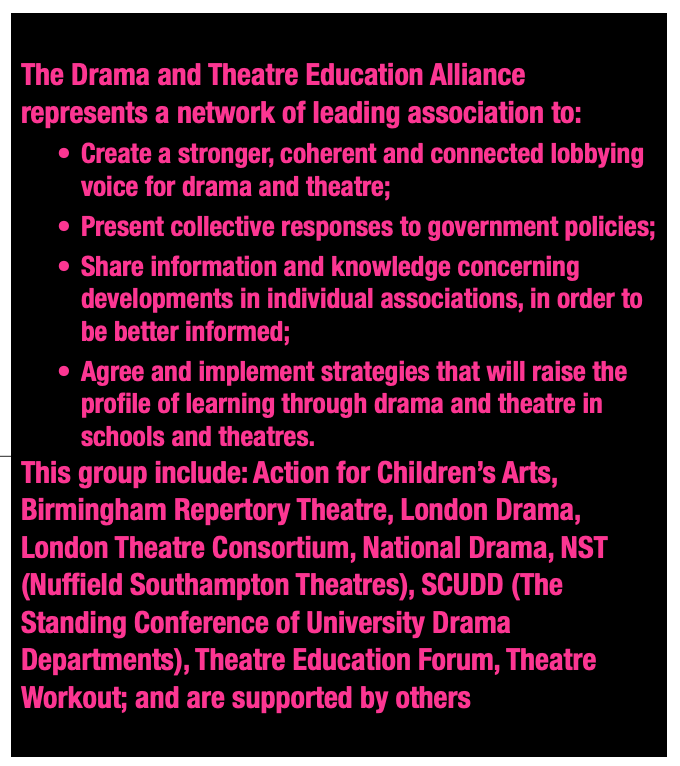
In the last week I have presented a keynote for the newly established Drama and Theatre Education Alliance  (https://dtealliance.wixsite.com/dtea) in the United Kingdom.

On July 15 the Alliance staged the Big Drama and Theatre Education Debate: Getting our act together. I have re-recorded my keynote and share it.

Looking beyond the Flood

Big Drama and Theatre Education Debate: Getting our act together

July 15 2020

Robin Pascoe,

President IDEA International Drama/Theatre and Education Association, Honorary Fellow, Murdoch University.

Thank you for the opportunity to talk with you today and warmest wishes from the wider IDEA community to all in Drama, Theatre and Education. 

I have lost track of the times we are told that we live in “an age of innovative disruption” (see, for example, Bower & Christensen, 1995). The Coronavirus COVID-19 Pandemic amplifies disruption in politics, technology, society, education in schools and universities. Our current moment of disruption presents both threats and opportunities. It also highlights fissures and divisions of the past. It calls for healing and looking beyond the flood.

You may have seen my recent post about the situation in Greece where the Ministry of Education announced the weekly program for upper secondary education for the new school year 2020-2021 and has eliminated the arts completely (http://www.stagepage.com.au/blog). There are threats in the ways that people are responding to the current Pandemic.

Each of us sees our realities through our autobiographies. In the world of drama and theatre education there are good news stories and sad news stories. In some places of the world, like Iceland and Taiwan, drama is embedded in the primary school. In Finland, despite a concerted long-term campaign by FIDEA, the Finnish association, drama has yet to be included in the curriculum. In my role in IDEA I see encouraging signs of remarkable growth in drama education happening in China and Turkey alongside contraction and denial elsewhere in the world. The promise of the Seoul Agenda on Arts Education (UNESCO, 2010), that was endorsed by all UNESCO members, has yet to be realised as an entitlement. The situation addressed in your Manifesto ("Drama, Theatre and Young People's Manifesto," 2020) highlights a local perspective with global implications.

It’s worth mentioning a little about the situation in Australia. 

Australia does have the Australian Curriculum: The Arts (ACARA, 2014). Drama Australia (https://dramaaustralia.org.au/0 ) has provided a unified voice for drama education. The National Advocates for Arts Education NAAE (https://naae.org.au) thrives as a network of peak national professional arts and arts education associations who represent arts educators across Australia. 

But … there’s always a but, isn’t there!

Implementation of the Australian Curriculum is, constitutionally, vested in the States and Territories. In my own state of Western Australia the decision has been made to “adopt and adapt” the national document. Similarly, other states have made local interpretations of the mandate. The scope of the promised entitlement is narrowed or changed. 

There is also the underlying question of implementation. Writing an Arts and Drama curriculum is one thing (Don’t forget this is not the first go we have had at doing this in Australia (2007; 1994)), successfully implementing that curriculum for every Australian student is a challenge.  As the evidence of two national reviews of arts education undertaken a relatively long time ago now (2008; 2005), what happens in schools may not reflect the written curriculum. Having the Australian Curriculum: The Arts published is only valuable when we can confidently say that all Australian students have a delivered arts curriculum that includes drama.

There is in Australia also evidence of contraction in drama teacher education across Australian universities that are reeling as they re-invent themselves in the current pandemic (though the writing has been on the wall of the rise of managerialist leadership and political interference (Hellyer & Jennings, May 28 2020). The decisions made in my own university to de-couple Arts and Drama and Education by locating them in different colleges is a sign of the times. The decision to double the cost of Arts degrees, made recently by the Australian Government (19 June 2020), further erodes the position of drama education.

Returning to an international perspective, it is useful to consider some of the possible reasons why as a drama education community we have reached this point. 

Why is drama education sometimes still considered extracurricular? 

Why is drama in schools sometimes considered suspect? 

Why isn’t our vision for drama and arts education widely shared?

Perhaps we need to look back at or collective histories and speculate. 

In the minds of many, drama education is aligned with “progressive education” (see, for example, Dewey, 1938 and many others).  The tenor of the times when drama education began to flourish it was alongside embodied commitment to greater informality in classrooms and relationships between teachers and students; broader curriculum; practical activities; flexibility of teaching procedures; diversity; focus on individual child and a balance of academic and social and emotional learning. There was also strong commitment to critical and socially-engaged teaching and learning. These notions challenge a politicised educational climate

The opposition to including drama in the school curriculum entitlement is often based on assumptions and prejudices and even misconceptions.  It is always useful to identify some of the misconceptions about our field and to question the fear and loathing that drives some political curriculum choices. 

Eggen and Kauchak (2013) observe, “misconceptions are constructed; they’re constructed because they make sense to the people who construct them; and they are often consistent with people’s prior knowledge or experiences” (p. 195).  Pointing out a misconception, simply labelling it as “wrong” or “flawed thinking”, is of limited use. People who change their thinking and practice need: 

  • viable, alternative experiences that disrupt their mis-conceptualised understandings

  • to see how that changed understanding is useful in the real world

  • to see how applying their revised thinking to new situation actually produces desired results

  • to have their revised world view valued and endorsed by peers and the school community

  • to see that students are learning differently, with higher levels of approval and satisfaction and with better outcomes or results

  • to see that parents and the community support what is different.

How are we, as a community of practice, challenging misconceptions?


I remind us all that our greatest asset is our art form as a change agent. With that in mind I invite you to imagine an unfolding process drama from a new pre-text Littlelight by Kelly Canby (2020). 

In the grey old town of Littlelight, a “big beautiful wall” surrounded the town. The wall was thick and all encompassing and the Mayor was strong .But one day a brick was missing in the wall. And no one noticed at first, but little by little, brick by brick, gaps appeared in the wall. And there were streaks of neon light fingering their way into the town. Who could be stealthily breaching the wall? 

What happens when the walls that are built are breached?

You can continue the metaphors of this process drama in your imaginations. 

Imagine how powerful our process drama could be in bringing about change.

What we need is to navigate our way through these disruptive times keeping our drama compass tracking true.

I began by invoking an image of the Flood. and return to it conclude.

Jackson Browne sang in Before the Deluge (1995) of a world of dreamers and fools “in the troubled years that came before the deluge”. But he also sang of a time beyond the flood:

Let the music keep our spirits high

Let the buildings keep our children dry

Let creation reveal its secrets by and by, by and by

When the light that's lost within us reaches the sky

We need to keep our eyes beyond the horizon, beyond the flood.

Thank you. 

Bibliography

ACARA. (2014). The Australian Curriculum: The Arts. Retrieved from http://www.australiancurriculum.edu.au/the-arts/introduction

Bower, J. L., & Christensen, C. M. (1995). Disruptive Technologies: Catching the Wave. Harvard Business Review, 73(1 (January–February)), 43–53. 

Browne, J. (1995). Before the Deluge (Lyrics). Retrieved from https://www.lyrics.com/lyric/2846364/Jackson+Browne

Canby, K. (2020). Littlelight. Fremantle, Western Australia: Fremantle Press.

Cultural Ministers Council (CMC), & Ministerial Council on Education Employment and Youth Affairs (MCEETYA). (2007). National Statement on Education and the Arts. Retrieved from http://www.cmc.gov.au/__data/assets/pdf_file/7366/National_Education_and_the_Arts_Statement_-_September_2007.pdf

Dewey, J. (1938). Experience & Education. New York, NY: Kappa Delta Pi.

Diana Davis, & Australia Council for the Arts. (2008). First We See: The National Review of Visual Education. Retrieved from http://www.australiacouncil.gov.au/research/education_and_the_arts/reports_and_publications/first_we_see_the_national_review_of_visual_education

Drama, Theatre and Young People's Manifesto. (2020). Retrieved from https://dtealliance.wixsite.com/dtea/manifesto

Eggen, P., & Kauchak, D. (2013). Educational Psychology: Windows on Classrooms, Ninth Edition. Boston: Pearson.

Emery, L., & Hammond, G. (1994). A Statement on the arts for Australian Schools. Melbourne: Curriculum Corporation (Australia)/Australian Education Council.

Hellyer, M., & Jennings, P. (May 28 2020). Our universities must rethink their broken business model or risk failure. Canberra Times. Retrieved from https://www.canberratimes.com.au/story/6771137/our-universities-must-rethink-their-broken-business-model-or-risk-failure/

Karp, P. (19 June 2020). Australian university fees to double for some arts courses, but fall for Stem subjects. Retrieved from https://www.theguardian.com/australia-news/2020/jun/19/australian-university-fees-arts-stem-science-maths-nursing-teaching-humanities

Pascoe, R., Leong, S., MacCallum, J., MacKinley, E., Marsh, K., Smith, B., . . . Winterton, A. (2005). Augmenting the Diminished: National Review of School Music Education. Retrieved from Canberra: 

UNESCO. (2010). Seoul Agenda: Goals for the Development of Arts Education. Retrieved from http://portal.unesco.org/culture/en/ev.php-URL_ID=41117&URL_DO=DO_TOPIC&URL_SECTION=201.html

Drama Tuesday - We learn drama by making drama – a Process Drama example 

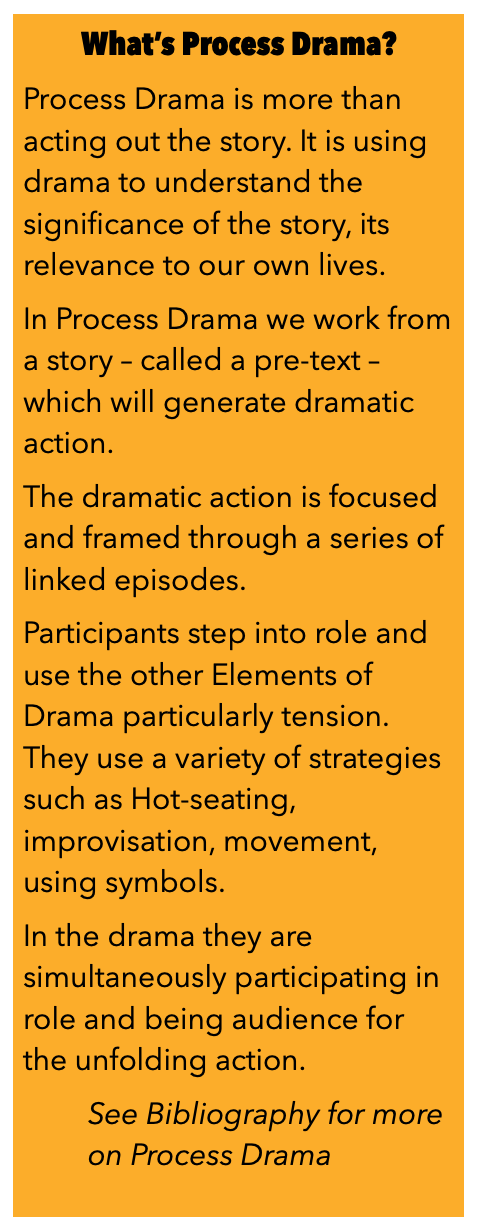
We learn Drama by making Drama. By using the Elements of Drama such as role, situation, voice, movement and tension, we learn how drama tells stories in our bodies.

In this short video I share with you some drama making from a workshop I ran in Baoding, China, in November 2019. 

Screen Shot 2020-07-21 at 9.07.23 AM.png

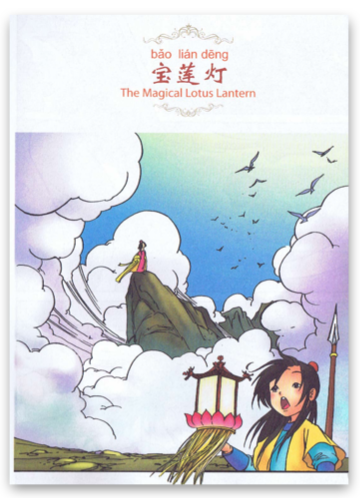
We used drama to bring to life the story of the Magic Lotus Lantern, a traditional story. We used drama strategies to build a series of dramatic action episodes exploring key moments in the story. This is a Process Drama.

In the traditional story of the Magic Lotus Lantern, on  the  Huashan Mountain there lived a guardian, the beautiful goddess Sanshenmu who had a brother Erlang who wanted to control his sister. 

We visualised the scene on the mountain. We created the mountain in the drama space using lengths of coloured fabric and sounds using our voices and recordings.

Screen Shot 2020-07-21 at 9.07.39 AM.png

Our Process Drama explored the relationship between brother and sister in role and out of role. We edged into the drama using physical activities of gatekeepers. We improvised scenes between siblings in everyday life.

We moved back into the story narrating how Sanshenmu had a magical treasure – a lotus lantern whose light could scare away all evil. We embodied using symbol as a fundamental building block of drama.

In the story, one winter, a scholar Liu Yanchang, a human, visited the temple and saw the image of Shenmu and was struck by her beauty. He thought that she was so beautiful he would ask her to be my wife. Shenmu was also struck by the authentic love of the young scholar. But she knew that it a deity like her could never fall in love with a mortal. Liu Yanchang left Shenmu not knowing she was pregnant.

Skipping ahead in this account, Erlang angered by this love story, stole the Magic Lotus Lantern and banished Shenmu to live inside a dark cave buried under a mountain. There she gave birth to a child.

We created the dark cave and the birth of the child. 

Liu Yanchang returned after his success in the examinations but when he came to the Shenmudian temple he found it deserted. Just as he turned to leave, he heard a baby crying.

He was puzzled at finding a baby in the temple. Bu t then he found Shenmu’s letter written on the silk and knew that the baby was Chenxiang. He took the child and raised it, teaching him to read and write as any mortal would. But he kept the secret of Shenmu from Chenxiang. 

However, one day, the boy discovered the silk letter. He went searching for his mother.

The child grew and fought his uncle Erlang and won the Magic Lotus Lantern an d used it to break open the mountain and rescue his mother. 

I will let the drama speak for itself.

We learn drama by making drama.

Acknowledgment: The workshop was run for Cambridge Education, Baoding with Early Childhood educators and organised by IDEC, Berijing. 

Bibliography

The following resources unpack Process Drama

Bowell, P., & Heap, B. S. (2013). Planning Process Drama: Enriching teaching and learning (2nd Edition). Abingdon, Oxon.: Routledge.

Bowell, P., & Heap, B. S. (2017). Putting Process Drama into Action: The Dynamics of Practice. Abingdon, Oxon.: Routledge.

O'Neill, C. (1995). Drama Worlds A Framework for Process Drama. Portsmouth: Heinemann.

O'Toole, J. (1992). The Process of Drama: Negotiating Art and Meaning. London: Routledge.

Taylor, P. (Ed.) (1995). Pre-Text and StoryDrama: The Artistry of Cecily O'Neill and David Booth. Brisbane: NADIE The National Association for Drama in Education.

Music Monday - Rhythm and Rhyme – working creatively with young children.

Both rhyme and rhythm are patterns in sound – in spoken sound as well as sung sound.

The wonderful work done by biggerbetterbrains.com highlights the importance of these skills in early language development. I have written about this in previous Music Monday posts and it continues to fascinate me, especially now that we have a pre-schooler grandson in our lives.

Yesterday (almost) 4 year-old William came to our house for the day. As usual he was excited about what activities we had planned for his visit. The hot favourites always include cooking, picking up the dog’s poop (yes, really) and music. The last always includes a very short period of hand positions on the piano, and a longer time singing songs, accompanied by me with William playing random notes in rhythm at the top end of the keyboard. Yesterday his attention was caught by the rhyming patterns in one particular song and I wondered whether we could play further with this idea, especially after he volunteered, “The rhymes are words that sound the same, aren’t they?”

We got out William’s scrap book and started writing down rhyming words. Of course, ‘poop’ featured – loads of good rhyming words with that one! 

Next we made up short phrases, each one ending with one of our rhyming words. After 8 phrases and 4 pairs of rhymes, we tried clapping each phrase. One of William’s made-up phrases started with an upbeat so we talked about that, and although he didn’t really understand the concept, he was able to clap it with the stress on the first beat of the bar. 

We then played a game where I clapped the phrases out of sequence and William guessed which phrase I was clapping – mostly accurately. We talked briefly about the words being the rhythm – that time-honoured concept of primary music teachers. 

Finally we invented a tune for his song. William was inclined to stick to a monotone and focus on the rhythmic patterns, but I guided and coaxed him towards a simple tune contained within the doh-soh range.

All up this song-writing activity took about 30 minutes.

Later, when his parents arrived for dinner, he was keen to share his song. As before, he clearly enjoyed stressing the strong beats, clapping and singing enthusiastically. He felt ownership of both the process and end product.

So much of what we do in music classes tends towards recreating. Sometimes it is fun – and beneficial – to be creative instead.


Drama Tuesday - What will I teach today?

It’s the question we face as teachers every day of our working lives?

What will I teach today?

Wouldn’t it be nice if there was a convenient text book to open and say to students,  Look at page 53 and do what it says there.

Unlike many other school subjects, drama does not seem to have a simple answer or a single set of textbooks or set syllabus.

Many Curriculum frameworks and syllabuses are written in open-ended ways. We need to join the dots or fill in the missing gaps.

  • What are the choices and decisions that drama teachers need to make in their day to day planning?

  • How do know what to teach in drama? When to teach specific concepts and skills and processes?

  • How do I teach so students learn in ways that match or suit their age and stage of development?

To answer these questions we need to build a map in our head about how students learn drama at different ages and stages.

Teaching drama can’t just be a jigsaw of randomly chosen activities or a haphazard collection of things that work. They have to lead students somewhere. The word educate comes from the Latin deuce I lead forward.

We must have a curriculum compass that guides us forward in the learning of our drama students. One of the principles must be that we teach drama in ways that acknowledge and understand the ways youngsters learn at different ages. We need to teach with a sense of an underlying progression in learning. 

The term learning progression refers to the purposeful sequencing of teaching and learning expectations across multiple developmental stages, ages, or grade levels. They provide concise, clearly articulated descriptions of what students should know and be able to do at a specific stage of their education.

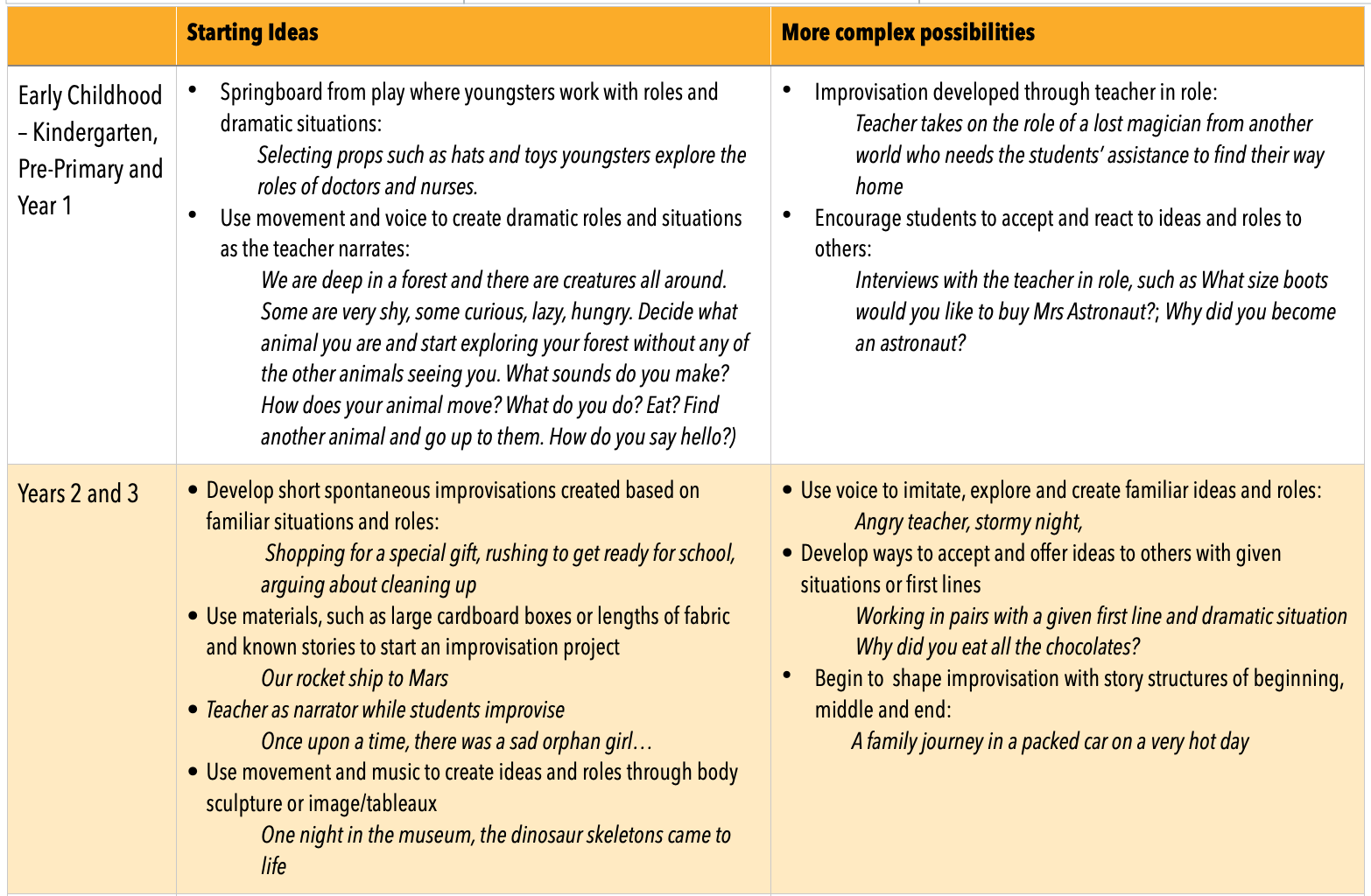
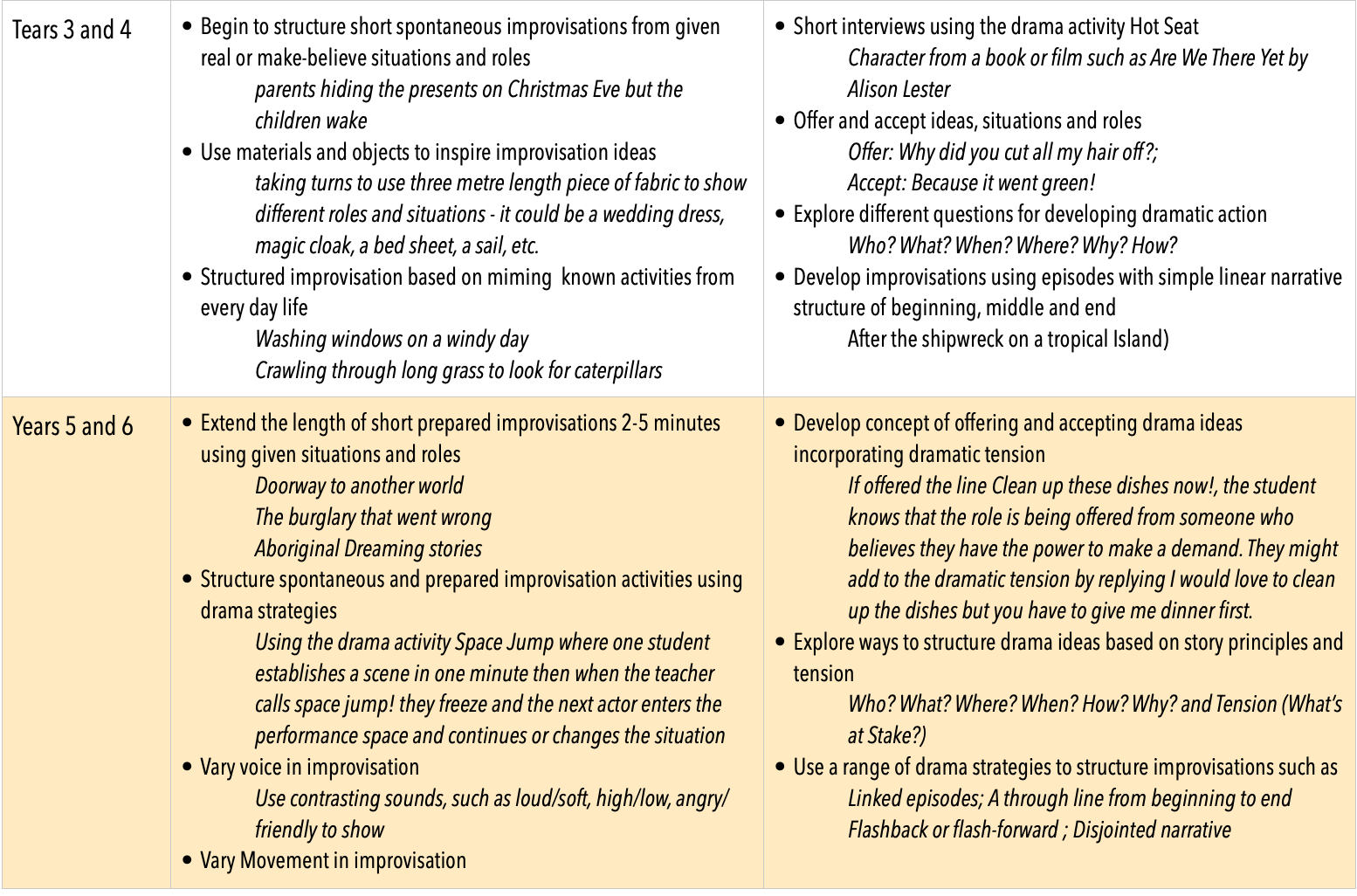
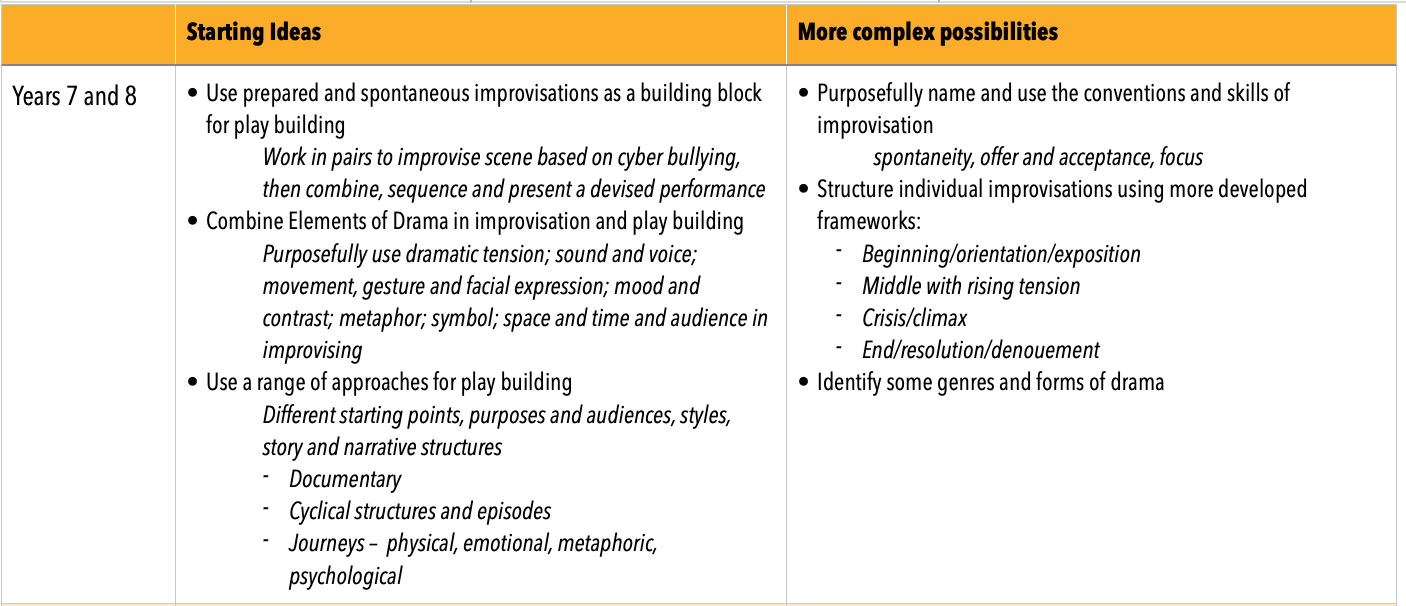
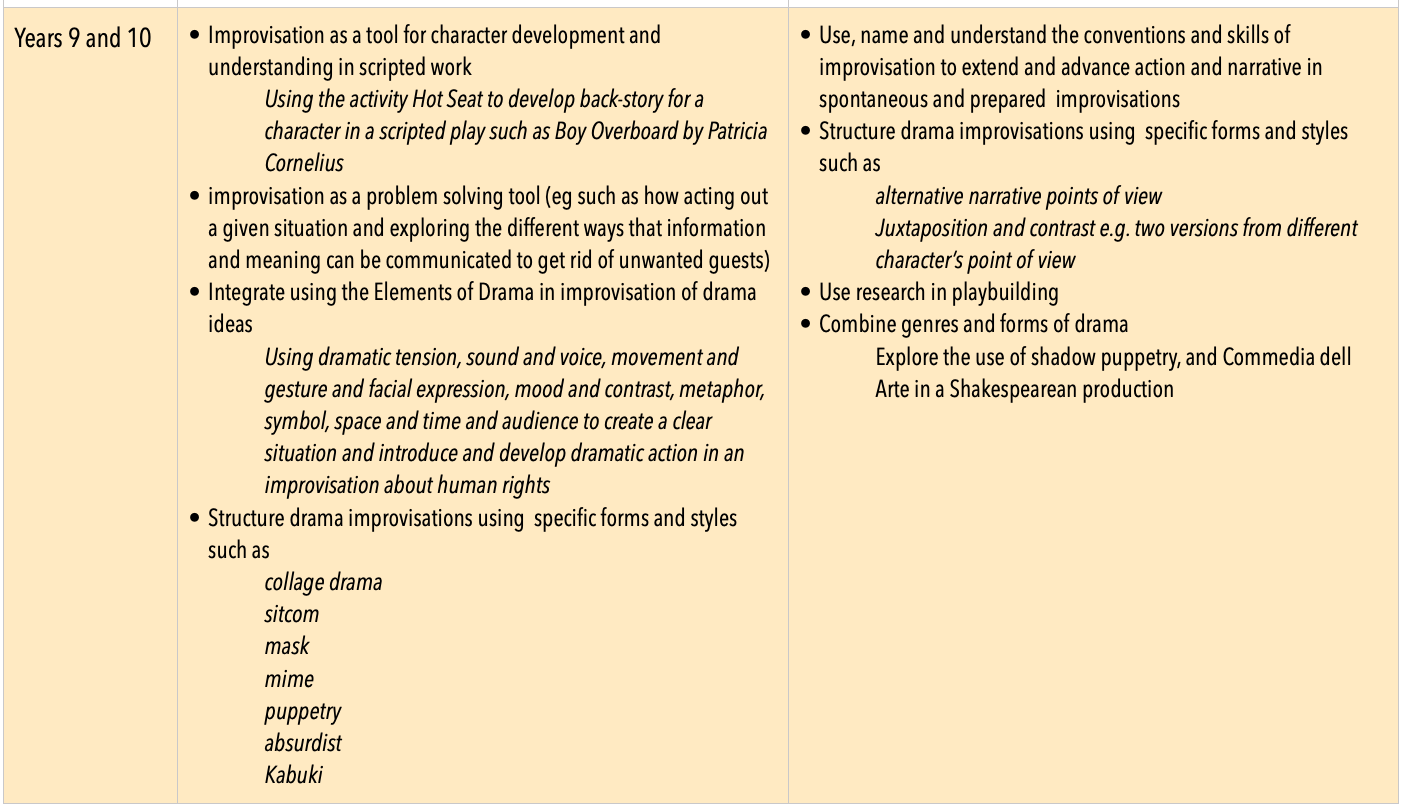
Consider the simple yet complex notion of improvising which is the backbone of many drama teaching programs. what is or expectation  of improvisation in children who are three and four? How do we shape learning experiences as they are five or ten or fourteen. We don’t expect 5 year olds to master the concepts of Algebra that they can learn in Year 12. But they do have things to learn in Year 1 so that they can learn in Year 12. There is a chain of connection across the learning years.

This is William, our grandson, in free play. This shows the seeds of improvisation that we develop through drama programs.

Where do we go next? How do we build learning upon learning?

What are aged and developmentally appropriate drama activities towards a growing learning about improvisation?

It is useful to visit again some of the learning progressions that have been developed as curriculum. 

 It might seem obvious, but nonetheless important, to observe that as children grow, their capacity to understand and apply concepts develop and our planning should reflect the patterns of child development.

The following example of a progression is based on some of my earlier research.

Screen Shot 2020-07-07 at 8.52.00 AM.png
Screen Shot 2020-07-07 at 8.52.10 AM.png
Screen Shot 2020-07-07 at 8.52.31 AM.png
Screen Shot 2020-07-07 at 8.52.39 AM.png

The Holy Grail of Drama Curriculum writers is to write workable progressions for development of drama across school years. It is notoriously difficult to write these progressions with ironclad certainty. They are at best useful approximations to guide. They are based on observation of young people learning drama and teacher experiences. But they are better than random guesses. 

A final thought:

I have had a conversation once with a teacher who said – for efficiency – that she teaches the same lesson to all the different years across the school. One size fits all. 

Can you spot the flaw in that approach?

What is the map that guides your choices as a drama teacher?

Drama Tuesday - Responding to existential threats to arts education

What is happening to the world of Arts Education internationally?

In my role as Chair of the World Alliance for Arts Education, I received the following message in an email from Greece:

Two days ago the Ministry of Education announced the weekly program for upper secondary education for the new school year 2020-2021 and they have eliminated the arts completely !!!

The arts, namely music, theater and visual arts, were among the elective subjects for pupils in their last three years of high school. In addition pupils had the opportunity to participate in interdisciplinary projects that usually included an art form and gave the opportunity to arts' specialists to collaborate with other specialists. Now everything has disappeared! There are no elective subjects. There are no arts in any form or in any way taught in upper secondary education. There are no projects any more. All of those hours have been re-allocated to other more highly valued subjects. (17 June 2020)

If this was happening in just one country we might be alarmed but just shrug our shoulders. But similar situations are being experienced in other parts of the world. In Australian Universities, the Federal Minister for Education, Dan Tehan announced changes that will favour maths, teaching and nursing units over humanities, commerce and law (Karp, 19 June 2020). 

How do we as an arts community respond to these threats to our work?

I share the Open Letter from the WAAE 

Screen Shot 2020-07-07 at 8.41.46 AM.png

International Drama/Theatre and Education Association (IDEA)

International Society for Education through Art (InSEA)

International Society for Music Education (ISME)

World Dance Alliance (WDA)

Advocating for arts education worldwide – https://www.waae.online 

June 25 2020

An Open Letter from the World Alliance for Arts Education WAAE representing International Arts Education Professional Associations to:

Niki Kerameus, Minister of Education and Religious Affairs, info@nikikerameus.gr 

Sofia Zaharaki, Vice-Minister, Primary and Secondary Education, szacharaki@minedu.gov.gr 

Anastasia Gika, General Secretary for Primary and Secondary Education, sgika@minedu.gov.gr

I write to add the voice of the World Alliance for Arts Education WAAE to the many students and teachers of the Arts (Music, Dance, Theatre and Visual Arts) requesting the reversal of the decision by the Ministry of Education that announced the elimination of the Arts in the weekly program for upper secondary education for the new school year 2020-2021. The WAAE supports those who protest about the removal of elective programs in the Arts for pupils in their last three years of high school. This retrograde decision impacts on the lives of many and on the future of Arts Education in Greece.

The World Alliance for Arts Education WAAE is honoured to add our voices to the Departments of Theatre, Dance, Music and Visual Arts and professional organisations that represent specialist teachers from Greece, that are writing letters and petitions of protest. The Alliance highlights the negative impacts of this directive on students, teachers and ultimately the whole country.

Robust international research on the purpose, value and importance of arts education is rich and deep. The WAAE urges you to read and heed the research. Learning in, through and with the Arts shapes personal, social and cultural identity and is an entitlement for all students (see The UNESCO Seoul Agenda For Arts Education (2010) and the Frankfurt Declaration for Arts Education https://www.insea.org/docs/waae/WAAE-Frankfurt-declaration.pdf). 

The Arts contribute to the development of values, personal and interpersonal development. Learning in the Arts fosters creativity, innovation and persistence. In these times of crisis, the Arts play a significant role in mental and emotional health and wellbeing, as the current Coronavirus COVID-19 Pandemic is showing us all. The losses to individual students and teachers are devastating. They amplify the loss to the Greek education system as a whole from this decision. 

Please reconsider and rescind this directive.

The letter was signed by the members of the WAAE Executive Committee.

What is happening with Arts and Drama Education in your parts of the world?

What actions can you take at a local level when you see or hear of threats to arts education?

Why is a healthy arts education in schools and community valuable and necessary?

Why should we take action when we see an issue with arts education?

You will remember the famous quotation from Martin Niemöller (1892–1984)

First they came for the socialists, and I did not speak out—because I was not a socialist.

Then they came for the trade unionists, and I did not speak out— because I was not a trade unionist.

Then they came for the Jews, and I did not speak out—because I was not a Jew.

Then they came for me—and there was no one left to speak for me.

Bibliography

Karp, P. (19 June 2020). Australian university fees to double for some arts courses, but fall for Stem subjects. Retrieved from https://www.theguardian.com/australia-news/2020/jun/19/australian-university-fees-arts-stem-science-maths-nursing-teaching-humanities

Martin Niemöller (1892–1984). Retrieved from https://encyclopedia.ushmm.org/content/en/article/martin-niemoeller-first-they-came-for-the-socialists

Music Monday - The 25th Annual Putnam County Spelling Bee on zoom.

On Saturday evening I drove into WAAPA at Edith Cowan University to see a production on zoom of the musical Spelling Bee, performed by Diploma of Music Theatre students under the direction of creatives Nicole Stinton (director and co-ordinator of the Diploma course), Tim How (musical director) and Jayne Smeulders (choreography). 

 I was curious to see this production. Very unusually, the audience were to gather in a lecture theatre on campus while the performers remained at home, ready to perform live over zoom. Across Perth, cast members farewelled their parents and families as the latter prepared to drive to WAAPA, and then the performers themselves settled in front of their laptops at home, ready to perform. Strange times indeed.

I confess that I was hoping that this might be the last zoom performance I would watch for the foreseeable future. Over the past few weeks I have seen several plays on this platform and although each had its merits, it was always hard to ignore the unfavourable comparison with a live performance. Spelling Bee would certainly be different in the sense that the performance was to be largely live – with some pre-recorded backup vocals and a couple of film sequences.

In the lecture theatre the atmosphere was that of excited curiosity – how was this going to work?

We were instructed to feel comfortable applauding after songs -although the performers at home wouldn’t hear us, the creative team had allowed for applause breaks.

And so the show started. 

It was certainly more comfortable to watch on a large screen rather than home laptop. That was my first observation.

The premise for this production was ‘that due to Covid 19, the annual spelling bee had been forced online. The rules would be the same as usual, with one additional rule being that spellers must have both hands visible on screen as they spelled.’

In this production the four audience members in the original script became additional characters – the exchange student from Australia who had become stranded in the USA due to the pandemic, one of the speller’s Dads, and so on.

Solo songs were performed to backing tracks played in the singer’s own space. Back-up vocals had been pre-recorded. 

The rehearsal process had clearly taken care and time with playing to the camera and to finding visual and aural clarity in dialogue between characters. There was a strong and vibrant energy in this performance -and a clear sense of ownership of and commitment to the production. There was some vocal pushing (perhaps because it was the final show) but there were also many memorable moments – one was the Dan Schwartz character who spent the performance cooking in his own kitchen, while manning the bell in the spelling bee.  A convincing variation on how it is usually played. An unscripted (I think) but hilarious moment was when the family pet dog started barking. Even on the zoom platform, live performance throws up the unexpected!

At the end of the show the audience were clearly delighted with what they had experienced.  I enjoyed every moment.

I spoke with Nicole Stinton afterwards and confirmed that she had chosen the musical before Covid 19 struck. It is hard to imagine a musical better suited to an online production.

I imagine that there will be many post-grad dissertations in the coming years about performing online during a pandemic. This production and its creatives would certainly have much of value to lend to the conversation.

Bravo to all.


Questions about inclusion for Drama Teachers in contemporary times

A teacher found a beautiful and compassionate monologue based play written and performed by an aboriginal woman . It provided interesting acting challenges for her students. They had to make strong physical, vocal and movement choices. They had to use their dramaturgy skills to contextualise their choices to embody the role. It was accessible and relevant. She presented it to them to workshop acting, dramaturge and director roles. 

The 12 girls in her class responded well to the challenge. She didn’t notice the looks exchanged between the 5 boys in her class.

As a reflective teacher, she was interested to read her student journals.

Some students questioned using a text that provided acting roles only for a single female character. Other students discussed the appropriateness of asking non-aboriginal actors to play an aboriginal character. Her one indigenous student who comes from a Western Australian Noongar identity, asked about playing a role based on Murri life.

The teacher began to question her assumptions. The text was theatrically compelling and offered challenges for her students. But she also realised that her focus on theatrically strong moments for her students maybe problematic.

The question of appropriation of culture is interesting, particularly in the week when it’s announced that on The Simpsons, characters of colour will no longer be voiced by white actors ("The Simpsons stops using white actors to voice non-white characters," 27 June 2020). Is it appropriate for non-aboriginal actors to portray indigenous roles? As drama educators we have come a long way from Laurence Olivier playing Othello in blackface (1965, check it out on the Internet). 

It’s interesting if you think about it. If we extended the logic, could any Australian actor ever portray an Irish character or a character from Ibsen or Chekhov or Shaw where the roles are so deeply imbued with a national identity? It may be inappropriate for a caucasian actor to reach into the makeup kit to portray an Asian or Indian character but where is the line to be drawn?

We could ask questions of other plays that, for example, portray abuse of women. What are the implications of studying A Streetcar Named Desire (Williams, 1947) and the portrayal of Blanche and mental breakdown? And Stanley’s treatment of her?

If you extend this line of argument, are there any plays but the most innocuous that can be studied by drama students? There are some who would argue that school drama needs to be neutralised. The spirit of Thomas Bowdler lives on in contemporary times. ( Bowdler gives us the term bowdlerise which means to remove material that is considered improper or offensive from (a text or account), especially with the result that the text becomes weaker or less effective.) And many teachers tell of choices of self-censorship when it comes to choosing texts for students to work with. 

What are your thoughts?

Where do you draw the line in the sand in the choices you make as drama teachers?

What are appropriate texts(see interesting discussion in Lambert, Wright, Currie, & Pascoe, 2016)?

Bibliography

Enoch, W., & Mailman, D. (1996). THE 7 STAGES OF GRIEVING. Brisbane: Playlab Press.

Lambert, K., Wright, P. R., Currie, J., & Pascoe, R. (2016). Performativity and creativity in senior secondary drama classrooms. NJ Drama Australia Journal, 40(1), 15-26. 

The Simpsons stops using white actors to voice non-white characters. (27 June 2020). Retrieved from https://www.theguardian.com/tv-and-radio/2020/jun/27/the-simpsons-stops-using-white-actors-to-voice-non-white-characters

Williams, T. (1947). A Streetcar Named Desire: [a Play.]. New York, NY: New American Library.

Music Monday - Embodied Singing

This is the final week of what has been a long and challenging semester in high schools across Australia and the whole world. In my own little world of a performing arts high school in Perth, I have a tradition in the final week of allowing the younger music theatre specialist students to sing an ‘own choice song’ of any genre, purely for the fun of singing -  the only provision being that the text is suitable for a school environment. I work at the school on Mondays and Fridays so today was the first of these ‘own choice song’ days for this year.

Predictably, today the year 10 girls chose music theatre songs from current favourite shows – think Wicked, Frozen, Beetle Juice, Bring It On.  And the year 8 boys, after asking, “Miss, is it okay to do a rap song if we don’t sing the rude words?”, sang lustily, with a nudge and wink at each other at all the (silent) offensive moments. 

What was clear in all the fun song performances today was that every student was relaxed. There was no sense of assessment or preparing a song that would at some point become an assessment task. Their bodies were relaxed and when they inhaled it was with relaxed abdominal muscles. There was a bit of bopping around to the backing tracks and a much greater unconscious grounding of their lower bodies. These are all qualities that as a singing teacher, I strive for every day. All the singing today was embodied.

Greater embodiment is something we often observe in a masterclass when a singer, after instruction from the master teacher, sings very much better on the second attempt. This can be due to valuable help from the master teacher -  but can also be in part, a more relaxed performance after settling into a performance situation.

At my other workplace – a music theatre department at tertiary level – we have a series of ‘audition performance practices’. Lately these have of course been online, but when we are all in the space together, students so often fare much better in the singing task set at the ‘call back’ than in their actual performance. It seems that getting an endorsement of their initial performance in the form of a call-back allows them to relax into their bodies for the ‘call back’.

What does this all mean for us as teachers of singing? 

I think we need to take every opportunity to learn from the expertise of psychologists working in the field of performance. And we need to constantly search for the warm-up strategies which help students unlock their own bodies. In performance, we need to encourage students to embrace the character and story and lose themselves and their complete focus on technique.

As always, I invite and thank you for your comments.