
Drama Tuesday - Actors, theatre and superstition

Hooking drama students

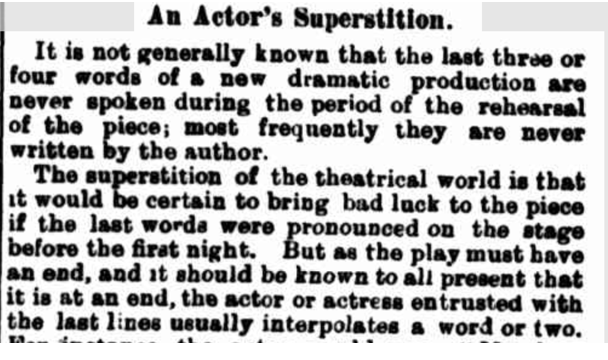
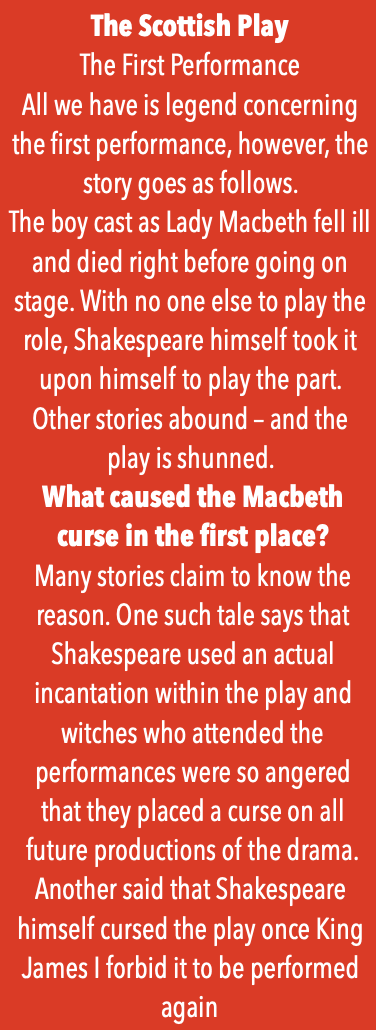
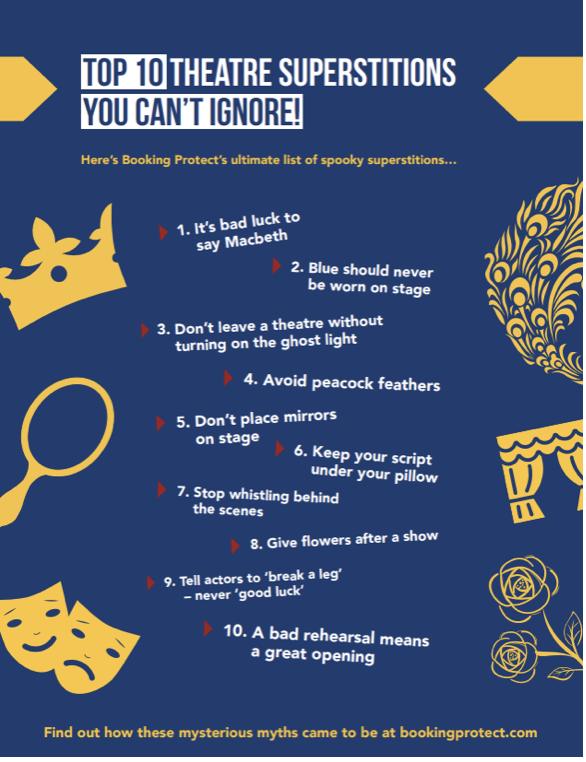
Drama teachers often pepper their lessons with little gems plucked from theatre history. They can be fun and can sometimes be what are the take aways from the lesson for drama students. As an art form that conjures a kind of magic through make belief, it is not surprising that theatre has many intriguing superstitions and stories. Perhaps this accounts for some of the suspicion awarded to actors and theatre.

There are many other nuggets of information for drama teachers.

For example, St. Genesius, is known as the patron saint of actors. In the third century, during the reign of the Roman Emperor Diocletian, he is said to have worked as an actor in a number of plays. In order to get the Emperor’s approval, he played a role in which he satirised a Christian who was going to be baptised. In the middle of his presentation, Genesius was struck by the reality of what he was saying and was converted to Christianity on the spot, right there on the spot.

When he refused, he was put to death almost quickly after. 

It’s always worth checking  your community and attitudes to these small gobbets of  theatre history.
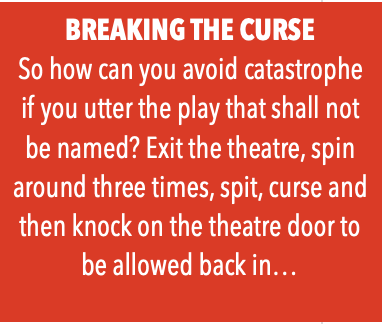
Or as the saying goes: break a leg!

Drama Tuesday - It pays to check what you’re about to throw out

 Building Characters from Scripted Drama Text

Aligning drama activities to Curriculum Documents

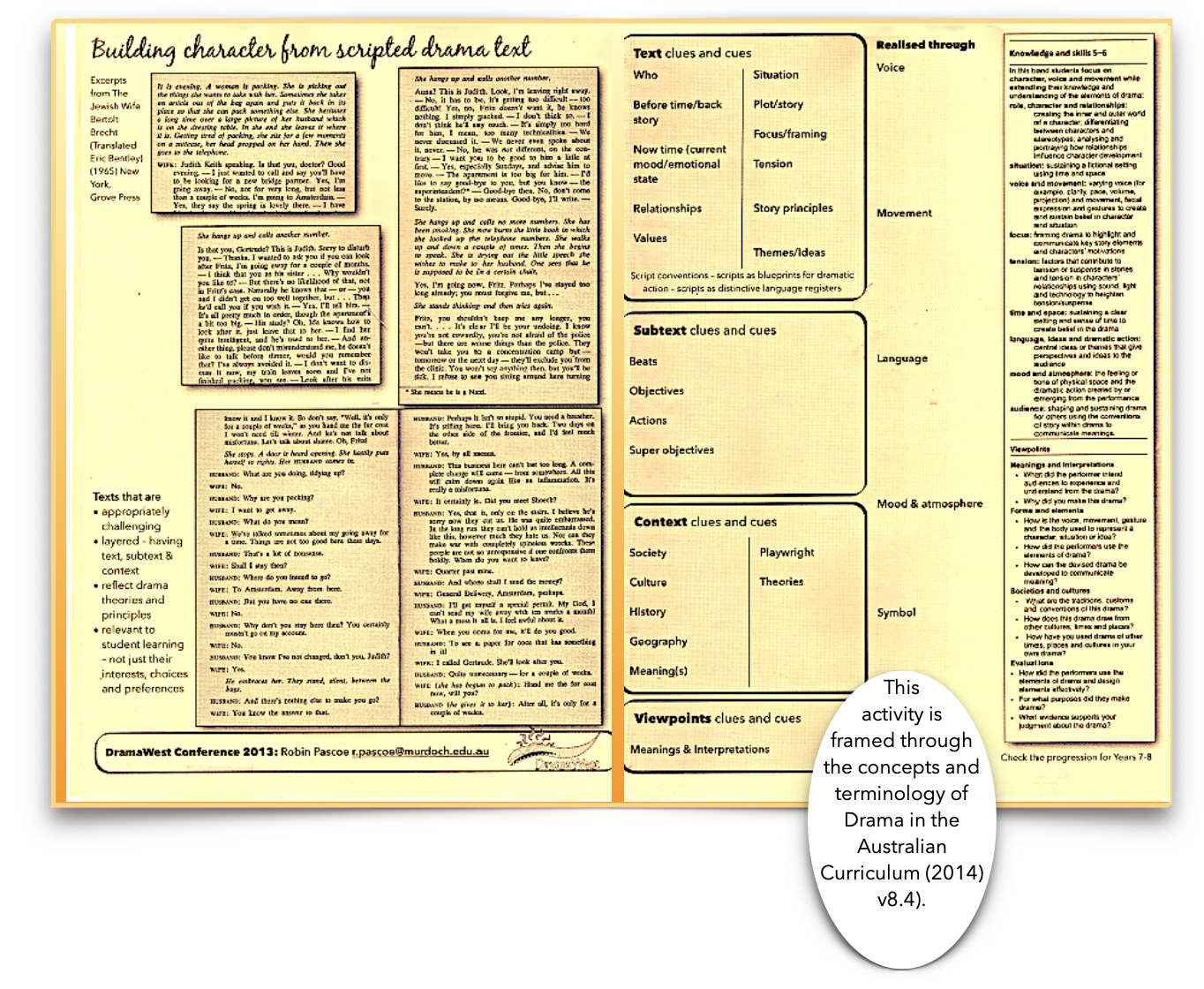
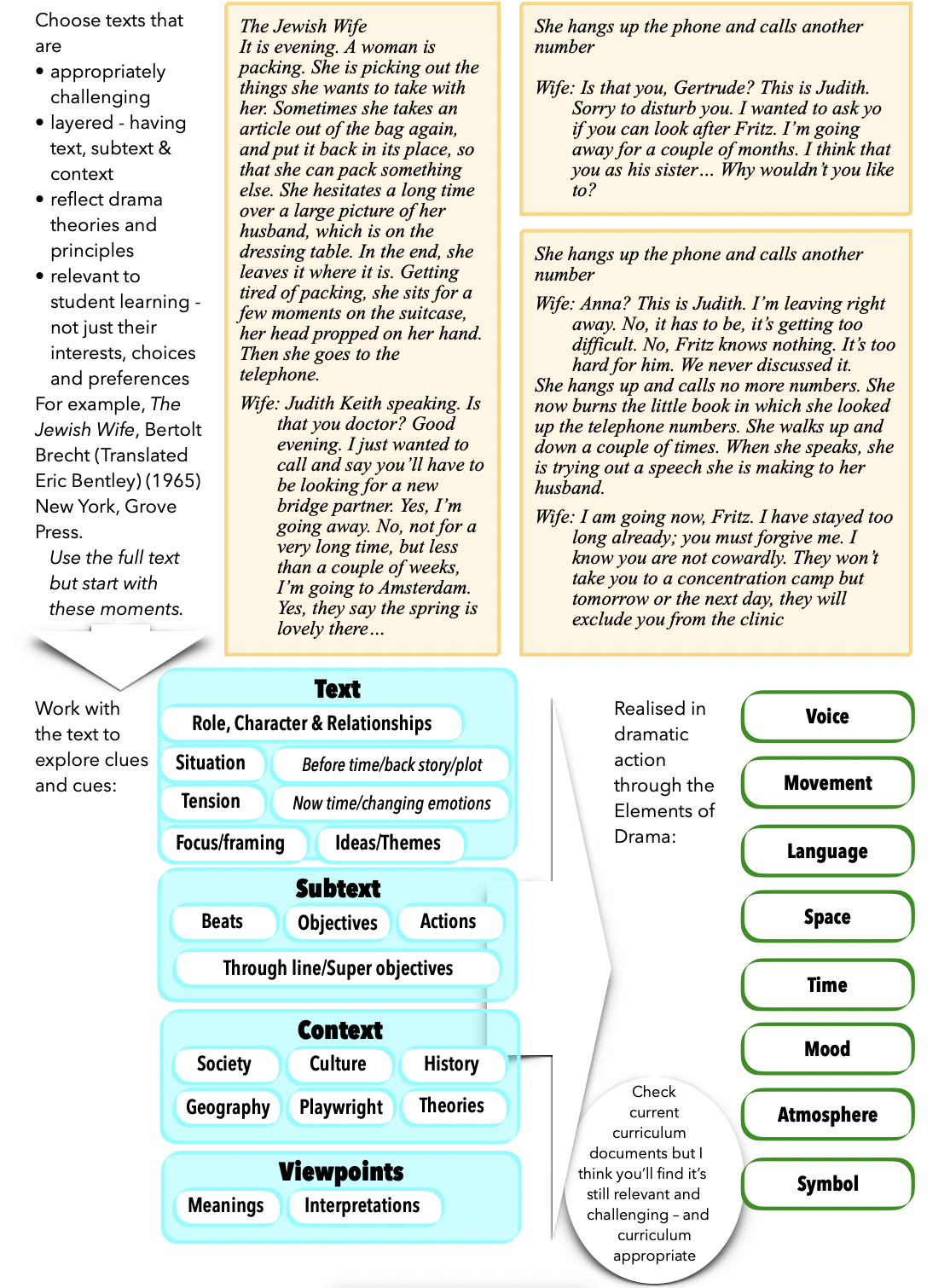
For the 2013 DramaWest Conference I developed a workshop designed to link a relevant and recognisable drama activity with Drama in the Australian Curriculum: The Arts (2014) At one level, the activity reaffirmed familiar practice – something that we have been doing often and successfully. 

In that workshop I had a slide that asked participants to identify: What changes and what stays the same?.

There was a clear subtext to the workshop: the curriculum reflects good practice. It may clarify some terms that we use but essentially, it is built on good drama teaching and learning, but draws connection between task and curriculum terminology.

The other theme is the importance of aligning what we do with a clear sense of progression in learning drama.

Rather than being a hit or miss collection of drama activities (or drama like activities), there is a need to connect what we do in classes day to day with a sense of students being on a learning journey with clearly stated destinations underpinned by having clear road markers at specific key points or stages. 

The sub-text to that concept was the need to provide students with drama activities and texts or material that are age and developmentally appropriate. And to challenge the dumbing down of drama opportunities offered to students (I am thinking about the endless offerings of Fractured Fairytale style scripts and improvisation starters that encourage “going for the gag”). We need to offer our drama students texts of challenge and substance.

This is the workshop handout that I shared. The details of the outline continue to be relevant (even though in the 2022 version of the Australian Curriculum: The Arts some of the organisational details and emphases may have changed.

Drama Tuesday - Knowledge and Learning (Part 2)

How do you know what you know about drama?

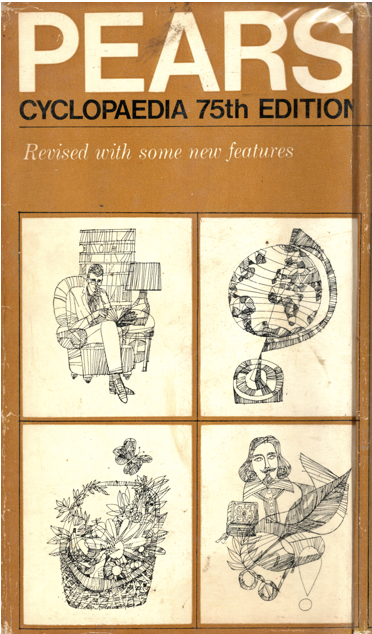
From the 1970 Edition of the Pears Cyclopaedia, I was fascinated to read again, the Introduction to Contemporary Theatre. It presented a very English centric version “confined to plays produced before a live audience”. But I remember reading (and re-reading) page after page. 

It’s interesting to wonder how many of the ideas that shaped my own drama education practice find their roots in these particular words. I do still have a bias for “live theatre” even in a world where there are multiple versions at our fingertips on streaming services.  

The Cyclopaedia does present a limited vision. So much so, that it might explain my insistence upon Australian theatre and a focus on Australian theatre and playwrights that became important to the ways I developed. Why, for example, I took the first offering of Australian Literature at UWA when it became available in my last year of studies (very late in 1973 – unbelievable that it was this late in an Australian University).

As I noted, the limits of knowledge are often dependent on the sources of our knowledge. Whoever curated the section on theatre in the Pears Cyclopaedia presented one view. Obviously there are many others.

But this musing prompts to me wonder: 

  • What are the sources of your knowledge about drama?

  • What limits your knowledge? And what empowers it?

  • What are your thoughts and responses to these extracts from the 1970 Introduction to Contemporary Theatre?

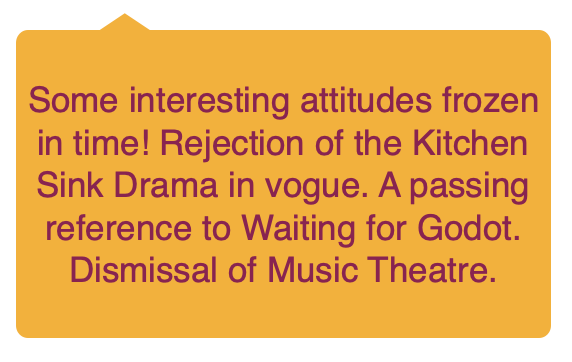
What significance can the modern audience be expected to find in such spectacles as squalid garrets and basement, characters most unrealistically bursting into song, old tramps changing hats, or a young man trying to teach a set of weighing machines to sing the Hallelujah Chorus. 

These are some of the questions that trouble the playgoer, and since they are not always easy to answer it may be helpful first to consider what is the 

Function of Dramatic Art.

It is not the function of art to make a statement but to induce an imaginative response. and the spectator receives not an answer to a question but an experience.

Drama., like the other arts, gives expression to that subtle and elusive life of feelIng that defies logical definition. By feeling ls to be understood the whole experience of what It feels like to be alive - physical sensations, emotions. and even what It feels like to think.

This flux of sensibility cannot be netted down in logical discourse. but can find expression In what Clive Bell, when discussing the visual arts, called " significant form.'' Susanne Longer in her book, Form and Feeling,  has developed Clive Bell's concept, arguing that al artistic form is an indirect expression of feeling. The artist, be he painter, poet. or dramatist, create an image a form that gives shape to his feeling and it Is for the sensitive recipient to interpret its significance.

The especial province of drama, as was pointed out by Aristotle, Is to create an image, an illusion of action, that action " which springs from the past but is directed towards the future and is always great with things to come." 

The Therapeutic Effect of Drama.

One of the achievements of serious drama is to create an image that will objectify and help to resolve deep human conflicts.
It is noteworthy also that drama. can be fully appreciated only in a public performance, a social event demanding the cooperation and understanding between author, players, and audiences.

The Constituents of Drama.

Drama Is a complex art in that It uses two very different kinds of Ingredient or material, one speech, the literary constituent. the other the gesture, movement, and confrontation of actors on an actual stage.

The Ritual Element

While speech and the confrontation of actors are essential to full drama, there is an element that has sometimes been neglected and that is ritual  perhaps the most primitive and evocative of all.

Drama Tuesday - Knowledge and Learning (Part 1)

 How do you know what you know?

I’ve been thinking this week about the nature of knowledge and its role in learning. 

This rather philosophical turn of mind has arisen, because I have been sorting through some very old books in preparation to send them off to the Save The Children Annual bookstall. 

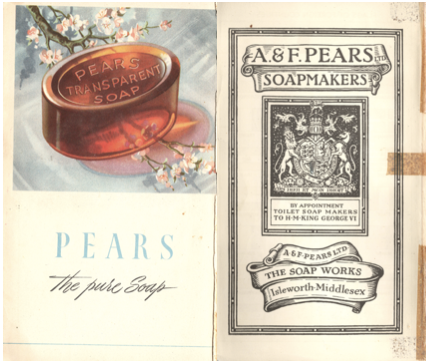
In my family when I was growing up. My mother had a copy of the Pears Cyclopaedia, 60th Edition (1950) . This was an annual publication that brought together in 992 pages of very fine print some key ideas about the  world. There were sections about prominent people, history, a Gazetteer and a rather quaint 1940s Atlas of the World. English Dictionary, Synonyms and Antonyms, Classical Mythology, Health and Beauty, and sections on the new fangled Radio, Television and Radar. The publication was originally produced by the Pears soap company. 

As well as the original one, over the years, I gathered a number of other editions (including a birthday present from Phillip). Sadly annual publication ceased a few years ago before I throw them out,  I have taken the moment to fun through the rice paper thin pages and look at the nature of the way that we looked at knowledge then and now. Given that my mother in 1950 was living in isolated country Western Australia, this was obviously a treasured source of knowledge. Though, of course, the world of the Pears was narrower and coloured by British eyes. Even when I was growing up and buying my own copies of these publications, the world was narrower.

There was the time, and it’s in my life time at knowledge was contains mostly in books and, of course, word of mouth, person-to-person sharing of ideas. We relied heavily on libraries and these sorts of books. I still have fond memories of the chief librarian of University of Western Australia, and of course his team and the way they brought their version of knowledge to us but we always were presented with a curated knowledge  chosen for us by others. Similarly, with our views of the world through newspapers and media.

Even in these days of so-called instantaneous knowledge of our fingertips on the computer keyboard, recent events in the world of politics in the USA and elsewhere remind us that we are always presented with someone’s point of view. Or, to put it another way, we need to filter the world by considering multiple points of view. Access to billions of bits of knowledge, does not necessarily make us wiser.

Quaint. But of interest to our wood cartographer grandson, William. 

Hence my questions about the value of knowledge and the sorts of knowledge that matter. There has been a relatively virulent debate about “learning facts”. As a school student, we learnt all the Squares of numbers 1-39. We learnt lists of Masculine and Feminine nouns – Aviator and Aviatrix, for example (something that would shock our feminist friends). And there is an argument that we should not “burden” our minds with trivia that are good only for Pub Quiz nights.

But there is a counter argument that with our some knowledge, we are limiting our responses to the world as it rises up to meet us. Or rather, we need to reconsider learning in terms of applying knowledge, or “useful knowledge”

What is your construct of knowledge and knowing and its role in learning?

Read more in Part 2.

Drama Tuesday - Boal and Forum Theatre

 At one level Forum Theatre is easy to define – as a practice.

In Forum Theatre, actors perform a short scene based on an event involving oppression. Spectators are encouraged to suggest and enact solutions to the problem in the scene. Image Theatre and Forum Theatre require skilled facilitators, called Jokers, to mediate between the actors and the spectators. (https://www.britannica.com/art/Forum-Theatre

But it is important to see Forum Theatre in context.

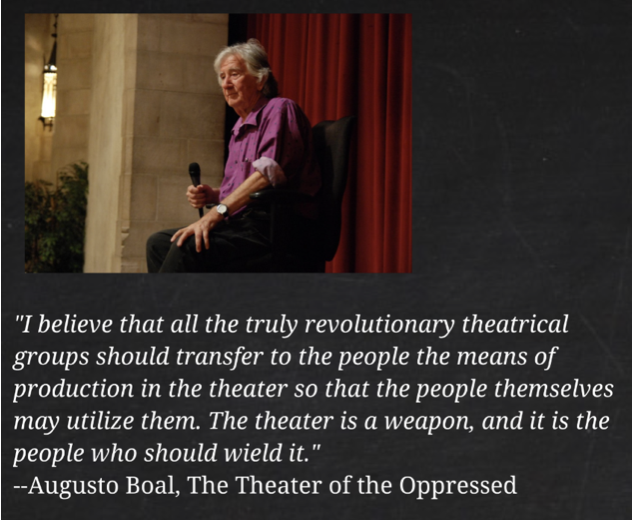
Boal (1931-2009) was an activist with a commitment to political, economic and social change influenced by his own life circumstances and exile. He developed in a climate inspired by writers in Brazil and South America such as Paulo Fiere’s Pedagogy of the Oppressed.

The intent of Forum Theatre was political, social and personal change through directly addressing significant issue and pursuing change and revolution. 

In the drama context, Boal builds on the rhetoric and practice of Brecht. Forum Theatre sets out to actively disrupt what Boal saw as the status quo of power relationships in theatre, notably the passive and “oppressed” audience. He challenged the power positioning of the actor, the script, the director and therefore, the audience. 

  • The actor is supplanted by the spect-actor – an activist audience empowered to change the text and the outcomes of the dramatic action

  • The director becomes the Joker – disempowered as dictator and neutered as “objective though contradictorily could still be manipulator puppeteer

  • The text is changeable, reformable at the point of uttering, not just improvisationally but shaped shifted

In short, Boal’s purpose was revolutionary and radical.

Boal (and others) embed Forum Theatre as one of a series of innovations of form such as Image Theatre, Legislative Theatre, Invisible Theatre, Newspaper Theatre, Rainbow of Desire. They are all, in turn, build on a concept of freeing the body through games designed to engage and empower. 

Boal in Australia 

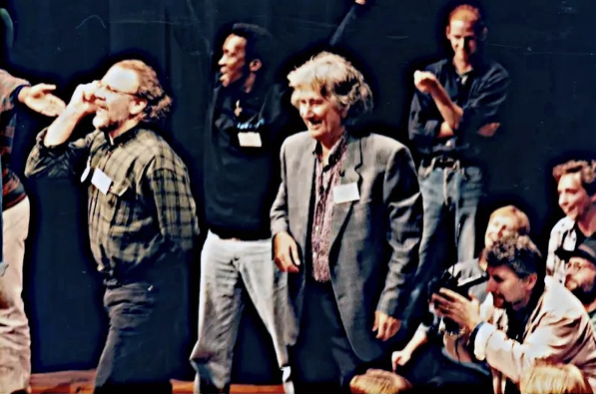
Boal was a keynote speaker at the IDEA 1995 Congress in Brisbane. He was a celebrity presence in that event and “played to packed houses” who all wanted to be part of the excitement. 

I have distinct memories of watching the session late in the afternoon from the choir stalls of QPAC. Boal had insisted that the curtain be dropped on the stage and that the whole session took place on the stage. The vast stage was packed with people and Boal worked with a team of actors who had been working with him during the week of the congress. The action was played out and the substitutions of spect-actors made. 

There was an enthusiastic buzz of excitement. Boal received the “rock star” treatment.


Thinking about Forum Theatre today

There are many enthusiasts. A simple Internet search reveals many examples both within the drama classroom and beyond in development contexts. It is useful to make the connections between Boal’s application and the ideas of Brecht (e.g. 1964). 

There are questions to be asked about the ways that strategies such as Forum Theatre are applied and can be applied. While the techniques can be superficially used, it could be a disservice to the vision Boal (and others) had and continue to have for an empowered and different audience. 

But there is fascinating potential for deep engagement through Forum Theatre and Boal’s other strategies.  It is important to engage with the underlying construction of identified oppression and move beyond shallow playing out of first world angst.


Bibliography

. Augusto Boal: theatre of the oppressed. (2001). In B. Burton (Ed.), Living drama (pp. 240-247). South Melbourne, Vic.: Pearson Education Australia.

Boal, A. (1993). Theatre of the Oppressed (C. A. McBride, Trans.). New York: Theatre Communications Group.

Boal, A. (1995). The Rainbow of Desire. The Boal method of Theatre and Therapy. New York: Routledge.

Boal, A. (1996). Politics, Education and Change. In Drama, culture and empowerment (pp. dk-dk). Brisbane: IDEA Publications.

Boal, A. (2011). Juegos para actores y no actores. Barcelona: Alba.

Brecht, B. (1964). A Short Organum for the Theatre. In J. Willet (Ed.), Brecht on Theatre: The Development of an Aesthetic, 1st ed. (pp. 233-246). New York: Hill and Wang.

Drama Tuesday - Samovila

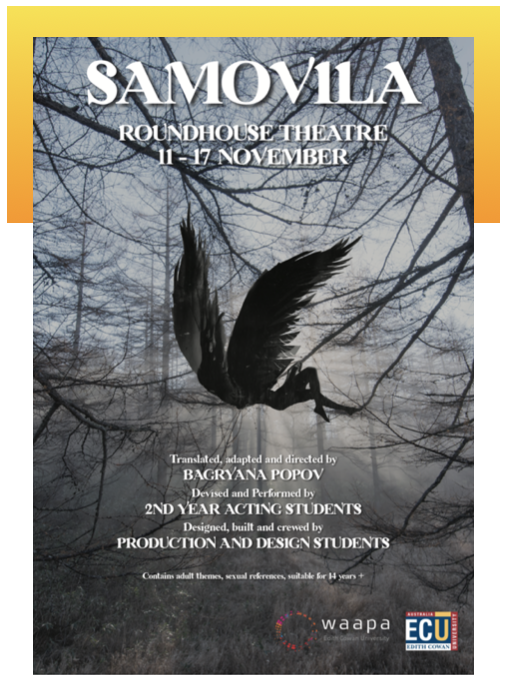
  Samovila in Bulgarian and Serbian legend are mythic creatures in the woodlands, mesmerising male passersby with their songs and dances. Some believe they are daughters of the Thracian goddess Bendis. They are are immortal keepers of nature with an affinity for fire. They have the power to bring about drought, burn a farmer's crops, or make cattle die of high fever. It is said that, when angered, a Samovila (sometimes called Samodiva) can change her appearance and turn into a monstrous bird, capable of throwing fire at her enemies.

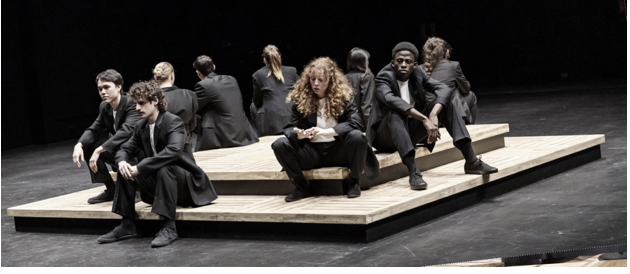
From these traditional folk stories, Second Year actors at WAAPA with their director Bagryana Popov, weave a mystical retelling in the Roundhouse Theatre @ WAAPA ECU. 

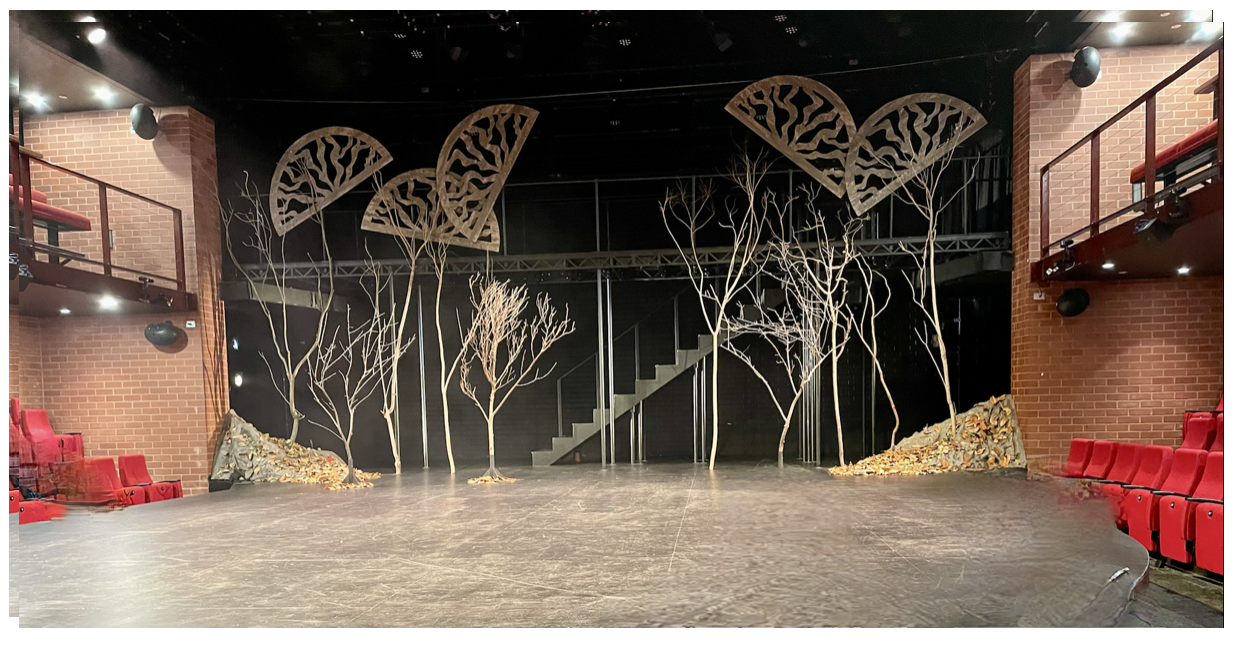
I love this kind of theatrical storytelling. Evocative and imaginative use of lengths of fabric, voices, movement shaping a succession of characters and stories. Theatrical and satisfying. Strongly physical theatre incorporating folk dances – wonderful training for these young actors. An Eastern European sensibility realised through the diverse talents of this group of actors in their first public performances near the end of their second year of study. Simple use of props but mostly skilful use of bodies and voices. Strong sense of ensemble and committed, focused performances. Simple set, great use of the levels and entrances of the theatre with lighting to match the mood. Wonderful evocative singing. 

I would go to see it again for the richness and colour. 

Drama Tuesday - Flowering in unlikely places

 There are many characters in my teaching career but one of them I remember with  mixed feelings was the Deputy  Principal of Western Australian Secondary Teachers College.

Somewhat typically of my generation we found his leadership was blustery and bureaucratic and not always warmly accepted. Intolerant lot we were, I know. But there is one story about him that continues to  endear him to me. 

If still from the deserts the prophets come  (A.D. Hope Australia)

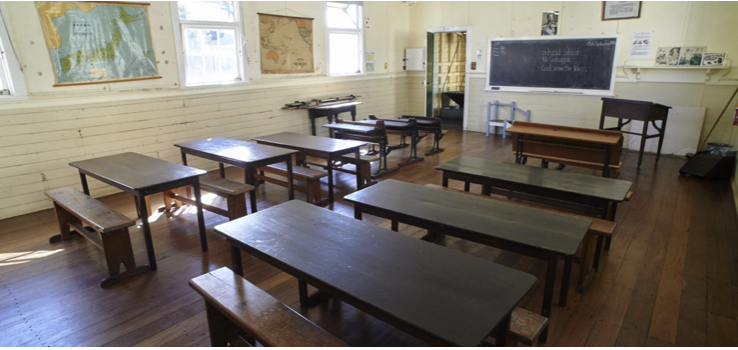
Early in his career - so the story goes - he was a teacher in what in Western Australia were called “one teacher schools”. That’s a school out in a rural community where all of the students are taught in one class. All ages from the youngest to the oldest (remembering of course that the age of leaving school was somewhat younger in those days). If you are familiar with the Anne of Green Gables stories, you may remember a similar school was featured.

As the single teacher of the school the person I’m talking about decided that he would mount a production of Shakespeare’s Hamlet. This involved all the students in the school. The littlest students, in homemade costumes stitched together from flour sacks by willing mums, were the guards on the battlements of Elsinore. The production was staged in the school room with rudimentary lighting and makeshift scenery put together in woodworking Friday afternoon classes the hammering alongside the line memorising. The roles were shared across all the students according to their capacities but everyone, including the teacher, had roles. 

Maybe rough and ready. Maybe not the Bell Shakespeare. But, according to legend, it had energy and verve. And heart. 

When you think about all the incidental applied learning and the bringing together of community involved, there’s a kind of rough magic to the teaching. 

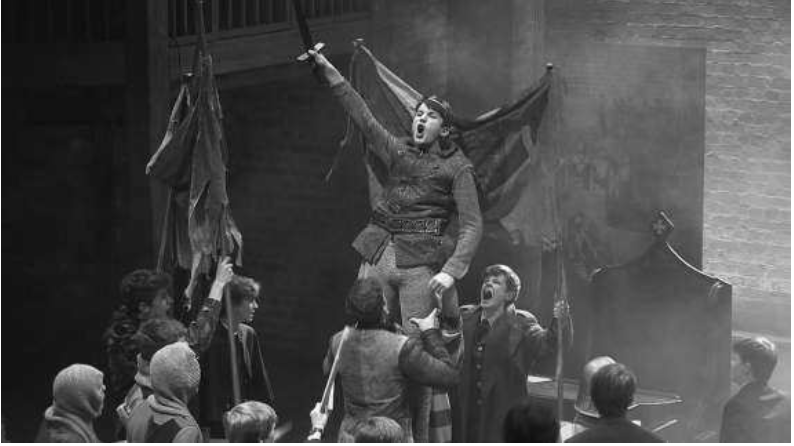
Edward’s Boys ensemble in the 2013 production of Shakespeare’s Henry V, directed by Perry Mills. Photo by Gavin Birkett, courtesy of Edward’s Boys.

Let’s not over romanticise this. It’s the sort of thing that happened in the straightened years after the Second World War when there was a flood of returned soldiers and airmen adjusting to the recovery years. This story seems incongruous with the image I have of clashing impatiently with him in his role as Deputy. But we should give credit where credit’s due. 


On this unworthy scaffold to bring forth (Shakespeare, Henry V Prologue) 

Cambridge University Press

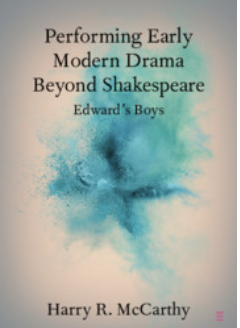
978-1-108-81023-4 — Performing Early Modern Drama Beyond Shakespeare Harry R. McCarthy in the Elements in Shakespeare Performance series

This story came to mind today as I read about a contemporary drama production project in the King Edward VI Grammar School (KES), reputed to have been attended by Shakespeare. Over time within the school there’s developed a theatre project known as Edward’s Boys dedicated to  ‘striving to explore the repertoire of the boys’ companies’ under the direction of the school’s deputy headmaster, Perry Mills. Edward’s Boys is an amateur troupe composed entirely of pupils (aged 11–18) from the school which has been in continuous operation since 2008. They have performed at the grammar school in Stratford on Avon, as well as on tour in venues as varied as Oxford college dining halls, the Sam Wanamaker Playhouse, St Paul’s Cathedral, a chapel in Montpellier, and a ducal  palace in Genoa. “These productions constitute the largest corpus of early modern boy theatre in performance available for examination by twenty-first-century scholars.”

The focus of this company is a range of early

modern dramatists such as Marston’s The

Dutch Courtesan and Antonio’s Revenge, extracts from Lyly’s Endymion and Mother Bombie, Middleton’s A Mad World, My Masters and A Chaste Maid in Cheapside, and, Dekker and Webster’s Westward Ho!. They also have produced Shakespeare’s Henry V

As McCarthy observes,

“these unique productions had been distinctly shaped by the company’s institutional context and their development of a vigorous, contemporary performance style … in the hands of Edward’s Boys, early modern drama becomes a site of sport and play, of physical experimentation, and of exploring contemporary boyhood.”

There is something quaintly and quintessentially English about the notion of exploring the early repertoire built on a company of “scholar actors” in the spirit of the companies of boy actors in Shakespeare’s times.

It’s also inspiring. And thought provoking.

Drama Tuesday - But does drama education really work?

 I have titled this post provocatively  and purposefully.

One of the questions we need reassurance about is whether what we do really works and how it works?

Research in drama education is more likely to be qualitative rather than quantitative. That probably says something about drama education researchers. Therefore it is interesting to find newly published research that focuses on mixed methods research using quasi-experimental pre-post-test design. It is also research that explores the role of drama education pedagogy in creative thinking, perspective taking as an underlying process “that explains both creative thinking and the development of socio-emotional competencies by permitting the child to see from another person’s perspective, providing several ideas-solutions for a problem (creative thinking), as well as understanding other people’s emotions and motivations (theory-of-mind).”  In other words, the focus on drama education is through its impact on the  broader field of the psychology of creativity. 

So often in my professional life I have been asked to answer the “doubting Thomas” sceptics who want “proof” that drama education really does what it says. 

And, perhaps too often, as advocates for drama education we have been reluctant or unwilling or unable to provide the answer to the question. Leave aside that the concept of “proving something” is a flawed logic, there are questions that we as drama education researchers need to address. 

I was recently re-reading Michael J. Finneran’s thesis Critical Myths in Drama as Education, and reminded about the sometimes hazy constructions of drama education that are provided. Celume and Zenasni note that while there is evidence of positive effects of drama education pedagogies, 

…we agree with several authors (Goldstein et al., 2017; Winner et al., 2013) who establish that there is a number of drama-based studies that lack scientific rigor, presenting an absence of controlled trials (Joronen et al., 2012), which results in there being little evidence to support the crucial role of pretence activities in children development (Lillard et al., 2013). (2022)

The evidence or our practice – strongly recorded in qualitative research – does provide a sound foundation for our field, yet can be too easily dismissed or ignored. Not that I am arguing for more quantitative research. But there is research in allied fields for us to notice.

The important question for us is to answer the critics who demand “proof” of our claims. 

Youth Arts Incorporated

How do we know if drama education works? 

Really works?

The discussion in this newly published research provides some clues to how drama works.

In drama we often talk about being in the moment and out of the moment simultaneously – the concept of metaxis. To my mind this aligns with the concept identified as perspective taking. The active processes of learning and reflection that we build into our drama education activities are also directed towards developing “a wide range of cognitive, social, and emotional competencies in children, such as social relationships and behaviors, empathy, humour, emotional understanding, and Theory of Mind (ToM)”.

What do you think?


Bibliography

Celume, M.-P., & Zenasni, F. (2022). How perspective-taking underlies creative thinking and the socio-emotional competency in trainings of drama pedagogy. Estudos de Psicologia (Campinas), 39. doi:https://doi.org/10.1590/1982-0275202239e200015

Finneran, M. J. (2008). Critical Myths in Drama as Education. (Ph.D.). University of Warwick, Warwick. 

Drama Tuesday - Barracking for the Umpire

Black Swan State Theatre Company, Subiaco Theatre Centre 

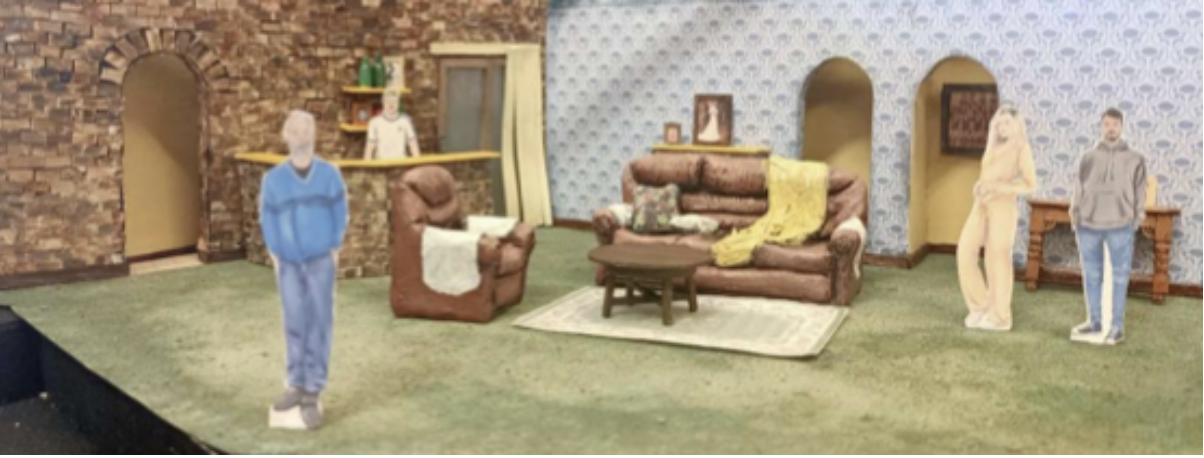
It’s great to see Black Swan supporting new local writing. It’s wonderful to be back in the neglected Subiaco Theatre Centre. It’s important that the often unspoken issue of lingering impact of football injuries is aired with local resonance and heart. Recognisable characters in familiar settings. And, it’s funny. Genuinely funny. Audience erupting into laughter funny.   

The exposed brick, arches and vertical blinds set is on song. Like much of this production there is attention to detail. We begin with the twilight world of Doug (Steve Le Marquand), former footbal great for Donnybrook as his lifetime achievement is about to be celebrated , bringing about a family reunion. Footballer son, Ben (Ian Wilkes), journalist daughter, Mena (Ebony McGuire), and the daughter who stayed home, Charlene (Jo Morris). Holding it all together is Delveen (Pippa Grandison) holding to herself the secret of Doug’s condition (CTE Chronic Traumatic Encephalopathy). There is a strong trajectory for characters glued together by the toxic masculinity exhortations of the Coach (Joel Jackson) who magically appears from behind the exposed brick bar. Rounding out the cast is Charlene’s former husband, football tragic, (Michael Abercrombie). 

At one level, these “typical” Ocker names signal the comic chops of the play (a nod to Kath and Kim). But the play deftly navigates the journey from sit com to seriousness. The underlying violence of a culture is sharply focused. There is a thread of the Coach’s jaw clenched punching through the pain in Australian society that is deeper than football. It stains politics, work culture, relationships, broken dreams and families. Look beyond the fast and glib jokes. 

Interesting to see Black Swan performing at Subi. A warm and enfolding theatre space with a sense of human scale. I also noticed that unlike so many, maybe all, other plays in Perth over the last few years, the actors were not miked. Black Swan’s move out of the Heath Ledger and embrace of other venues such as the Octagon and The Mag, is worth watching as a trend.


The writing is confident and sure, though perhaps a couple of awkward moments that a film version would handle better. The jump cut generation may find the short “blue outs” and prop setting interruptions to the flow. In a couple of places – the long monologues and Delveen’s speech to the Toastmasters for Bunbury – it felt more like standup in flow and pace. A couple of curious lighting state choices, too, where the action downstage – the airport pick up and Del’s speech – seemed to have the main set in full light. I get the transition from the sitcom lighting (pioneered in the 1950’s by the I Love Lucy series) to the more subtle domestic lighting as the impact of Doug’s condition becomes apparent. Perhaps the lighting has yet to settle. 

A new writer to encourage. Well grounded characters. Firmly directed. Familiar and warmly explored territory. Relevance. Funny. 

What more can you ask for a good night at the theatre!