
Drama Tuesday - What is drama education?
/I am responding to a question from drama educators in China: How to determine the appropriate form of teaching (for example, DIE or TIE, or the ordinary form of drama education?
It echoes a question I had once in a conference plenary session in Beijing where a confused drama educator asked what was the difference between creative dramatics and drama in education and theatre in education and Applied Theatre and … the list continued.
It seems that there are many different names for the broad field of drama education (See the list at the end). It must be confusing for many people particularly if they are trawling through the literature of the field in translation. Despite the efforts of many writers and researchers to clarify confusion, it is clear that the claims and counterclaims for defining the field of drama education still bedevil easy resolution.
Writing in 1984, O’Hara observed, “drama is marked by diversity of practice, with those involved in the area appearing "unable or unwilling to speak for themselves with authority and unity in both academic and practical terms" (Norman, 1971)”. In 2007 Gavin Bolton in the International Handbook of Research in Arts Education titled his contribution A History of Drama Education: A Search for Substance. In 2016 Mages wrote an overview of a number of prominent forms of educational drama and theatre designed to introduce educators, who are not drama or theatre specialists, to the paradigms and merits of educational drama and theatre.
Towards resolving this issue
There is a need for our field of drama education to acknowledge the issue and to find a useful yet clear definition and explanation that works for teachers. Putting the problem in context:
Drama education is the term for the broad field.
Within drama education there are different terms with histories, traditions and practitioner points of view.
These different terms can be confusing (particularly in translation)

To help address this confusion I begin by establishing some principles:
1. There is a continuum and relationships between Play / Drama / Theatre.
Play is the broad field term for activities that are pleasurable and intrinsically motivated. Neuroscience research shows the role of play in human development particularly in imagination, language, visual and symbolic expression. Drama is a specific form of play based on symbolic representation of people and situations. Drama occurs within the broad field of Play. Within Drama there is Theatre, the specific forms of Drama focused on presentation to audiences.
The relationships show how Theatre is nested within Drama and Drama is nested within Play. The boundaries between Play, Drama and Theatre are porous and often there is overlap and blending.
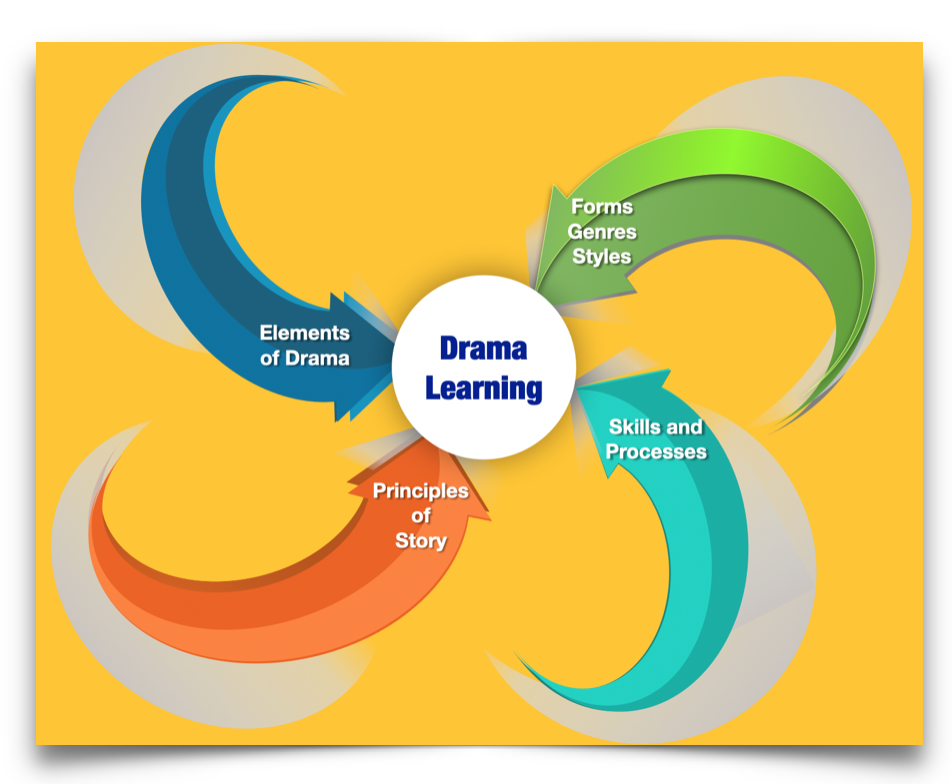
2. Within the many differently named approaches to drama education there is a commonality of purpose: engaging people with the embodied experience of taking on role and acting out dramatic action. In doing so they learn, understand and work with identified Elements of Drama, Principles of Story, Forms and Types of Drama and use the Skills and Processes of Drama
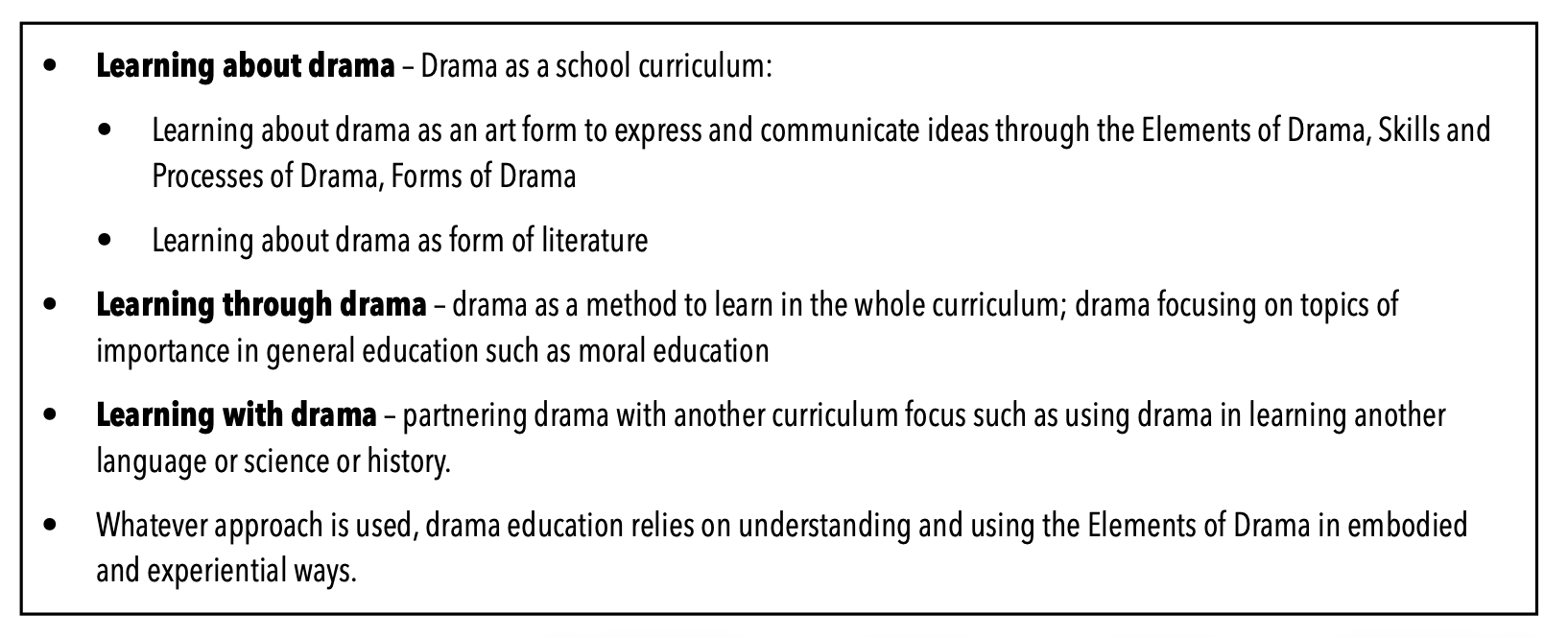
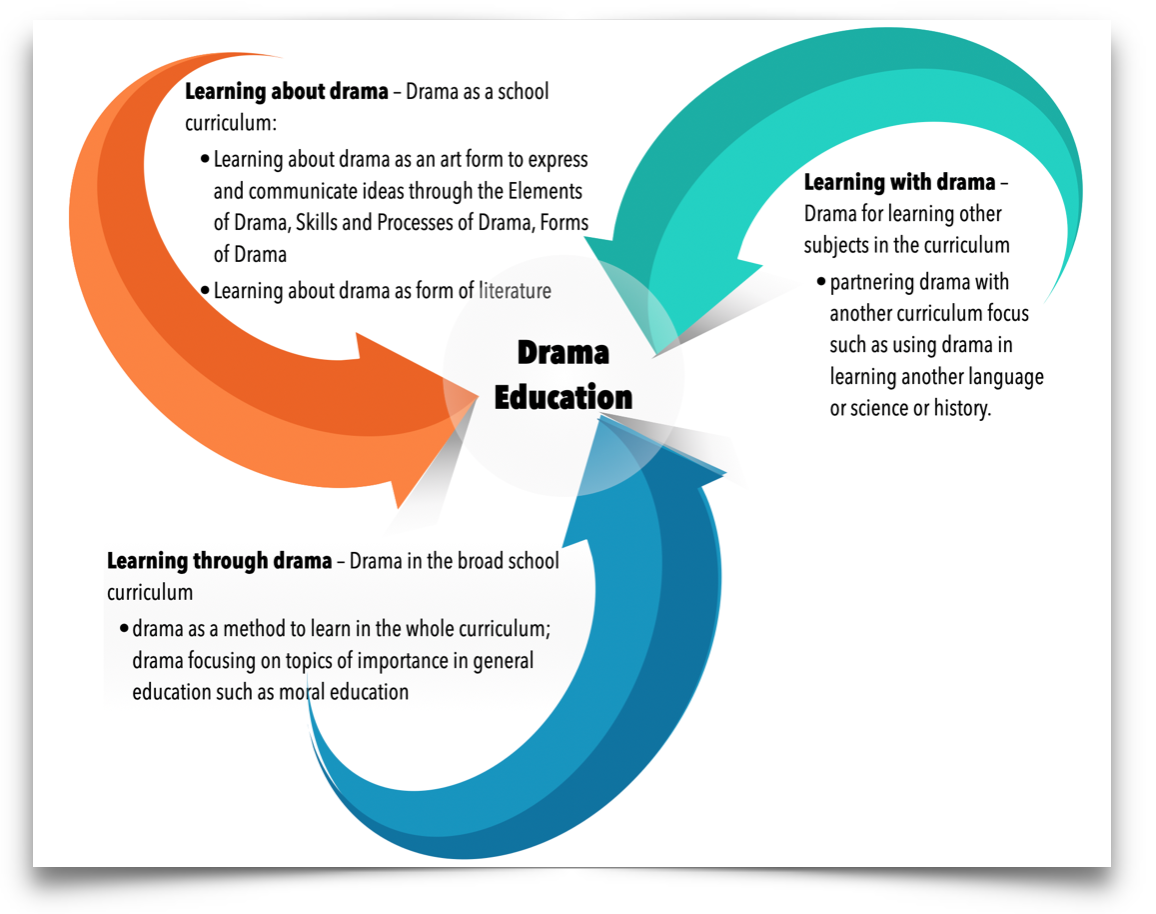
3. It is helpful to think about three overarching categories of drama education (which can be used to group the many different approaches.
Terms for creative drama and similar or related constructs (Mages, 2008)
Acting-out stories Paley, 1978 Child drama Davis and Behm, 1978, 1987
Creative drama Cooper and Collins, 1992; Davis and Behm, 1978, 1987; Kardash and Wright, 1987; McCaslin, 1996; Vitz, 1984; Wagner, 1998
Creative dramatics Cullinan, Jaggar, and Strickland, 1974; Strickland, 1973 Drama Brown, 1992; Conlan, 1995; Cooper and Collins, 1992
Drama in education Brown, 1992
Dramatic play Galda, 1984; Smilansky, 1968
Dramatics Niedermeyer and Oliver, 1972; Paley, 1978
Dramatization Fein, Ardila-Rey, and Groth, 2000; Kirk, 1998; McNamee, 1987; McNamee, McLane, Cooper, and Kerwin, 1985; Warash and Workman, 1993
Educational drama Wagner, 1998
Fantasy play Saltz, Dixon, and Johnson, 1977; Smith, Dalgleish, and Herzmark, 1981; Smith and Syddall, 1978
Fantasy reenactment Pellegrini, 1984
Group-dramatic play Christie, 1987
Guided drama Davis and Behm, 1978, 1987
Imaginative drama Paley, 1978
Imaginative play Marbach and Yawkey, 1980; Saltz and Johnson, 1974
Improvisation Brown, 1992; Conlan, 1995; Niedermeyer and Oliver, 1972
Informal classroom drama Wagner, 1998
Let’s pretend play Yawkey, 1979
Make-believe Christie, 1983; Singer, 1973; Smilansky, 1968; Yawkey, 1979
Play Fein, 1981; Galda, 1982; Silvern, 1980; Yawkey, 1979
Play enactment Saltz et al., 1977
Play tutoring Christie, 1983; Smith et al., 1981
Pretend play Fein, 1981; Harris, 2000; Nicolopoulou, 2002
Pretense Fein, 1981; Leslie, 1987
Process drama Montgomerie and Ferguson, 1999
Reenactment Nielsen, 1993
Role enactment Fein, 1981
Role play or role playing Brown, 1992; Cullinan et al., 1974; Fein, 1981; Strickland, 1973
Role-taking Levy, Wolfgang, and Koorland, 1992
Shared enactment Fein et al., 2000
Social role enactment Fein, 1981 Sociodramatic play Saltz et al., 1977; Saltz and Johnson, 1974; Smilansky, 1968; Smilansky and Shefatya, 1990; Smith et al., 1981; Smith and Syddall, 1978; Warash and Workman, 1993; Wolf, 1985
Story dramatization Brown, 1992; Cooper and Collins, 1992; Levy et al., 1992; McNamee et al., 1985; Vitz, 1984
Story-acting Nicolopoulou, 1996; Richner and Nicolopoulou, 2001
Symbolic play Marbach and Yawkey, 1980; Saltz and Johnson, 1974; Silvern, Taylor, Williamson, Surbeck, and Kelley, 1986
Thematic-fantasy play Pellegrini, 1984; Pellegrini and Galda, 1982; Saltz et al., 1977; Saltz and Johnson, 1974; Silvern et al., 1986; Williamson, 1993
To this list you might add role drama, applied theatre, theatre in education, story drama.
The list goes on.
Is it any wonder that teachers in classrooms are confused?
Bibliography
Bolton, G. (2007). A History of Drama Education: A Search for Substance. In L. Bresler (Ed.), International Handbook of Research in Arts Education (Vol. 1, pp. 45-62). Dordrecht: Springer.
Mages, W. K. (2008). Does Creative Drama Promote Language Development in Early Childhood? A Review of the Methods and Measures Employed in the Empirical Literature. Review of Educational Research, 78, 124–152. doi:10.3102/0034654307313401
Mages, W. K. (2016). Educational Drama and Theatre Paradigms for Understanding and Engagement. R&E-SOURCE http://journal.ph-noe.ac.at Open Online Journal for Research and Education(Special Issue #5, September 2016, ISSN: 2313-1640).
O'Hara, M. (1984). Drama in Education: A Curriculum Dilemma. Theory Into Practice, 22(4 Teaching the Arts), 314-320. Retrieved from https://www.jstor.org/stable/1476387