
How is drama travelling a year into the Pandemic?

Screen Shot 2021-03-30 at 8.56.31 AM.png

We are a year into the Coronavirus COVID-19 Pandemic. Even though the roll out of a vaccine is happening in countries around the world, there are still students not in classes – not in drama classes. In many places, theatres remain closed and creatives are out of work.
Screen Shot 2021-03-30 at 8.56.38 AM.png

The immediate responses to the Pandemic are one sign of the vital concerns felt in the drama education community – a pragmatic response.(See, for example, the support from IDEA:  https://www.ideadrama.org/Supporting-teaching-drama-and-theatre-in-these-times)  


But how are we travelling now 12 months on?

If anything, the Coronavirus COVID-19 Pandemic has provided increasing opportunities for these alternatives to drama teacher education to flourish. In the midst of disruption there are  entrepreneurial openings (for example, Roundabout Theatre Company, 2021. https://sites.google.com/schools.nyc.gov/theater-ralp/home). 
Screen Shot 2021-03-30 at 8.56.47 AM.png

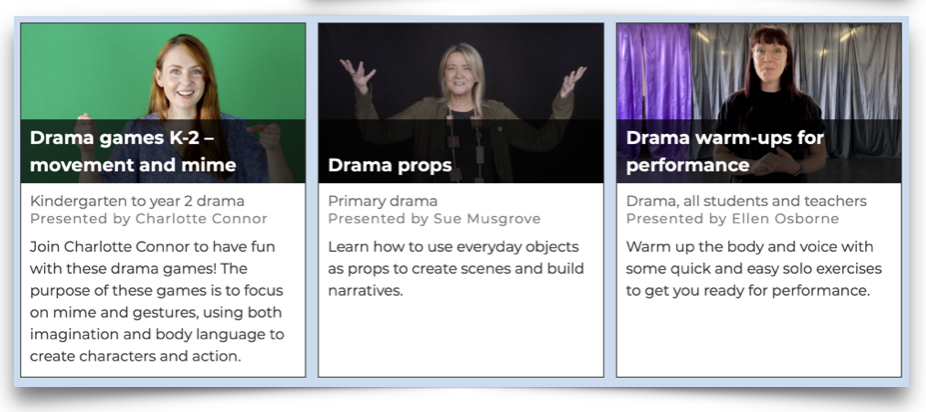
The rescue has two modules – with grade related resources. Module 1 focuses on using your voice; Module 2 is an Introduction to Design. There are lesson plans and video resources to support instruction as well as independent  student learning.

There are professionally produced videos with personable presenters published in a YouTube channel. Check out the Using Your Voice: Vocal Warmups video to see if it will work for you.

For teachers working in Zoom environments these are valuable resources.

As always, check that these resources are suitable for your students.  also, question whether the US accents are useful or helpful. 

Australia

Closer to home, the Inclusive Creative Arts digital teaching resources produced by the New South Wales Arts Unit are also worth considering. 

https://digital.artsunit.nsw.edu.au/the-arts-unit-home/art-bites?subject=drama 

These Arts Bites are another source for stimulating drama activities. The accents are Australian and the presenters are enthusiastic and focus on speaking directly with students. 
Screen Shot 2021-03-30 at 8.56.56 AM.png

The question still remains

What is unclear is how they present antidotes to trends towards dis-embodied drama education. The lure of the on-line world and the ZOOM meeting present traps for embodied drama learning and teaching. 

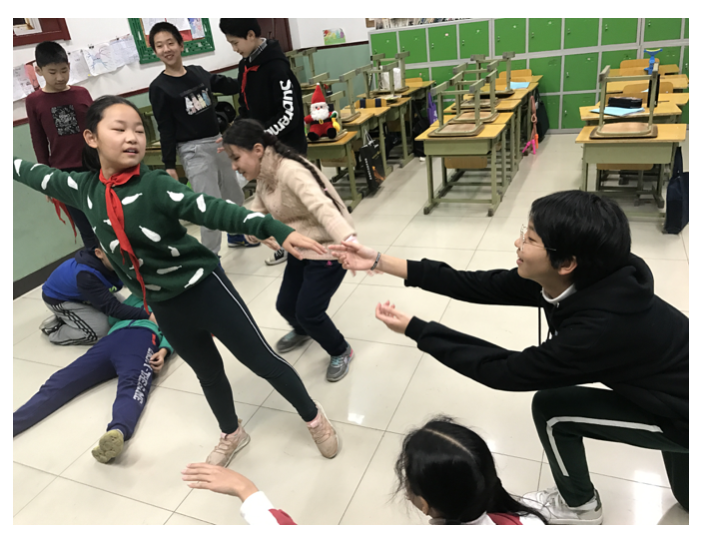
Drama is practical, hands on, embodied learning. How does that change in the “new normal”?

Whatever approach is taken to drama teacher education, there needs to be an underlying robust, durable, practical schema to serve as a living and responsive guide to our work.

Learning to teach drama focuses on embodied learning in the arts  (Bresler, 2004). Through practical, hands on experiences in the drama we model the ways that your students learn the arts and ways that you teach the arts. This engenders embodied teaching.


Bibliography

Bresler, L. (2004). Knowing Bodies, Knowing Minds - Towards Embodied Teaching and Learning. Dordrecht: Kluwer Academic.

Music Monday - More about Practice

Last week’s post about music practice generated some interesting discussion. Thank you to those who contacted me with anecdotal stories about students young and older.

I’ve been thinking and reflecting further on this essential component of successful music performance.

Our daughter, Hannah had an outstanding piano teacher. Sue’s students were typical suburban kids, but consistently achieved above - average results in their AMEB piano exams. Her own daughters all went on to become professional string players. The family are clearly extremely talented in music, but I have often wondered if a significant part of their professional success was their mother’s guidance about practice routines from an early age.

I have been searching (without success) for one of Hannah’s old practice books, but my recollections of a typical page would read something like this:

D major scale. Practise hands separately 3 times then together, slowly, 3 times

Gavotte. New. Try page one slowly, separate hands. 3 times each practice.

Revise List A and D pieces once each practice.

List C. Check bars 43-49 (wrong today) and practice slowly 3 times each practice

And so on.

Very specific.

This week with my Year 8 boys’ singing group, I quizzed them about their practice since the last lesson. Interestingly - but unsurprisingly - the boy who scored highest in a technical work assessment had the most specific practice routine. Here is what he reported as being his practice routine:

“I sang each of our (5) scales 5 times to warm up.

Then I sang the vocalise, checking the breathing and the dynamics.

I practised the song, checking the rhythms at the bars you told us to.

I recorded myself singing to make sure that I wasn’t scooping or sliding.

Then I went through my parts in Matilda (their current school musical).”

Again, very specific and ordered.

We are living in an age where technology provides so many tools for practice – warm up apps, recording devices on our phones, backing tracks with or without voice / piano / orchestra. The list goes on.

But as music educators we still need to train effective practice habits.


Drama Thinking - Part 6

Finding the stories for drama

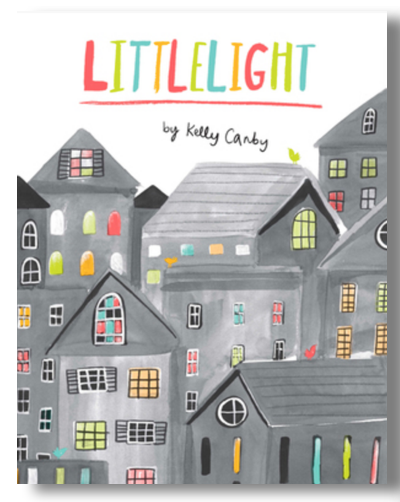
The town of Littlight and its people live in a grey and lifeless community, dictated to by the Mayor, an autocratic man who fears change and difference. Mysteriously, the brick walls surrounding the town start to disappear and as they do so, light, …

The town of Littlight and its people live in a grey and lifeless community, dictated to by the Mayor, an autocratic man who fears change and difference. Mysteriously, the brick walls surrounding the town start to disappear and as they do so, light, colour, sound and eventually people start to appear through the every enlarging holes.

This is a story about one person setting of a change reaction - about celebrating difference, tolerance and not just being open-minded to those who live different lives, but being open enough to embrace and enjoy their differences.

The illustrations are simple and stylistic - quite childlike. Stark shades of grey depict the township except for one bright, colourful girl and a ladder. As the bricks disappear psychedelic colours leech through along with small differences to start with - as brightly coloured birds start to emerge. As the holes in the wall grow larger we get glimpses of different people doing different things - cooking, dancing etc with different senses being awoken but the Littlelight townsfolk. The Mayor is angry, and at first the people are frightened of something new and different but as the colours take over their community they become happy and cheerful. The vivid endpapers are filled with bright and colourful houses side by side and provide a good talking point.

Goodreads

A frequent  question I am asked is about the stories I use in drama workshops: where do you find the stories?

I find stories for drama literally everywhere.

I am always looking for stories for drama.

You might find me in the children’s picture book section of the book store. Or, I might see something in a newspaper clipping. Or, a friend might tell me a story from local history. 

For example, in the children’s section of a bookshop and found a new book by a Western Australian author, Kelly Canby, called Littlelight (2020). Immediately, I could see the situation – a town that is walled in  – and the roles – the pompous mayor and the fun-loving stealer of the bricks in the wall. I could use the Drama Thinking processes described in earlier posts to generate dramatic action that can help students understand important life issues.


Another time the same bookstore I saw The Wanderer by Peter Van den Ende (2020). 

At once I could see a starting activity of making paper boats and talking about them – an activity outside the frame that enables us to edge into the drama where we take on roles.

A little boat sets out to sea and begins its voyage toward home. To get there it must travel across many strange, beautiful oceanscapes, full of fantastic creatures and deadly monsters, swept by terrifying storms and sailed by mysterious ships. Can …

A little boat sets out to sea and begins its voyage toward home. To get there it must travel across many strange, beautiful oceanscapes, full of fantastic creatures and deadly monsters, swept by terrifying storms and sailed by mysterious ships. Can the Wanderer pick a path through all these perils to a safe harbour?

Murdoch Books

The story itself  is so open ended. We could springboard from images in the book itself.  Each of the images could provide an episode for a drama activity. 

Or, we could invent our own adventures and places for the little paper boats to be  travelling.

These sorts of picture books are so great for generating drama thinking ideas. 

Generative stories are rich with potential drama.

They enable us as drama teachers to work between the

narrative threads to find the drama.

They focus on human experience that can be shared in embodied ways.


Screen Shot 2021-02-02 at 11.49.25 AM.png

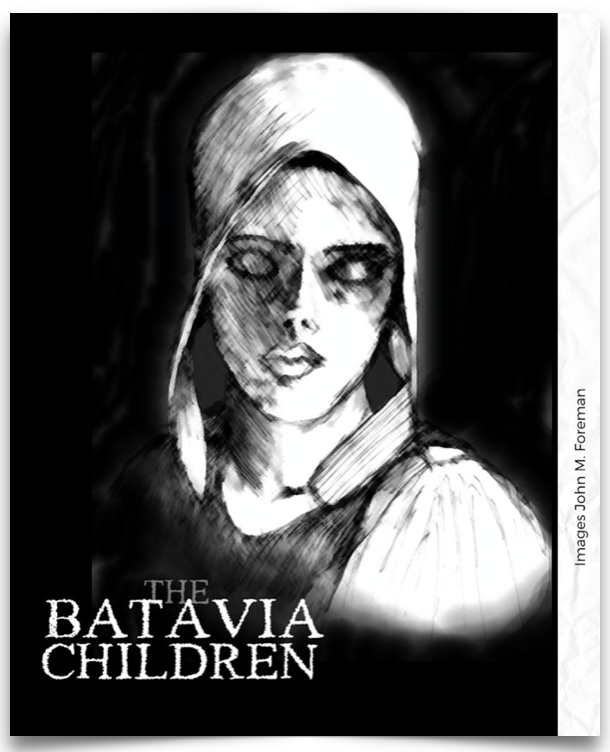
Similarly, a friend told me the story of the shipwreck off the coast of Western Australia – quite infamous for the bloody insurrection and mutiny and the terrible justice imposed on the mutineers. 

what her was fascinated about was that in the party of several ships in the convey making the journey from Amsterdam to the Dutch East Indies, there were many children. 

I thought about the potential for drama in this story from our shared history. 

Stories don’t have to be written down or published in books.

Just as Drama reflects life, so too, all of our lives can be the source for good drama lessons.

They open doors to Process Drama activities. 

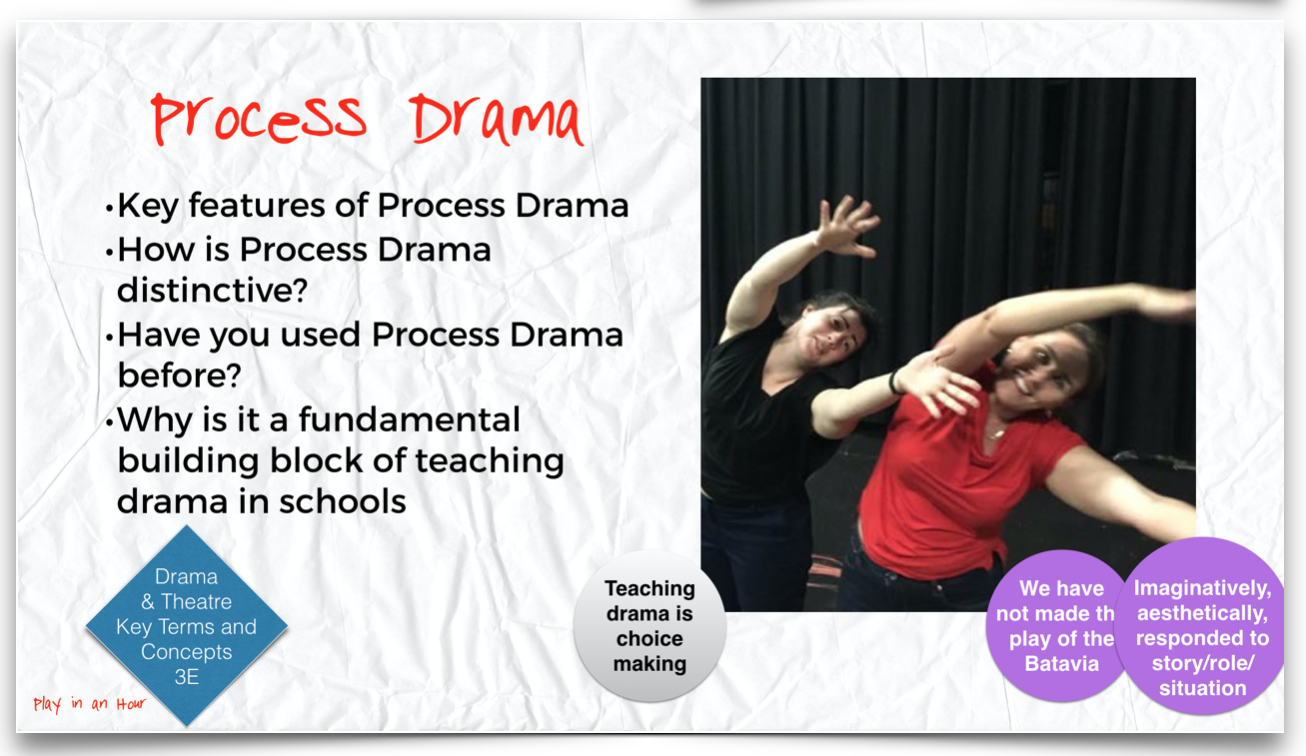
With my teacher education students we worked through the Process Drama of the Batavia Children, to learn about Process Drama. 

Screen Shot 2021-02-02 at 12.02.53 PM.png

An associated question I am sometimes asked: Why do I use stories for drama?

My job as a drama teacher is to help students learn about drama - using the Elements of Drama to express and communicate ideas and feelings as well as to understand and respond to drama.

Stories are ways of embedding these important elements into packages that. Help students learn.

Of course, there are times when I plan a drama based on a concept – such as using voice dynamically to create character. Or, teaching about the important ideas of Brecht as a playwright and director that have influenced contemporary drama. So there are drama lessons that don’t necessarily start with a story. I can start with a specific lesson concept in mind. But even then, I try to find a way of bringing it to life through including part of a story. 

But there is nothing to match the power of a generative story to hook and engage students. Into that story, I can embed important conceptual and practical learning.

In overview, this series of posts have focused on the ways that we as drama teachers move from a starting point – often a story – through processes of drama thinking linked with my portfolio of Drama Teaching and Learning Strategies. Through these processes, I am in a position to create a specific drama lesson plan.

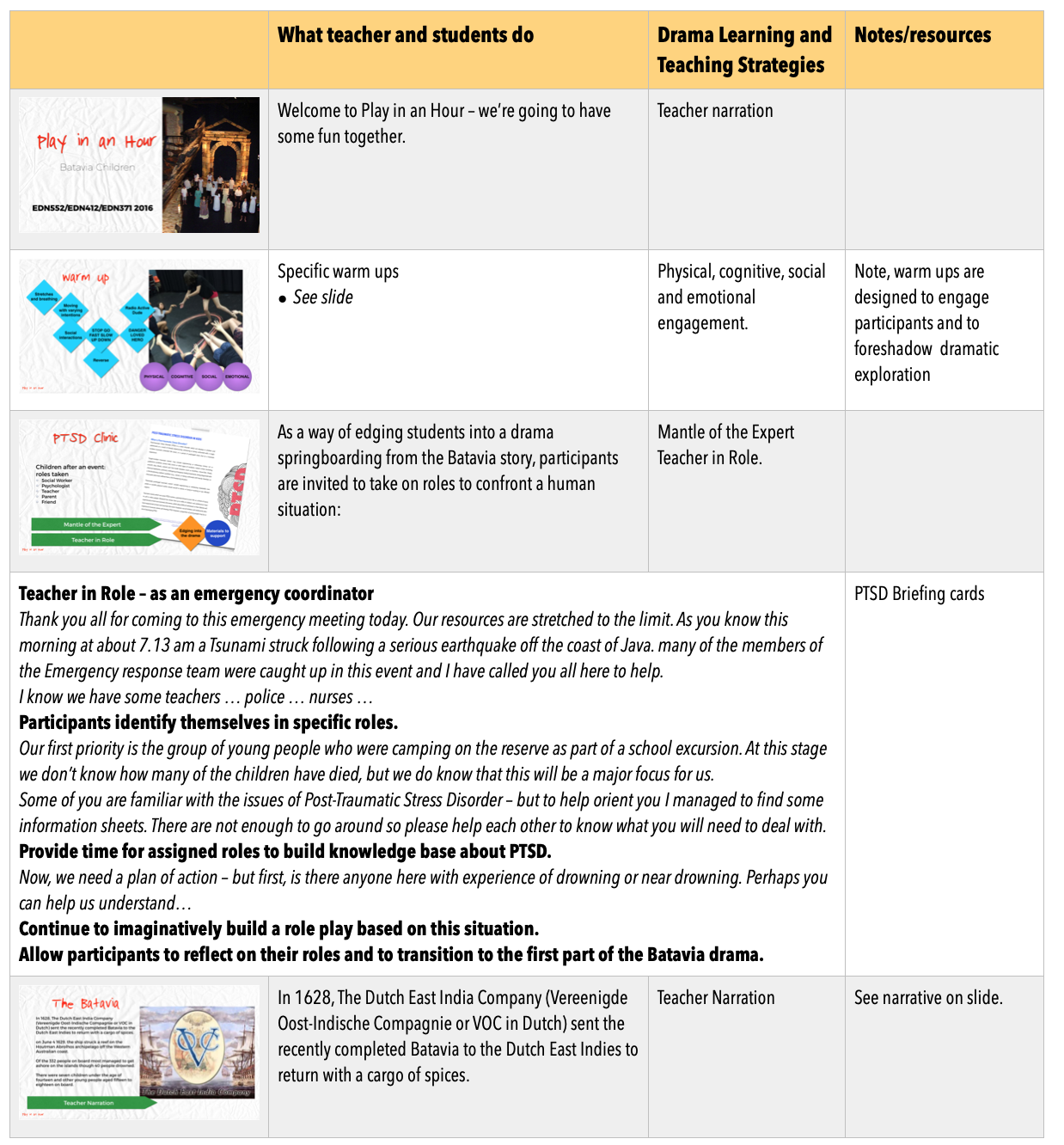
My planning often looks something like this:

Excerpt from Batavia Children Process Drama Planning

Excerpt from Batavia Children Process Drama Planning

Bibliography

Canby, K. (2020). Littlelight. Fremantle, Western Australia: Fremantle Press.

Peter Van den Ende. (2020). The Wanderer. San Francisco: Chronicle Books.

Music Monday - Practice

A couple of weeks ago I was shocked when a tertiary singing student confessed to me that she had never done any singing practice. Never. Not in the 15 months I have been teaching her and not at any point during her secondary schooling, which is when she started formal singing lessons. What was even more galling to me was that I hadn’t realised. This student is naturally talented and learns new song repertoire easily. She had recorded her lessons with me, including exercises to teach and reinforce new aspects of vocal technique. In my turn, I had observed that her progress with new vocal technique concepts was slow; however her strong natural instincts for ‘selling’ a song, as well as a naturally robust vocal instrument had enabled her to get away with it to a certain extent. Her confession came in response to my observation (at this particular lesson) that she was taking a long time to develop a secure head dominant mix.

In our frank discussion which followed, the student confided that she had always had a lazy attitude towards work, but more than that, no one had ever told her how to practice. That really set me thinking.

With my young beginner singers, I always make explicit instructions- “do this exercise 5 times each day”, “sing through the song then go over the problem phrases”, “check in the mirror to see that you are….”. The younger students have a journal in which to write instructions and record their practice times and at each lesson there is discussion about how they have fared since the previous lesson.

With tertiary / adult students, I have, until now, verbally suggested the recommended number of repetitions of new exercises and techniques, but I have assumed that these were practised at home. Clearly this has not always been the case. 

Since that lesson, I am now quizzing students in more detail. Instead of a generic “how has your practice gone since the last lesson?” I am asking, “How many times did you do the … exercises?” etc.

And what of the student who started this? Well, in the past week she has practised in detail twice. Not yet ideal, but baby steps towards a more effective artistic practice routine.


Drama Thinking - Part 5

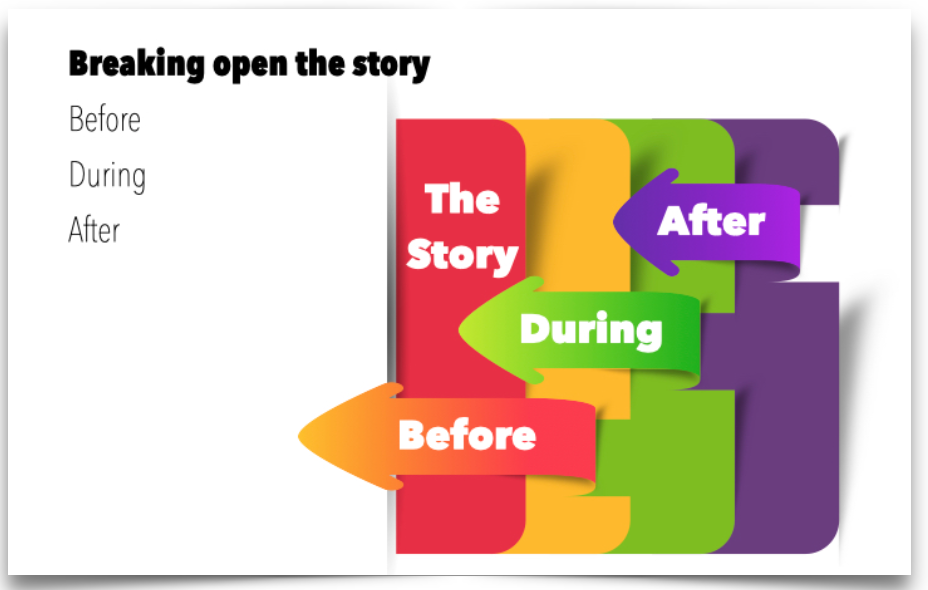
In Part 5 I share with you one further Drama Thinking process to help you move from a story to your planned drama lesson. This is a simple strategy. Think about your story in terms of Before, During and After the story.  

Before During and After

Perhaps the simplest of all these drama Thinking Processes, Before, During and After looks carefully at the story.

What happened before the story starts – to the people in the story. Think about their situation, relationships and what they are thinking and feeling. 

Look inside the story – what happens during the story. It is useful to look here at the narrative chain. 

Finally, we can look at what happens or might happen after the story ends.

Alternative stories 

Screen Shot 2021-02-02 at 11.42.29 AM.png

Sometimes, within a story we can imagine alternatives.

We can asks ourselves what if questions. 

If the original story of our travellers to a New World, their adventure begins in Europe and they venture to the Dutch East Indies. 

But what if… instead of reaching their destination, their ship is wrecked on rocks on the coast of Western Australia and they must learn to live with the Aboriginal people.

Or, what if… in a huge storm, their ship is swept into outer space and they travel to the Moon.

Stories do not have to go in straight lines. 

There are no limits to your imagination. You can make alternative stories. 

Introduce new tensions.

Introduce new people and characters.

Change the location. Or, the time. Or the ending of the story.


Story drives drama. The Principles of Stories work along side the Elements of Drama. To plan our drama lessons, we need to understand how story can be unpacked and understood, so that we can make drama with our students

Drama Thinking - Part 4

In Parts 1, 2 and 3 we unpacked different Drama Thinking approaches to help open the story to drama planning.  This post will develop further drama thinking approaches. 

Contrasts and Oppositions

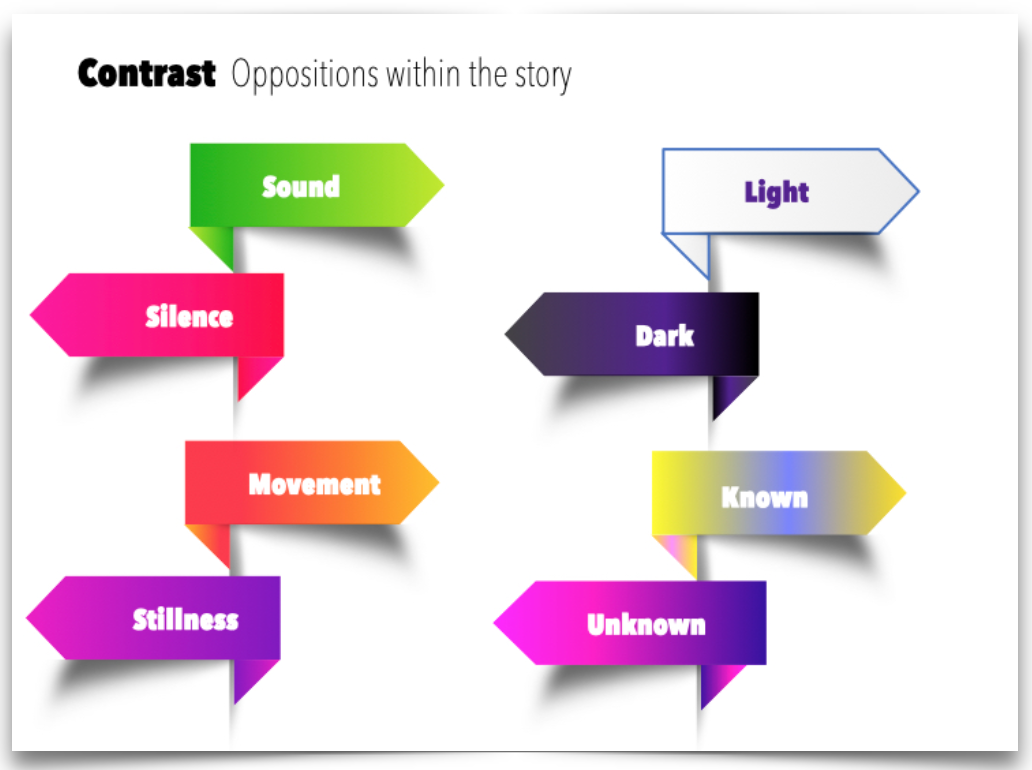
Stories work because there are moments of contrast – something that is strikingly different placed side by side in juxtaposition. In our drama work, we look for these contrast and moments of opposition because they generate dramatic tension 

Look within the story to find contrasts or oppositions. 

For example, look in the story for when there are sounds or silences. Look for parts of the story where there is movement or stillness.

In the journey of the ship there are moments when there is much activity and excitement. The ship is leaving harbour for the first time; the sails are being unfurled; the wind is carrying them forward on an adventure. There are many sounds to go with this part of the story.

By contrast there are also times of great boredom; perhaps the ship is becalmed and there is no wind blowing. The only sounds that can be heard are the quiet breathing of people waiting for some wind to stir and carry them forward. 

Find parts of the story that are known or unknown. Look for moments of lightness or darkness. 

In the story of the travellers to the New World for example there will be moments where the travellers are happy and light-hearted; maybe they have successfully reached a safe harbour or they have plenty of food. By contrast there will be times in their story when they are feeling dark threat or danger; maybe there is a storm or they have very little food or water. 

There are parts of the story when the travellers know what to expect. But there are times when they are confused and face the unknown. Where they don’t know what to expect.

Screen Shot 2021-02-02 at 11.37.14 AM.png

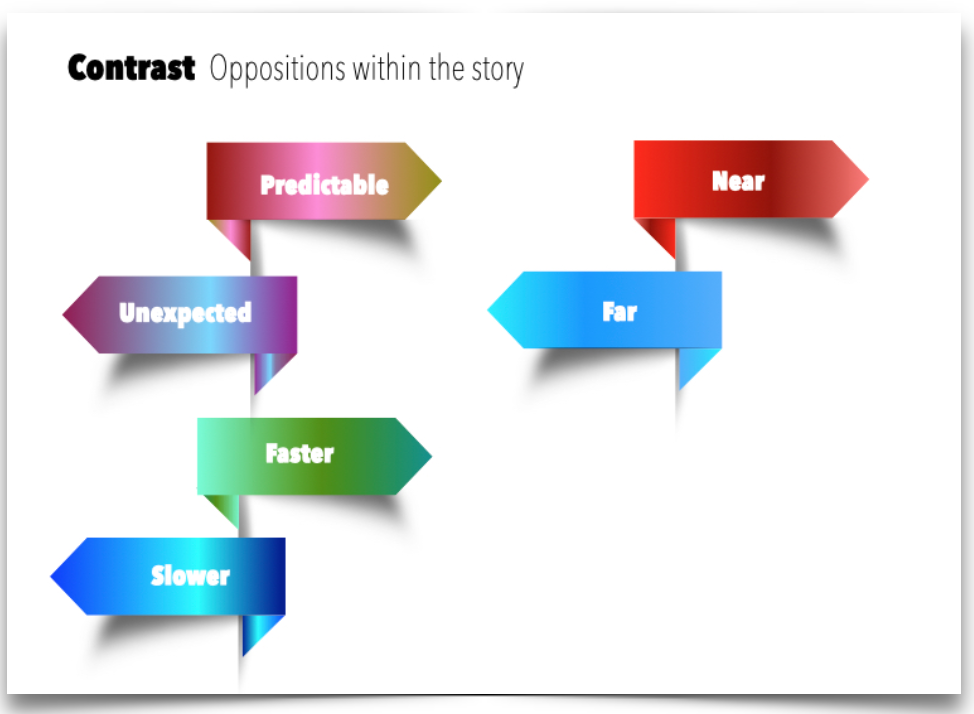
Look within the story to find other contrasts or oppositions. 

For example, look in the story for when the action is predictable or when it is unexpected.

Look for parts of the story where there is action moves faster or when it moves slower.

Look for when the drama is near to you or far away. 

In this series of posts I have been sharing with examples of Drama Thinking – processes of unpacking stories to use in drama.

Not all stories work for Drama. Not all stories are appropriate for your students. We take great care in choosing the stories we use. We need what are called generative stories. By that I mean stories that have potential to create drama moments.

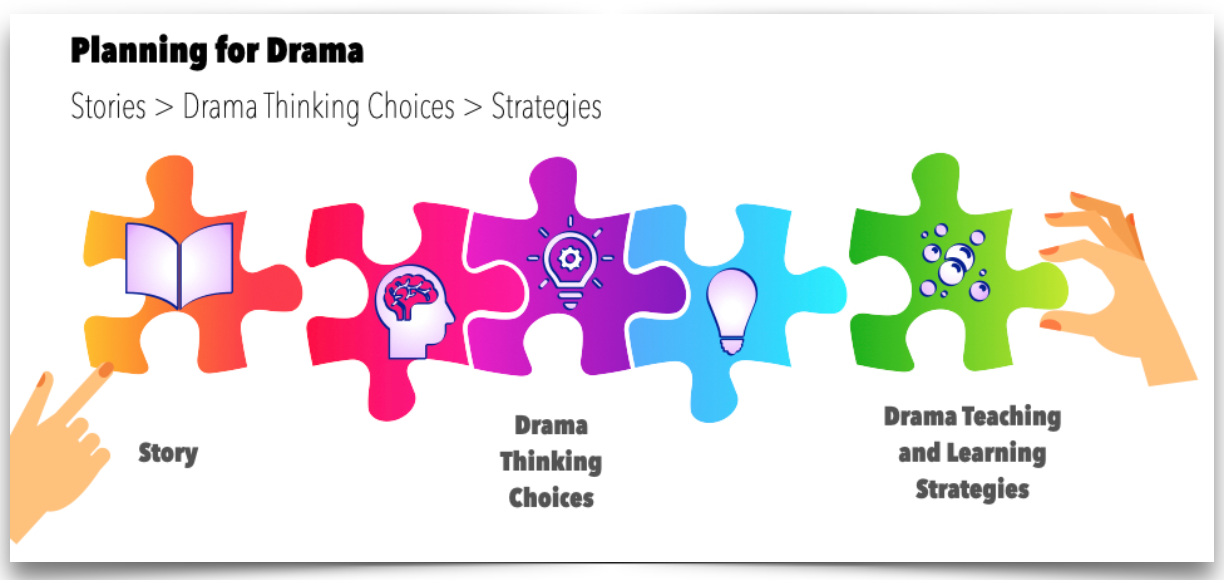
Remember, the Drama Thinking processes are a step in moving from the story to your final, planned drama lesson. The Drama Thinking Processes enable you to identify pivot points around which you can construct your drama lesson using Drama Teaching and Learning Strategies. 

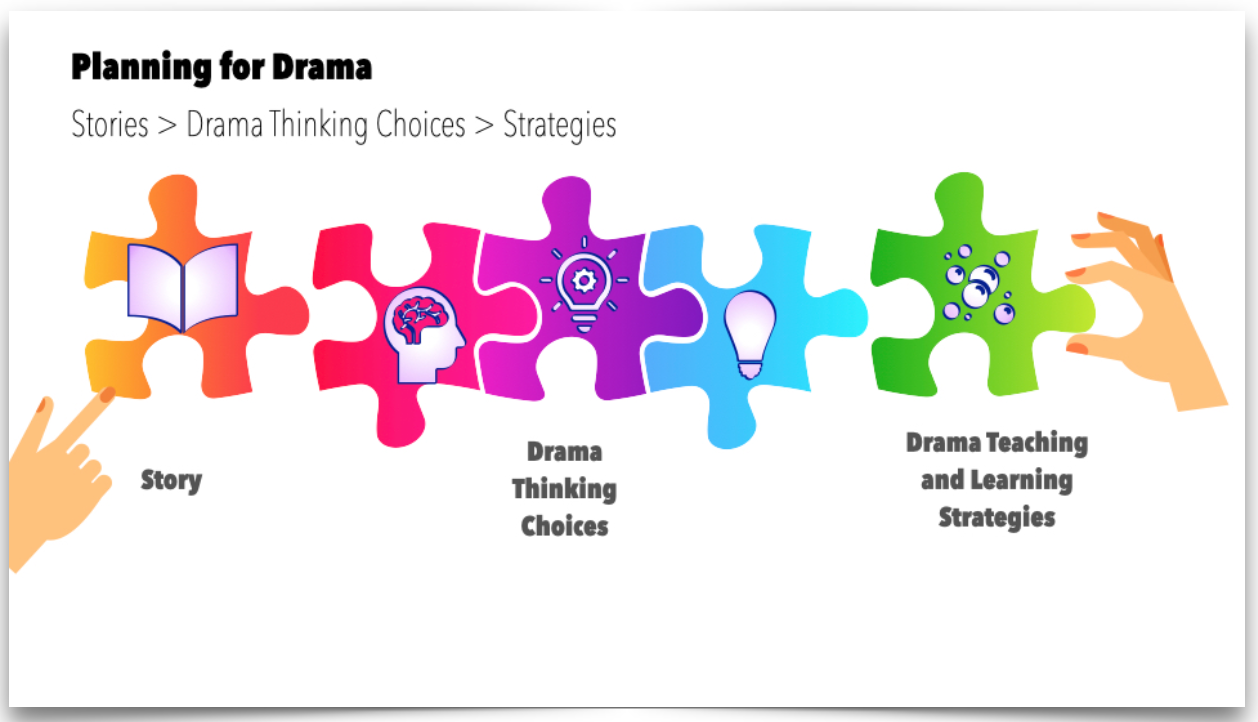
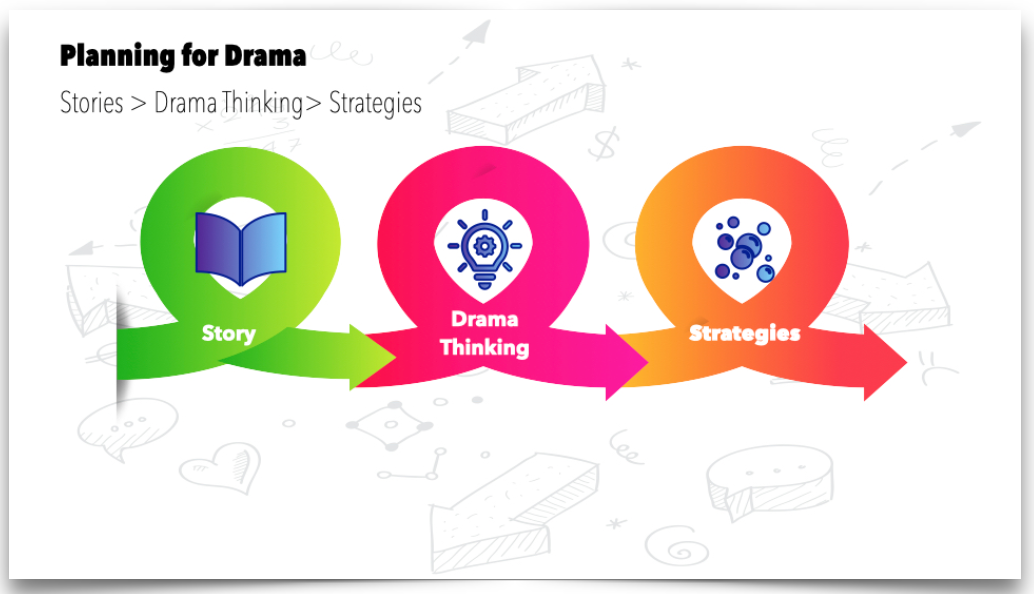
Like the pieces of a jigsaw, the story, the Drama Thinking and the Strategies all fit together to provide the basis for you planning of your lesson step by step.  

Screen Shot 2021-02-02 at 11.37.22 AM.png

Music Monday - International Women's Day

On this International Women’s Day, I have been reflecting on gender differences in the various aspects of music and teaching activity I am involved in.

As a registered teacher, I am firmly part of a majority. In 2017-18 the ratio of female to male teachers in Australian government schools was 76% to 24%. ( www.abs.gov.au)

As a registered music teacher, the ratio of females increases further to around 82% female to 18% male. 

And in the world of singing teaching and our professional association in Australia, ANATS, the female members significantly outnumber the males. (www.anats.org.au)

Yet when we look at the statistics on singing performance in Australia, males dominate the scene. In radio, for example, solo female artists tend to make up about 28% of the top 100 most-played songs. This kind of statistic is reflected across all aspects of the industry – festival line-ups, board representation, awards, grants. 

How do we redress this imbalance? Certainly, there is much being achieved by passionate young musicians of all genders, but there is still a very long road ahead.

Finally, in a post that offers no solutions, I would like to commemorate the composer generally acknowledged to be one of the first female composers – Hildegard of Bingen (12th century).

Check out her biography on www.classicfm.com

Happy International Women’s Day!


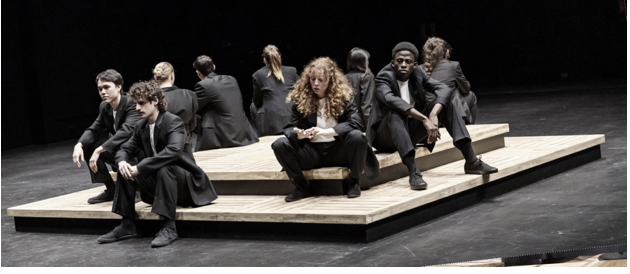
Black Swan State Theatre Company - The Cherry Orchard

Screen Shot 2021-03-02 at 11.47.10 AM.png

 It’s wonderful to see Black Swan return to site specific productions in iconic Western Australian landmarks. The production of The Cherry Orchard at Sunset joins the fondly remembered production of The Mysteries in and around the University of Western Australia. And, the production of Tourmaline at PICA with a young Marcus Graham on a hot sweaty Festival of Perth night. 

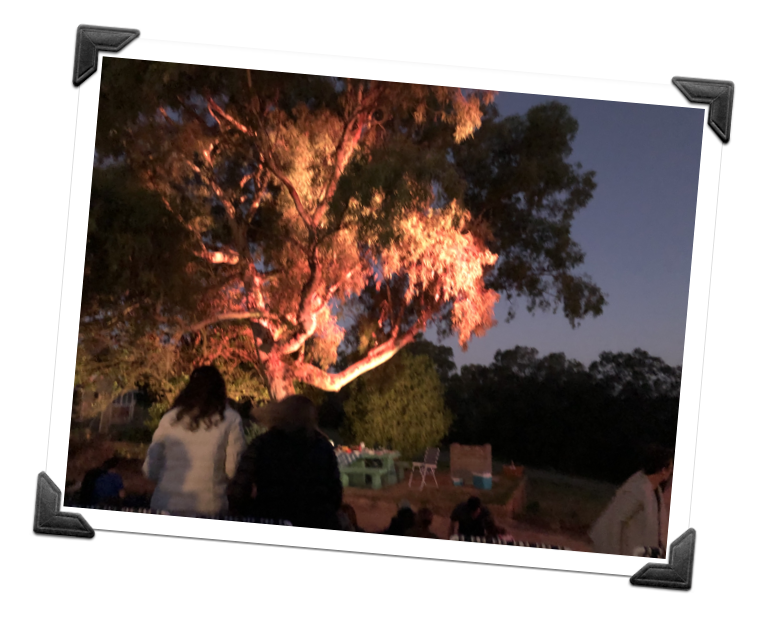
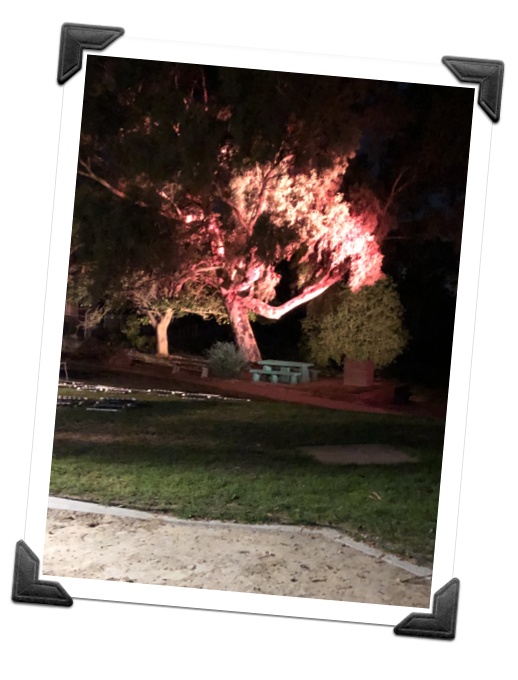
This Cherry Orchard production starts in the main hall (remember a Troupe touring show in there). In Act 2 we move to the breezy outlook overlooking the Swan River at sunset (artfully evoked in the lighting)  After interval with Russian food from a van and iced vodka cocktails, we are at a party in the courtyard. The final act moves into the hall where the seats are now draped with dust sheets and there are a few packing boxes (with a final melancholic reveal of Firs to top the show). 

Screen Shot 2021-03-02 at 11.47.25 AM.png

The decaying ambiance of Sunset evokes the sense of decadent decline of the family. The flaking paint and rusted roofing iron are successful in foregrounding that melancholic Chekhov ennui. In particular, the final act with the bare vast open space of the hall finally managed to give me a sense of loss that I didn’t find in the first act. 


There’s a whole thesis to be written about translating the location and time period of classic plays. At one level, all contemporary productions are transformational, reinterpreting texts for present day audiences. And we can’t forget that we are always working with Chekhov in translation – language and culture. In the first act, the overlay of Chekhov to Manimup in the 1980s seemed forced. The deliberately Kitsch fluffy bedspreads and electric fluoro outfits, the overt hints about sex, drugs and rock and roll and the music, seemed a little calculated and obviously signalled. The first act seemed cluttered. By contrast the sparseness of the final act, resonated  more. Less is more. 


Adaptations and translations are always an irresistible lure for directors. (Having inflicted on audiences a 1960’s Cyrano I can admit the fascination!). It will be interesting to see how audiences react to this adaptation. On opening night I overheard younger audience members enthusiastic about it as they left. 


One of the memorable lessons of visiting Disneyland and seeing how they stage arena outdoor productions is the skill in directing our attention in the moment to moment focus. No matter where the next action or scene was to take place, the audience was directed by action, music, sound and lighting. You knew instinctively where to look, anticipated for you by the direction. More could have been made of that skill in this production. 


The hard working cast handled the spaces well and carried off the fashion crimes of the times. They often had huge spaces to cover with entrances and exits. The hybrid language – sometimes awkwardly caught between Aussie vernacular and Chekhov – was managed though sometimes it grated. Also the improvised scenes (playing with the Casiotone while the audience joined the BBQ outdoors, for example) sit awkwardly alongside the “text”. There needs to be a fine balance between the tone of the original text and modern interpolations. 

In the end, none of the characters were truly likeable – and that bothered me. The familiar bumbling comic work of Sam Longley was sustained throughout. The “victory” speech in Act 3 by the nouveau rich Lopakhin, strongly delivered by Ben Mortley, worked hard to convey a judgement on the hopeless decadence and myopia of the landowner family. The final act farewells finally managed to draw out of me some sense of their loss.  

The use of music to establish mood, time and place was a nostalgia trip for some of the audience. There’s skill in the choices made by directors and how those choices progress characterisation and plot development. Couple of times, particularly in the party scene, the music felt like it padded the action (I know in Chekhov, we are frequently waiting for action through inaction, but sometimes, it felt like truly nothing was happening). Music does more than summon up nostalgia.   

Screen Shot 2021-03-02 at 11.47.55 AM.png

Curiously, in Act 1, the actors were miked but not in Acts 3 and 4. I can understand why it is important to amplify the voices in the outdoor BBQ scene, but in Act 1, the reverb and distortion were off-putting.

As an aside: It was amusing  during the outdoor BBQ scene  at sunset, to see in the distance behind the action a group of kids playing – and then realising that there was something happening in their space. They scuttled off after pointing up the hill to the actors and audience. 

This production sees Black Swan back on song with staging and a strong presence in the Perth Festival. We need more reminders of this thread in the woven DNA of Black Swan.

Screen Shot 2021-03-30 at 10.36.04 AM.png

Encore - March 20, 2021

It’s rare to have the opportunity to see both opening performance and closing night. 

Being at Sunset for Black Swan’s The Cherry Orchard on closing night gives an insight into how performances grow and mature over a season’s run.  Or maybe it could be that my ear had attuned to the vibe of the script. 

The performances are fuller and have more nuanced substance. We see and hear more - or is it just me feeling more comfortable with the construct. 

The kitchiness of 1980s memorabilia still looks tokenistic. But there is a strong recognition factor for. See some in the audience who pause to comment on the placemats. 

Sound amplification in Act 1 better. But I still wonder if it was necessary. 

This time the BBQ scene looking over the river was enlivened by the 7:00pm fireworks over Melville Water.  

There’s still the jarring moments when the wittering small talk about Casiotone whatever kicks into Chekhov. But there is still a question about the interpolated ‘Good on ta Bondy!” And the interjected ’clusterfuck’! I know that we always view Chekhov through the filter of translation, but something is lost not gained. 

The party scene in the Vodka courtyard still has padding – manic dancing to music had attack and verve from the actors but is essentially dead air space in terms of dramatic action. 

The final act in the ruined crumbling house is still powerful in draped dust sheets. 

Screen Shot 2021-03-30 at 10.36.09 AM.png

This time I purposefully chose to see the play from differing perspectives – and it does make a difference in terms of where the action is focused (see my earlier comments about the Disney phenomenon of managing points of focus). 

Seeing a play a second time does allow for closer analysis.

The dual challenges of writing and acting are brought sharply into focus. Staying balanced on the continuum of role/character/caricature – the slippery slope between farce and tragedy – is difficult for writers and actors. How do you make the indolent toy boy more than supernumerary? How do you give even a touch of humanity to that role? And how do you make  the obviously farcical brother or neighbour less shallow and obvious? How do you take the former serf beyond simple resentment translated into revenge? This is a writing problem first. 

Did our opinion or response to Ranevskaya change? In complex characters (as Chekhov showed us) we look for the points in the action where the character’s journey changes, shifts, moves. The trajectory of Ranevskaya in this production seemed to move inevitably in one direction only. Did my emotional response to her predicament shift or change? I said after the first viewing of the production that I didn’t like any these characters and I think maybe I have worked out why.

The art of dramatic writing still goes back to the adage: show me, don;t tell me! In this version we are more often told about things – the loss of her first husband and child. Were we emotionally connected to them symbolically and emotionally? Or were we glossed past them as plot points? This is a writing issue.

It is still wonderful to see Black Swan performing at Sunset. The concept of staging a play around the site is exciting and invigorating (as much as I love going into the velvet hush of the theatre!). Let’s continue to bring excitement into our theatregoing. 

Drama Thinking - Part 3

In Part 1 we unpacked the story itself. In Part 2 we discussed using categories from everyday life and considering different perspectives – personal, social, cultural and historical. This post will develop further drama thinking approaches. 

Screen Shot 2021-02-02 at 11.30.03 AM.png

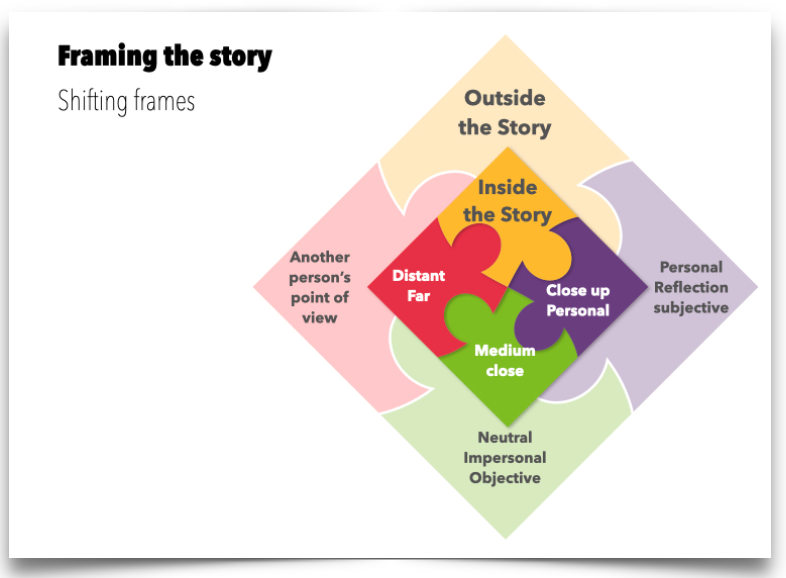
Framing the story Shifting frames 

Linked with seeing the story from different perspectives is to deliberately think about the ways that we can frame the story for our drama exploration.

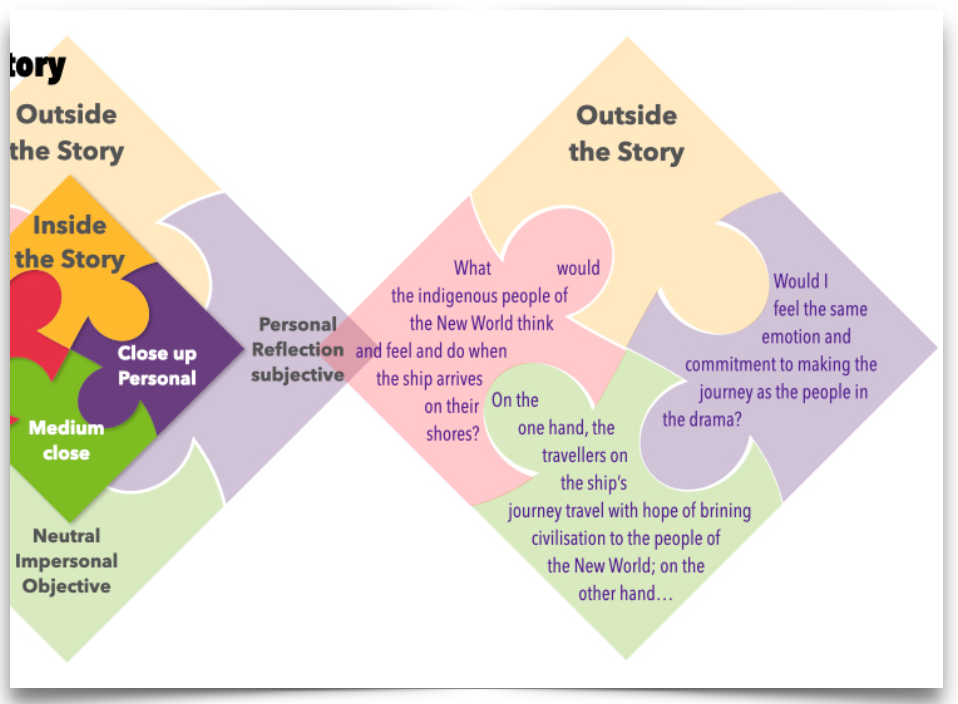
It is possible to frame the story Inside the story where we focus on taking role and acting out situation directly; or we can consider the perspective of being outside the story where we think about the story and its implications for us. 

Both perspectives are important in planning our drama. 

Consider what happens when you frame the story from these different frames or points of view. 


Inside the story you can choose to focus

  • up close and personal

  • stepping back from the up close and personal to see it from mid distance – medium close.

  • stepping right back to see the story from far away.

Screen Shot 2021-02-02 at 11.30.09 AM.png

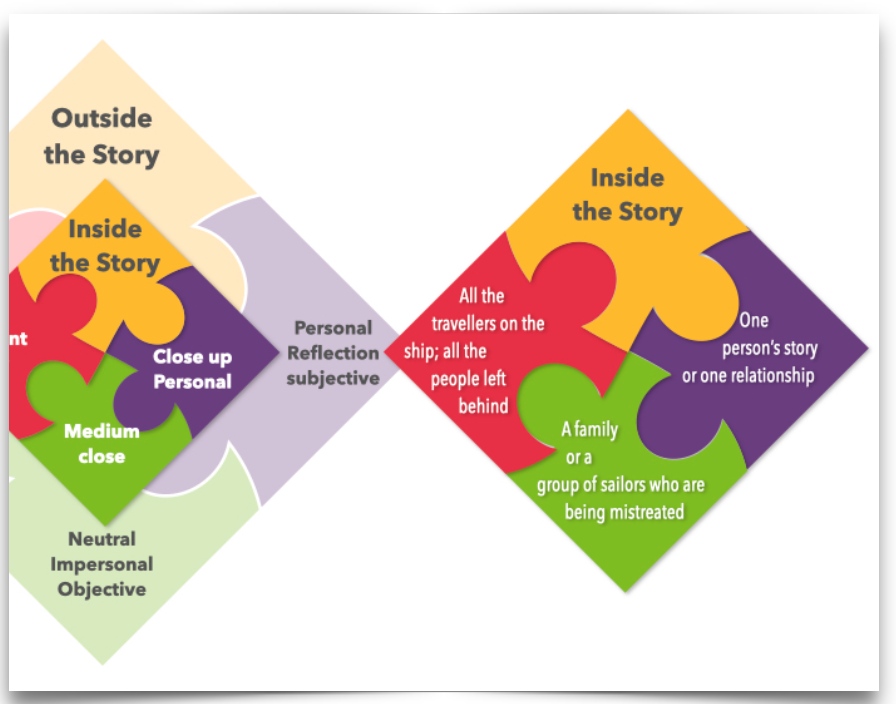
In the example of the travellers on board a ship to the New World, up close and personal focuses on one person’s story or one relationship between two people in the story. Stepping to the mid distance, you might consider all the members of one group, say a family or a group of sailors who are being mistreated. Looking at the story from a distance would focus on all the travellers on the ship.

All of these examples, still have people stepping into specific roles and characters. They are inside the action of the situation and respond to the tension.

Outside the story you step out of role and consider the story from someone looking in on it.  

Screen Shot 2021-02-02 at 11.30.17 AM.png
  1. For example, the personal reflection is a subjective opportunity for you to think about the people and action of the story as an observer. You examine your thoughts and feelings about the story and the dramatic action. You explore your empathy (or antipathy) to the people and situation. For example, would I feel the same emotion and commitment to making the journey as the people in the drama?

  2. Stepping further back from the story to a neutral position enables you to look at both sides of what happens in the story. You are neither for or against but considering the implications of the story with one even hand. On the one hand, the travellers on the ship’s journey travel with hope; on the other hand they are going to a New World where they hope to exploit the natural wealth and make the indigenous people slaves.

  3. The third possibility of a frame outside the story is to consider it from another person’a point of view. What would the people who stay behind when the travellers leave on the ship think and feel? What would the indigenous people of the New World think and feel and do when the ship arrives on their shores?

 A reminder: You do not necessarily have a plan for teaching your drama lesson. The Drama Thinking outlined in this post is a process that hand in hand with an understanding of Drama Teaching and Learning Strategies, enables you to plan your lesson.

There are still more Drama Thinking approaches to explore. 

Drama Thinking - Part 2

In the first part I discussed drama thinking approaches to getting to know and understand the story better. This included looking at the narrative chain – the who, when, where, what happens and why of the story.  A second approach looked at the story in terms of dramatic structure – as suggested by Gustave Freytag. The first drama thinking approach suggested was brainstorming – thematic networking. This post will develop further drama thinking approaches. 

Categorisation of the story in terms of daily lives.

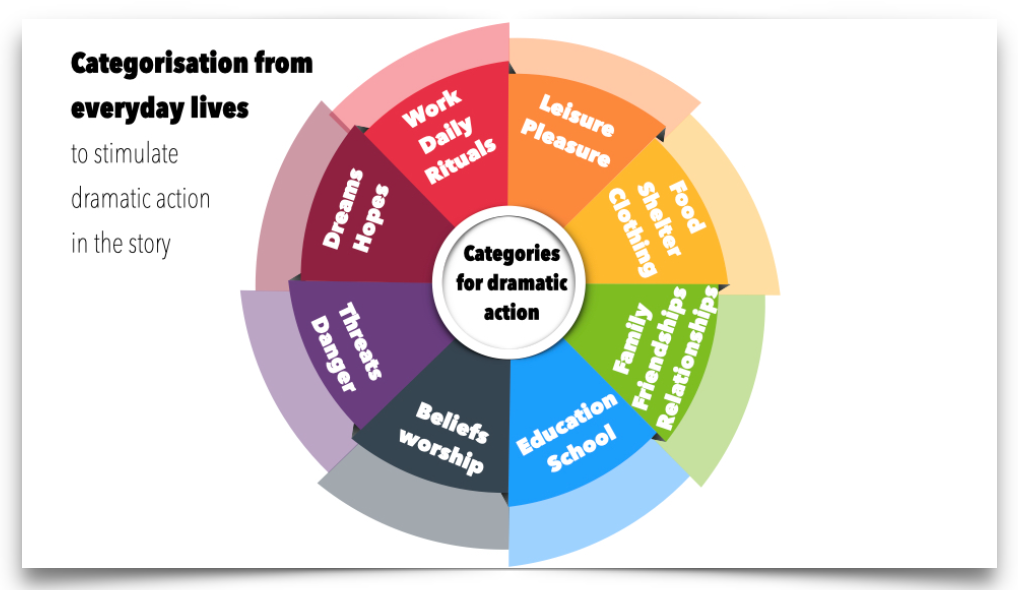
Rather than the free association of ideas in brainstorming or thematic networking, the starting point are experiences  commonly found in everyday lives and asking if this is a source for drama in this story. 

Some categories include:

  • Work and daily rituals

  • Leisure and pleasure

  • Food, shelter and clothing

  • Family, friends and relationships

  • Education and schooling

  • Beliefs and worship

  • Threats and danger

  • Drama and hopes.

There can be other categories too.

Screen Shot 2021-02-02 at 10.46.03 AM.png

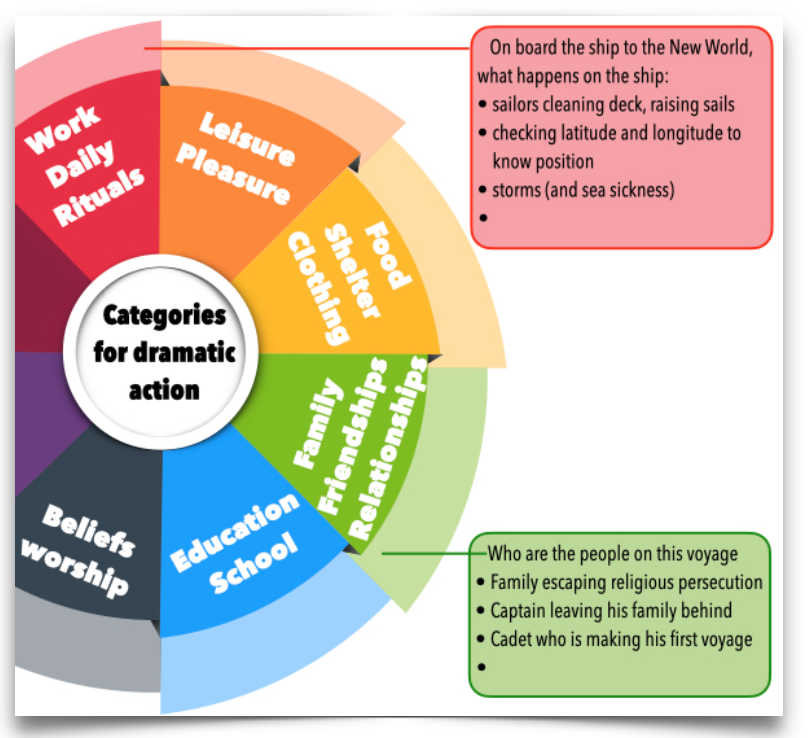
For example, what is the drama in the daily work and rituals of life on board a ship headed for the New World:

  • sailors cleaning deck, raising sails – opportunities for movement and voice

  • checking latitude and longitude to know position – using Mantle of the Expert to reinforce knowledge of the world

  • storms (and sea sickness) – exploring the emotions along with movement, improvisation, etc.

  • not forgetting that there are many other possibilities

A second example: are families, friendships and relationships central to the story?

What are the essential Elements of Drama and potential for tension within the families in the stories? And how do the relationships change during the story?Narrative Structure  of the story

  • Who are the people on this voyage

  • Family escaping religious persecution

  • Captain leaving his family behind

  • Cadet who is making his first voyage

  • There are more possibilities

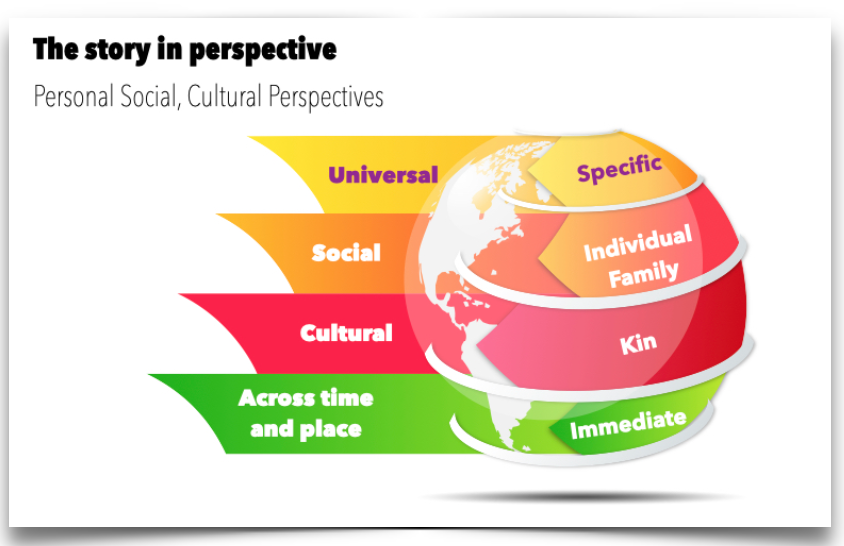
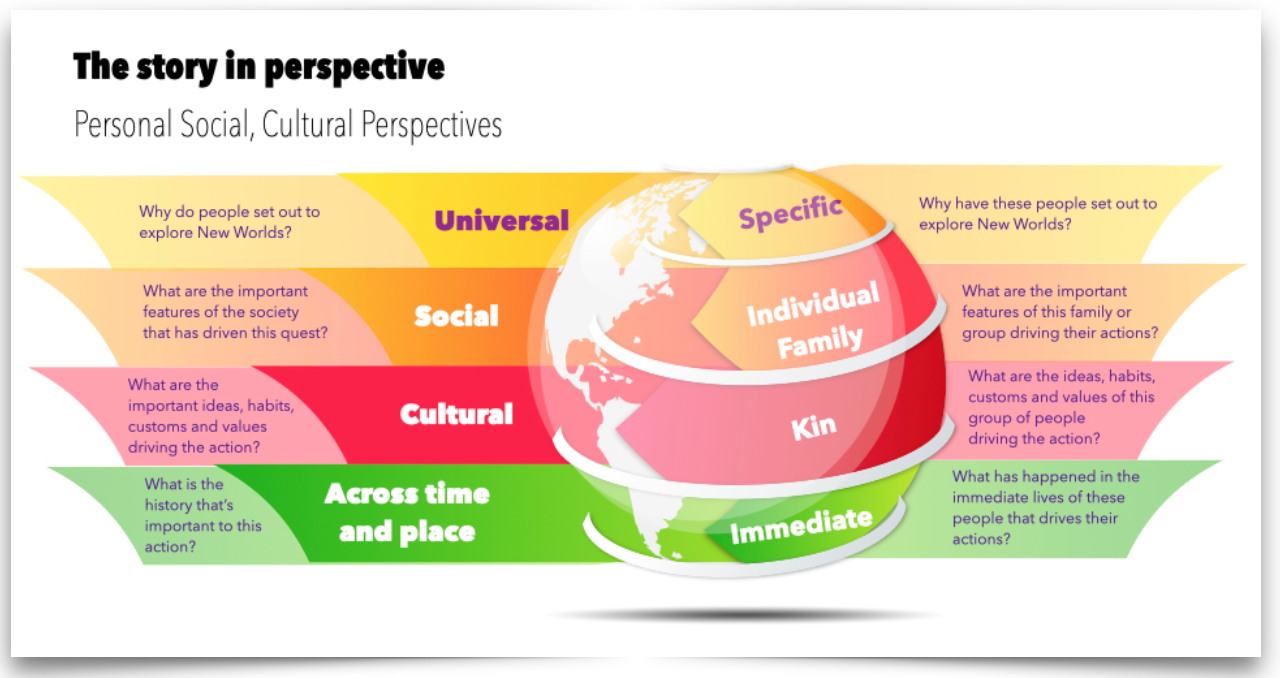
The story in perspective - seeing the story from Personal Social, Cultural Perspectives  

It is possible to think of the story from different perspectives. 

You can consider the relationships between

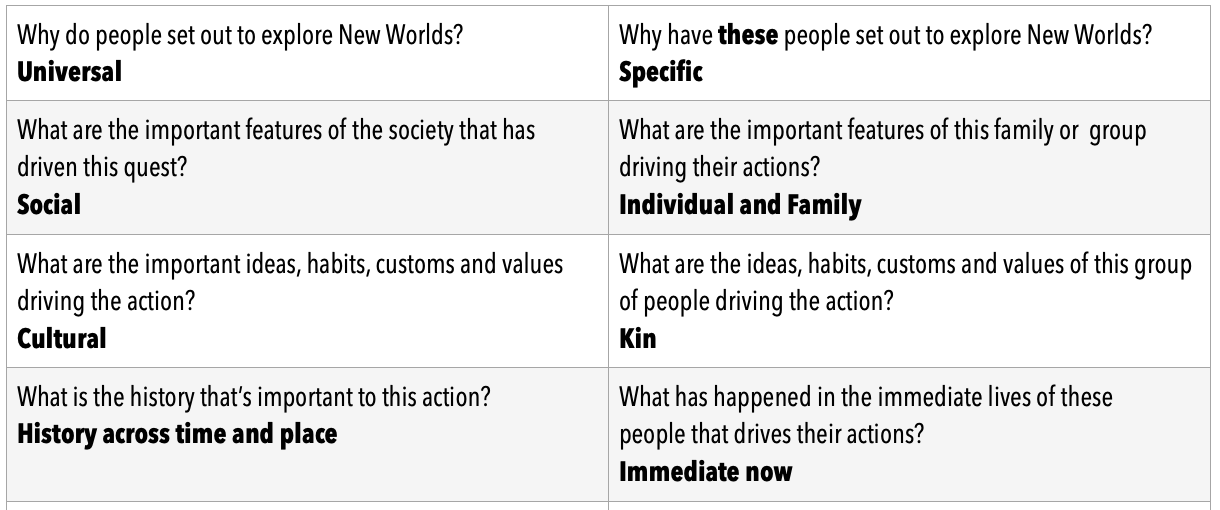
  • the universal elements of the story (how it applies to all people and places) or you can think about the story as very specific to only some people and places.

  • the broader society and the individual or family perspective

  • the cultural – affecting wider ideas, habits, customs and values – or those of a specific group

  • the broadly historical – what happens across time and place – and the immediate and personal history.

Screen Shot 2021-02-02 at 10.46.16 AM.png

The sorts of questions that can be asked about the travellers on board the ship to the new world.

There is caution needed in using terms such as universal or cult. They have specific meanings and are often argued about as theoretical and practical concepts. But it is nonetheless useful to think about these aspects of a story when we are planning our drama workshops. 

This is not yet a plan for teaching your drama lesson. This is a process that hand in hand with an understanding of Drama Teaching and Learning Strategies, enables you to plan your lesson. 

There are still more Drama Thinking approaches to explore.