
Foreman Funnies - Who Knows! Cyranose!

Screen Shot 2021-05-25 at 4.36.15 PM.png

“A great nose may be an index/ Of a great soul”

― Edmond Rostand, Cyrano de Bergerac

Screen Shot 2021-05-25 at 4.36.26 PM.png

Ah, the joys of double casting. 

Every Drama teacher’s nightmare. 

Double the cast, quadruple the work.

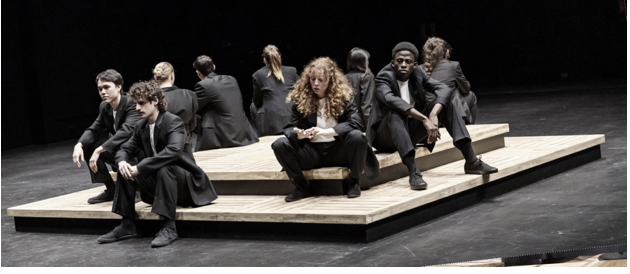
That’s what Robin and I did for our ’86 adaptation of Cyrano. 

Oh yes, and all written in blank verse

Strangely enough after a while I found myself thinking in blank verse.


Cyrano’s nose

Of course, we had two Cyranos. And two very different noses to find/make; one very solid chunk of a Roman nose and one much finer, Nordic nose. 
Screen Shot 2021-05-25 at 4.36.37 PM.png

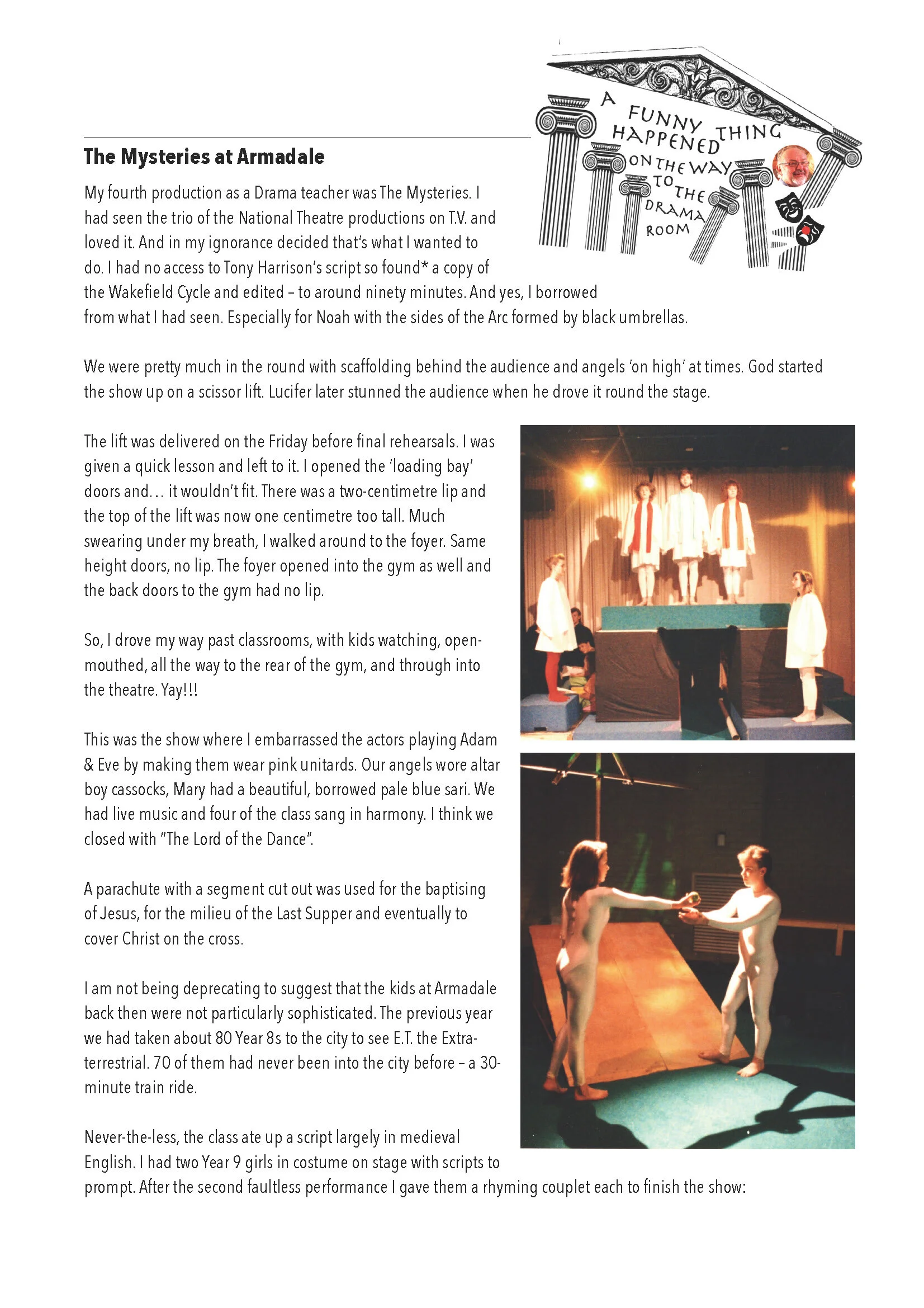
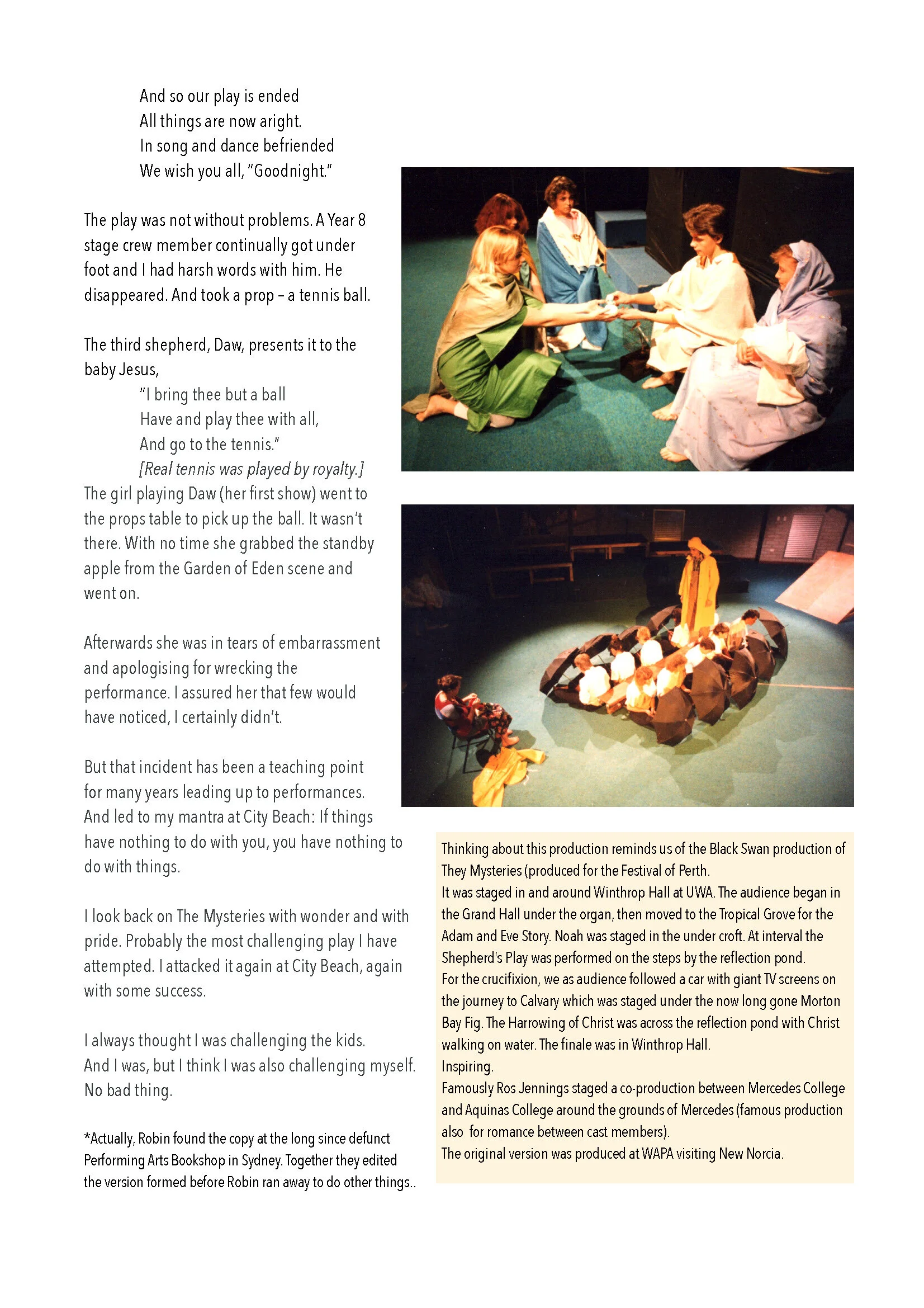
I’d been having fun using plaster of Paris bandage for mask making so I thought, Easy. I made a cast of each one, then filled each clay. Wait for it to dry, peel away the plaster, build up each with plasticine. But then what. I’d been making the masks by layering onto a positive mould. That wouldn’t work for this.

I sourced some cold moulding latex. And had to make another mould of each new nose. And then remove the plasticine. I had never used latex before but lucked out that the first pour worked, and the resultant noses fitted but needed paint and make-up.

Job done. Well, that job done.

Then there was the fight. At the end of Act One. Involving 15 people. 
Screen Shot 2021-05-25 at 4.36.46 PM.png

I’ve since explained to classes that a stage fight is very much a choreographed free dance. Every action and reaction must be carefully planned if it is to be performed over a number of shows. And safely. Each combatant MUST know exactly they are doing and when and where. Relatively easy when it is two people. Toss in the cross interaction between three, six, twelve, fifteen cast members on stage…

Now for cast two!

I swear we spent hours on three minutes of stage time. That three minutes was problematic, too. As the cast worked and re-worked the fight everything sped up. They knew what they were doing. [The cast of Starlight Express – performed on roller blades – cut the running time of performances by fifteen minutes the further into the run they went.]

Not forgetting… the car on stage (It was after all a  ‘Modern’ version)

Oh yeah, and a car on stage. An old Cortina was donated – too long to fit on stage! So, the ‘Shed Men” cat school ut off the roof and cut out the back seat, then welded both halves of our now convertible back together. Painted pink with white-walled tyres, a ‘foxtail’ on the aerial and headlights connected to a battery, it was ready.  

There was no room backstage for it so it stayed onstage, under a black sheet for the first two scenes. Blackout. Sheet removed, rolled forward three meters, lights up… and gasps from the audience. They truly had not noticed it sitting there. 

Screen Shot 2021-05-25 at 4.37.05 PM.png

Drama Tuesday - A Cyrano for the Times

“Take it, and turn to facts my fantasies.”

― Edmond Rostand, Cyrano de Bergerac

An antipodean and retro Cyrano with high school kids

Armadale SHS Production 1986

Armadale SHS Production 1986

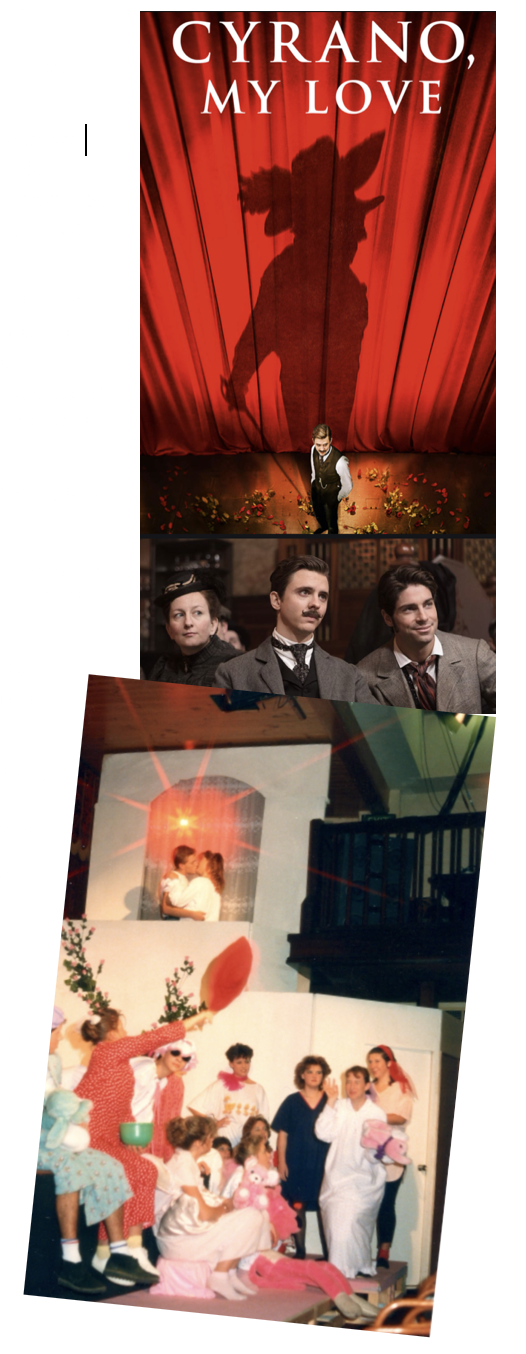
Airing on SBS this week is a delightful recent French comedy film Cyrano My Love (In French released as Edmond).

A fanciful tale of Edmond Rostand “writing” Cyrano in a madcap few days with inspiration gleaned from his actor friend’s love for a costumier; a over the hill actor desperate for a leading role; a chaotic and comedic backstage account of the writing and staging of the play before going on to be a significant success with over 20,000 productions in the 20th Century alone. 

You can take the “historical accuracy” with the pre-requisite pinch of salt. But it doesn’t make it any the less funny. The scene where Edmond improvises (in verse) the famous “nose speech, drawing images and metaphors out of thin air in a backstage walk is delightfully inventive. If you are in anyway familiar with the play (or its many adaptations like the limp Roxanne with Steve Martin) then there are resonances to be milked.

This was a play that celebrated the very theatricality of theatre – the long tradition of the playing within the play. 

But having watched it (when I probably should have been tucked up in bed) I was transported to the production that John Foreman and I did at Armadale Senior High in 1986. 

Who on earth would have thought that it was a good idea to tackle this High Romance from the French Belle Epoch? People must have thought that we had rocks in our head to even contemplate it. But we did it. 

More than that we had the reckless and rash notion of re-shaping the play into a 1960’s setting! And that we would intersperse rock songs throughout (to move the whole 5 act structure along at a cracking pace).

It was an act of hubris (of the kind that drama teachers are so fond of).

But… it did work.

And the students did respond to the text and built their own connections. 

The closing scene with the mortally wounded Cyrano finally revealing his true love for Roxanne was introduced by the melancholy of the Don McLean song American Pie

Screen Shot 2021-05-18 at 5.57.59 PM.png

Something touched me deep inside

The day the music died

Not surprisingly, I am fascinated by these plays about plays. 

I return (as a teacher) to sharing Stage Beauty about the transition point in Restoration Theatre when women were able to take roles on stage. (Directed by Richard Eyre. The screenplay by Jeffrey Hatcher is based on his play Compleat Female Stage Beauty, which was inspired by references to 17th-century actor Edward Kynaston made in the detailed private diary kept by Samuel Pepys.

Of course, there is Shakespeare in Love  with all of Tom Stoppard’s wit.

“- Philip Henslowe: Mr. Fennyman, allow me to explain about the theatre business. The natural condition is one of insurmountable obstacles on the road to imminent disaster.

- Hugh Fennyman: So what do we do?

- Philip Henslowe: Nothing. Strangely enough, it all turns out well.

- Hugh Fennyman: How?

- Philip Henslowe: I don't know. It's a mystery.”

“Cyrano, My Love,” was written and directed by Alexis Michalik, adapting his own acclaimed play,

Like any high school production there were rough edges and some bumpier performances, but what this production did was to open the doors to a kind of theatre that was not harsh realism or Brechtian alienation. It opened minds to theatre seen through the lenses of time and continuity. It opened hearts to how music swells dramatic action. 

It’s a long time since that production – and those actors are now out there in the world with fading memories. The disintegrating paper scripts sit on my shelves slowing dissolving into dust (and who knows where the disc is – or if there is any technology that can possibly read it). But I wanted to remind us as drama teachers that sometimes we need to take bold and huge risks and to step out into the vast planes of imagined possibilities. Too often now I see drama in schools shuttering down; what will maximise the ATAR score thinking. It’s not easy to be bold. It’s risky business to push the boundaries. When it works, it’s worth it.

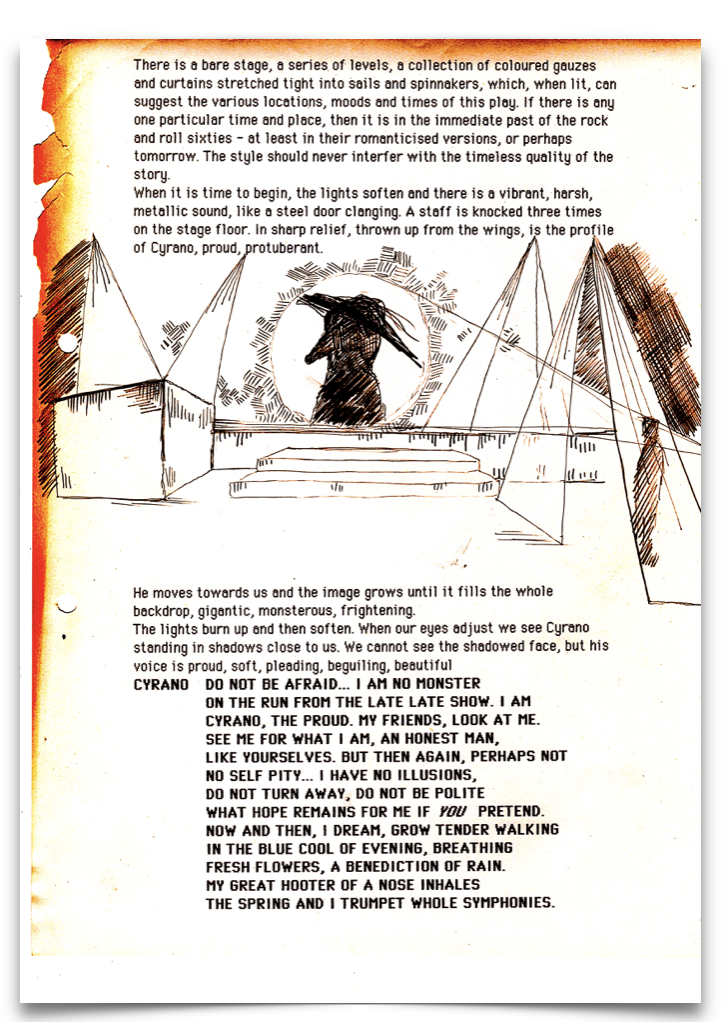
The first page of the script evokes the vaulting ambition of our production.

Screen Shot 2021-05-18 at 6.01.08 PM.png

Now all I have to do is find the images from the production. 

Music Monday - Adrian Adam Maydwell Music Archive

AAMMA.CO

Perth based harpist, choral director, musicologist and collector and researcher of all choral things Renaissance, Baroque and Bolivian, Anthony (Tony) Maywell, has set up a collection of works in memory of his son Adrian, also a musician and singer, who tragically lost his life in a road accident.

There are over 170 works already uploaded and eventually there will be over a thousand.

All are available for free with the only proviso being that appropriate attribution is given in performance. 

This is an incredible gesture from Anthony Maydwell and one which will benefit generations of musicians who love to play and sing this music. Tony writes in a facebook post: 

Adrian loved this repertoire and had opportunity to sing a great deal of it during his lifetime. Faith and I hope this will in a small way keep his memory alive for those who knew him and further an appreciation for the rich experience that can be had from singing and listening to this beautiful music.

Please share details of the site with musician friends.


Drama Tuesday - Why Drama – preparing young people for uncertain futures

 For the past few years I have been working with drama educators in China through keynotes and workshops. IDEC one of the IDEA members located in Beijing has been a wonderful collaborator on the development of interest and enthusiasm for drama teaching. There has been remarkable growth in the field. In May 2021, IDEC are staging another conference (though, of course, limited in the Coronavirus Pandemic). They asked me to talk about ho drama prepares young people for uncertain futures. 

It is useful to go back to our fundamental understandings to remind ourselves of the reasons why we teach drama. 

I share with you the recording I have just finished. Text is included below. 

Whatever it is, the way you tell your story online can make all the difference.

Whatever it is, the way you tell your story online can make all the difference.

The Coronavirus COVID-19 Pandemic has taught us many lessons. One of the most important is being prepared for uncertain futures. We have learnt the importance of the need to respond quickly as circumstances change. Drama teaches us about responding. Drama teaches us about improvising without pre-written scripts. Drama teaches us to focus on what it is to be human in the world.

When our students have authentic opportunities to work with the Elements of Drama, they develop their skills of enacting role and relationships, telling stories creating dramatic action and situations. They understand how tension drives dramatic action using space, and time, voice and movement and symbols, language, mood and atmosphere. The drama they learn and create and respond to develops an awareness of their world and enables them to imagine their futures. 

Drama education provides opportunities for observing and understanding people – including themselves. Through playing these roles and exploring relationships, they understand what it is to be human. This is developing  personal identity. This is a key skill for understanding and engaging with our collective uncertain futures. 

Drama education provides opportunities for trying out possibilities and exploring alternatives. In drama we can stop the action and restart it differently. We can stop the drama and reflect on what happened and what could happen next. Drama gives the chance of playing and replaying action. We can test our futures.

Drama education provides opportunities for entering the world that we live in and exploring it. These everyday stories about ordinary experiences help us understand our sense of personal, social and cultural identity.

Drama education provides opportunities for exploring the choices that we make in life – the ethical choices and the values that we need for a successful future. In learning to express and communicate ideas and feelings through stories enacted for others, our students learn to make choices and learning about becoming good people – people who care for others, show compassion and empathy and understanding. 

Drama education provides opportunities for understanding and sharing emotions. Learning to express themselves and their feelings, helps prepare for a world where it is important to show who we are to the world with honesty and authenticity.  

Drama education provides opportunities for sharing the stories of the past – the ones that have been handed to us over generations. And to understand them for the future as we hand them to our future children. 

Drama education provides opportunities for creativity and play. whatever unfolds in the future, there will continue to be the need for creativity and play. Creativity to imagine and re-imagine possibilities. Play as a context for learning. 


Drama education provides opportunities for learning together and building teams collaborating

To summarise some of the big ideas of this presentation, drama gives us opportunities to rehearse the past and present for the future.

There has been a long history of “future thinking” – thinking about the skills needed for the future. 

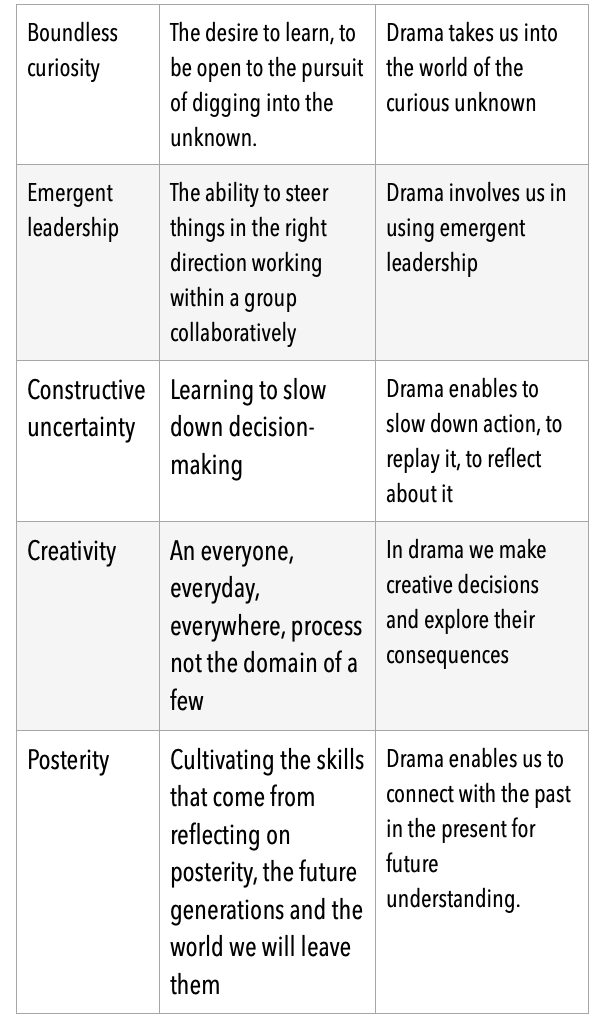
Writing in 2018 before the Pandemic, Stowe Boyd identified 10 Work Skills for An Uncertain Future.

I share some of this this work with you to make the point that Drama education can and does develop these skills. 

Screen Shot 2021-05-10 at 8.01.59 PM.png

To this list we can add that drama helps us respond to the uncertain futures through developing our skills in:

  • responding to people, relationships and situations - drama is action and response

  • problem solving – Drama is active problem solving

  • working together collaboratively for shared goals – Drama is team work

  • creative and critical thinking – Through Drama we ask questions and work creatively


We are not alone in seeking to re-imagine the world of learning for uncertain futures. As we meet in 2021, UNESCO is in the midst of project of magnitude that we should pay attention to. And we need to remind the decision makers and policy makers of the role of drama in educating for the future.


The playwright Shakespeare had Hamlet provide famous advice to players in hamlet prince of Denmark. There is good advice there for us to share with our students – don’t weave your arms around too much; don’t shout your lines; Suit the action to the word, the word to the action. And at the heart of drama education is his advice 

“the purpose of playing, whose end, both at the first and now, was and is, to hold, as 'twere, the mirror up to nature”.

We don’t know what the future will bring – some things good, some things uncertain. But we will always have drama as a powerful way of holding the mirror up to what we see. 


Thank you for the opportunity to talk with you today. 

I am a proud advocate for the power of drama to enrich and enhance the lives of young people.I encourage you to be the voice and action of drama education in your world. It changes the lives of all who participate. 

You can find more of my thoughts and ideas at www.stagepage.com.au 

and through IDEA www.ideadrama.org 

Thank you for listening. 


Bibliography

Boyd, R. N. (1988). How to Be a Moral Realist. In G. Sayre-McCord (Ed.), Essays on Moral Realism (pp. 181-128). New York: Cornell University Press.

Music Monday - Composing music at age 70.

This weekend our family celebrated a milestone for Robin Pascoe – he turned 70. In many ways it is hard to believe – he is still teaching and writing (words, not music) at the same energetic pace. 

But the calendar does not lie, and the mirror also gives the occasional brutal clue as well!

As we reminisced over his three score years plus ten, I found myself thinking of my favourite composers. Sadly, many did not make 70; however, I did find four favourites who published works at 70 or above.

  1. Stephen Sondheim (1930-) Bounce written in 2003, later retitled Roadshow in 2008.

  2. Olivier Messiaen (1908-1992) Saint-Francois d’Assise, Opera in 3 acts, written between 1975-83.

  3. Aaron Copland (1900-1990) Wrote Night Thoughts in 1972 for the Van Cliburn International Piano Competition

  4. Richard Rodgers (1902-1979) Two By Two (1970), Rex (1976), I Remember Mama (1979)

Can you add to this list? Please do so in the comments section below.


Music Monday - What will a post-Covid world look and sound like?

Back in February I attended a Perth fringe show featuring an opera singing friend and his soprano performance partner. While waiting in line to go in, our friends chatted about how lucky we were to live in such a remote capital city as Perth, where our annual fringe festival went ahead as usual. We laughed that the aspect of Perth that has always been perceived as its greatest disadvantage; namely its distance from other cities (it’s about as far as you can get from New York, for example), was in these strange new times, flipped to be perceived now as an advantage.

During the show, the soprano, who had migrated to Australia 20 years ago, commented that she would never have dreamed at the time she left a career in London, that 20 years later there would be more work for a singer in Perth, Western Australia, than in the UK or USA.

And this week, a player in WASO (Western Australian Symphony Orchestra) – not a large outfit by world standards – reported that, based on the statistics for the past 12 months, WASO was the busiest orchestra in the world. 

Strange times indeed.

I know of a music theatre performer, last engaged in a Broadway show which shut down at the start of the pandemic in 2020, who has retrained as a visual artist.

And only yesterday, at an ANATS (Australian National Association of Teachers of Singing) meeting, a colleague spoke of her friend and colleague in Scotland, a school music teacher, who has not been permitted to sing with her students, nor allow them to sing in class, for a year.

As the world now moves into the vaccination phase of the pandemic, and people become safer to start resuming a new normal, how will that look and sound for you?

For me, I have become much more tech-savvy over the past year – definitely through necessity rather than natural inclination. I think I have also learnt gratitude.

As I so often write on this blog, we are beyond lucky in Australia.  Our total number of lives (sadly) lost has been 900 rather than millions and our lockdowns (even taking into account the 100-day lockdown in Melbourne) have been minimal by world standards. I think we have all learned to be a bit more grateful.

Right now, Perth is in a week of additional restrictions. (We had 3 cases last weekend.) Until 8th May we have to wear a mask outside our home. Because we have been so spoilt, it feels uncomfortable and annoying. At the start of a singing lesson on Friday I asked a student how she was feeling about her mask. She said, “Every time I put it on, I think that it is a reminder to be grateful.” Wise words. 

There is no doubt that the music industry across the world, and even in Australia, has been hit hard by Covid. Where sporting events with thousands of spectators have often been allowed to go ahead, music venues have always been shut down. It was encouraging that our state government made a snap decision to close a football game to spectators yesterday (45,000 had been estimated to attend). If the risk is one of aerosol transmission, then 45,000 cheering supporters must be more risk than hundreds of seated patrons listening to music?

How do you see your world of music in the months and years ahead?


Drama Tuesday - Stirring the embers

Part Two - where have all the flowers gone?

Screen Shot 2021-04-20 at 8.42.07 AM.png

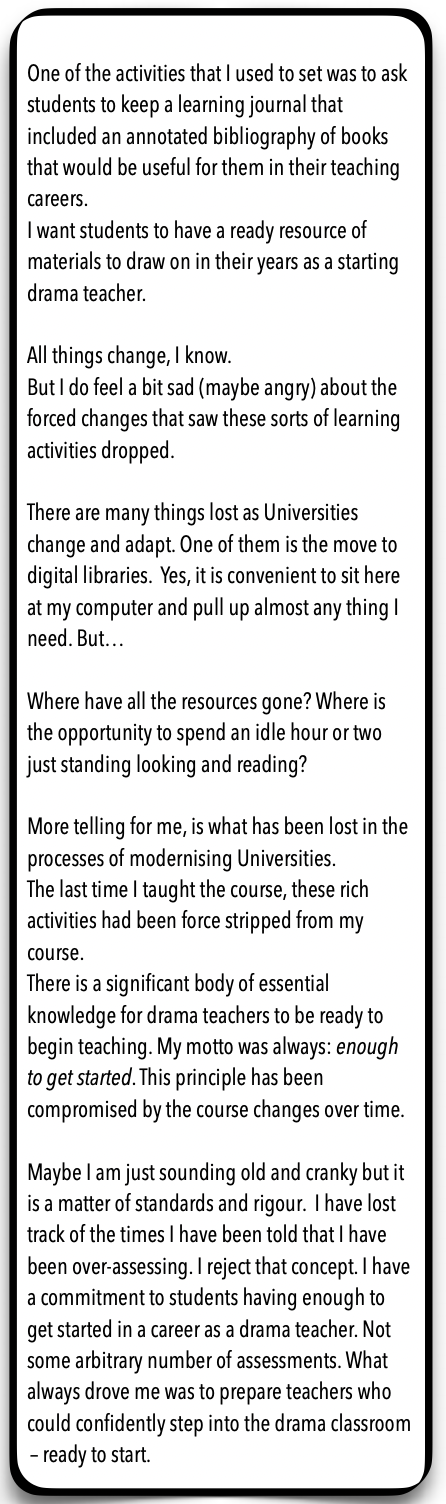
One other observation from all this sifting through the embers of a teaching career is to think deeply about what we need in order to be ready to teach drama. One of the necessary conditions is to have a swag bag of resources – a repertoire of practice to draw from.

Resources for teaching drama is one key.

Now, I have too many books. I know. A lifetime of collecting and learning and teaching.  And it is  a pain at this point in my life trying to wrangle them into some sort of order.

I will have to discard some of them. I am reminded about the old Jewish invocation against burning books. I also feel bad about consigning them to landfill and dust. But there is something to value in this collection.

There’s a Peter, Paul and Mary song from my adolescence:

Where have all the flowers gone?

Long time passing.

I am thinking about this as I write after spending a morning going through files that I have brought home from my office when I retired at Murdoch. I want to sing:

where have all the resources gone?

One of the unspoken pleasures of an inquisitive mind, is to stand at a bookshelf in a library or in a book store, and to just scan the titles available, looking for something new. It’s reassuring to reaffirm what you know is available, but also to discover new titles and writers. There is a physical pleasure of handling books. 

Maybe it tells something about me and my ways of engaging with knowledge. Knowing is a part of being (my epistemology is my ontology)

As I scanned former students’ annotated bibliographies I was reminded about how rich a vein of gold can be found in what has been written and published about teaching drama. Apart from dusty shelves like mine,  where are they all now? And how much impact have they had?

Part of me asks about all that history of drama teaching publishing: why isn’t there more evidence of impact in everyday schools? Part of me simply celebrates that there is knowledge shared. 

Anyone want to come and look at my bookshelves and share the knowledge there?

Music Monday - ANZAC Day

On the eve of the Anzac Day long weekend last Friday, Perth, and one regional area, Peel, in Western Australia, were plunged into a snap lockdown for the weekend, after a case of community transfer of the more contagious Covid variant. It came as complete surprise to us all, as we have been covid-free for months now. 

As many music teaching friends went about cancelling their bands’ and choirs’ attendance at Anzac Day ceremonies on Sunday (all public events were cancelled) I couldn’t help but reflect on my post from last Anzac Day. As the rest of Australia held ‘normal’ Anzac ceremonies on Sunday many Perth households revisited the tradition started in 2020.

Here’s the post from last year – I refrained from calling it the Last Post!

Anzac Day 2020 was like no other before it in the many years since 1915.

In Australia, with gatherings banned due to covid-19, the usual services and parades were cancelled  - except for one at the Australian War Memorial in Canberra attended by only the few dignitaries who conducted it, telecast to the nation..

Instead, at the tops of suburban driveways across the country, Australians gathered just before dawn, holding lighted candles, and sometimes waving to acknowledge their neighbours without approaching or speaking to them.

 In quiet reflection Australians remembered their Anzacs  - and all who have suffered and perished in war – and as the skies softly lightened with the dawn, the morning chorus of magpies and crows was augmented by players of music – student brass players, music teachers, amateur and professional musicians and singers – each contributing to an extraordinarily moving tribute.

On my own driveway I could hear from the next street the hesitant sounds of a student trumpeter playing “Lest We Forget”. Further away there was the faint sound of the Last Post with its tricky high notes for beginner players. 

In the couple of days since Saturday the papers have carried letters from Australians suggesting that the dawn driveway tradition be kept and commenting on how moving it was to have their own silent contemplation accompanied by the sound of live music. My music teacher friends as well as non-muso neighbours have all said much the same.

Music is SO important in our many life rituals. When we work on the tedium of music theory, or teaching the singing and playing of scales, it is worth remembering how important our job is. We are contributing in our way to the rich tapestry of our country’s unique culture.