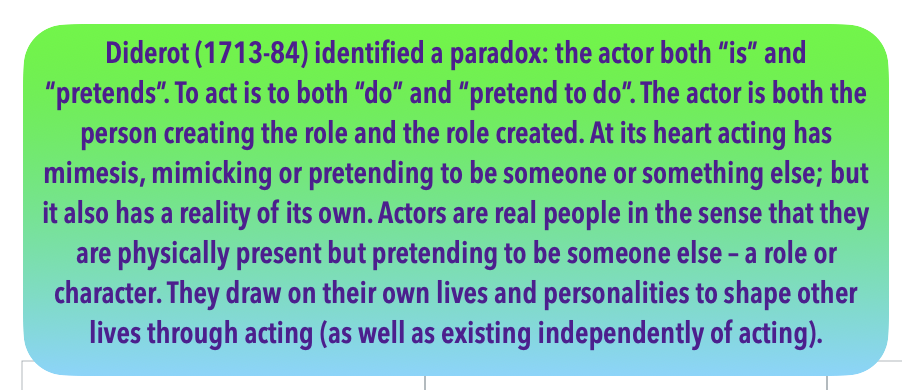
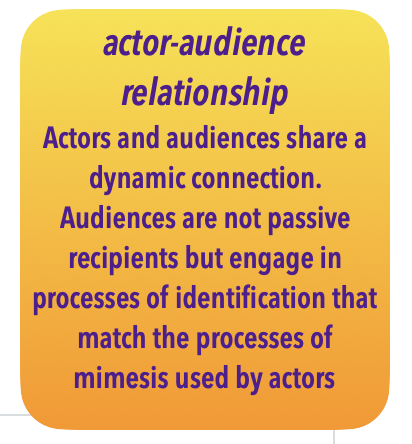
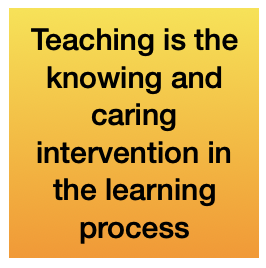
But you can sum up all these ideas:
Memorable Drama Teachers know their stuff… They get their act together and take it on the road everyday…
Bibliography
Borko, H., & Putnam, R. T. (1995). Expanding a teacher’s knowledge base: A cognitive psychological perspective on professional development. In T. R. Guskey & M. Huberman (Eds.), Professional Development in Education. New York: New York: Teachers College Press.
Bresler, L. (2004). Knowing Bodies, Knowing Minds - Towards Embodied Teaching and Learning. Dordrecht: Kluwer Academic.
Bruner, J. (1990). Acts of Meaning. Cambridge, MA: MIT Press.
Bruner, J. (1991). The Narrative Construction of Reality. Critical Inquiry, 18(1), 1-21. Retrieved from http://www.jstor.org/stable/1343711
Desimone, L. M., Porter, A. C., Garet, M. S., Yoon, K. S., & Birman, B. F. (2002). Effects of Professional Development on Teachers' Instruction: Results from a Three-Year Longitudinal Study. Educational Evaluation and Policy Analysis, 24(2 (Summer 2002)), 81-112. Retrieved from http://www.jstor.org/stable/3594138
Dewey, J. (1938). Experience & Education. New York, NY: Kappa Delta Pi.
Eisner, E. W. (2002). What can eduction learn from the arts about the practice of education? John Dewey Lecture for 2002, Stanford University. Retrieved from www.infed.org/biblio/eisner_arts_and_the_practice_or_education.htm . Last updated: April 17, 2005.
Franke, M., Fennema, E., & Carpenter, T. (1997). Teachers creating change: Examining evolving beliefs and classroom practice. In E. Fennema & B. Scott-Nelson (Eds.), Mathematics teachers in transition (pp. 255-282). Mahwah: Lawrence Erlbaum Associates.
Greene, M. (1995). Releasing the Imagination: Essays on Education, The Arts and Social Change. San Francisco: Jossey-Bass.
Grumet, M. (2004). No one learns alone. In N. Rabkin & R. Redmond (Eds.), Putting the Arts in the Picture: Reframing Education in the 21st Century, (pp. 49–80). Chicago, IL: Columbia College Chicago.
Guskey, T. R. (1986). Staff development and the process of teacher change. Educational Researcher, 15, 5-12.
Guskey, T. R. (2002). Professional development and teacher change. Teachers and Teaching: Theory and Practice, 8, 381-391.
Guskey, T. R. (2003). Scooping up meaningful evidence. Journal of Staff Development, 24(4), 27-30.
Morocco, C. C., & Solomon, M. Z. (1999). Revitalising professional development. In M. Z. Solomon (Ed.), The diagnostic teacher: Constructing new approaches to professional development (pp. 247-267). New York: Teachers College Press.
Peters, M. (2004). Education and the Philosophy of the Body: Bodies of Knowledge and Knowledges of the Body. In L. Bresler (Ed.), Knowing Bodies, Moving Minds - Towards Embodied Teaching and Learning. Dordrecht: Kluwer Academic Publishers.
S.Garet, M., Porter, A. C., Desimone, L., Birman, B. F., & SukYoon, K. (2001). What Makes Professional Development Effective? Results From a National Sample of Teachers. American Educational Research Journal. doi:https://doi.org/10.3102/00028312038004915
Shulman, L. (1986). Those who understand: Knowledge growth in teaching. Educational Researcher, 15(2), 4-14.
Virginia Richardson. (October 1990). Significant and Worthwhile Change in Teaching Practice. Educational Researcher, 19(7), 10-18. doi:10.2307/1176411
Vygotsky, L. S. (1978). Mind in Society: The Development of Higher Psychological Processes. Cambridge, MA: Harvard University Press.
Wenger, E. (1998). Communities of practice: Learning, meaning, and identity. Cambridge: Cambridge University Press.