
Drama Term Tuesday #9

Tension

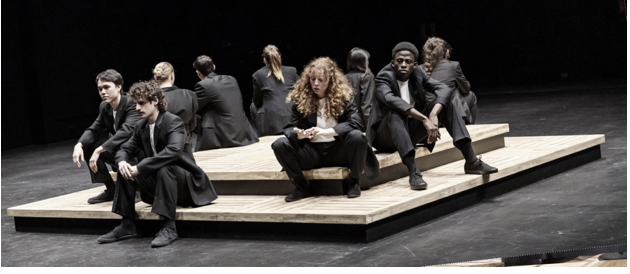
Dramatic Tension

Conflict

Sense of strain, excitement, anticipation or suspense used to animate and sustain interest and forward movement in drama.

Obstacle for a character to overcome.

A sense of ‘what’s at stake’ in a particular dramatic situation. Tension and dramatic tension are sometimes used interchangeably with conflict but the concept is more than simple arguments or differences of opinion.
Excerpt from Drama Key Terms and Concepts

Media Term Thursday #8

Japanese New Wave

A movement of Japanese filmmakers from the late 1950s to the early 1970s who brought a new creative burst in response to traditional Japanese cinema. They challenged traditional mainstream themes and values, and experimented with film styles and conventions to produce work that used sexual violence, radical politics and the aftermath of World War 2.


Examples are Crazed Fruit (1956), Black Sun (1964) and The Blind Beast (1969).

Excerpt from Media Key Terms and Concepts

Drama Term Tuesday #8

Theatre of the oppressed

T.O.

Brazilian director Augusto Boal (1931 - 2009) developed a method of forum theatre for, about and by the oppressed, who act as “spect-actors” (rather than spectators) to examine and change the existence in which they live, through drama.

Boal’s key practices:

  • Forum theatre

  • Image theatre: where the “spect-actors” are asked to sculpt their bodies and other participants’ bodies to create images (tableaux) representing particular situations, emotions or ideals. Boal encouraged the images to be created spontaneously so as to articulate raw emotions and ideas.

  • Invisible theatre: where a rehearsed play is performed in a public space without the public knowing that they are seeing a performance. This form was used to focus on social themes and to incite debate within society.

  • Legislative theatre: similar to forum theatre except the theme of the drama is based on local government.

  • Newspaper theatre

Extract from Drama Key Terms and Concepts

Music Tip Monday #6 - Vowel Shaping

Vowel Shaping

The 5 cardinal (Italian) vowels used in singing classical and music theatre legit styles

Whether you are a solo singer, teacher, chorister or choir director, it is useful to practise correct vowel shaping for the style you are singing.

Today we look at the more classical shaping used in classical vocal music as well as legit music theatre styles.

  1. i (think the vowel in ‘bee’): tip of the tongue rests gently on the back of the lower front teeth; the sides of the body of the tongue are higher and touching the upper back molars. This vowel has a bright, forward sound quality. The lips remain relaxed – not spread.

  2. e (think the vowel in ‘egg’): tip of the tongue rests gently on the back of the lower front teeth; the sides of the body of the tongue are still high and resting on the upper back molars, though very slightly more relaxed away from the teeth than in the i vowel. This vowel has a bright, forward sound quality. The lips remain relaxed.

  3. a (think the vowel in ‘bar’): tip of the tongue rests gently on the back of the lower front teeth; the tongue body relaxes gently down into the floor of the mouth (never press or push the tongue down). The soft palate rises, giving this vowel a rounded, spacious sound quality in classical and legit singing. The lips remain relaxed.

  4. o (think the vowel in ‘lot’): the tip of the tongue moves very slightly away from the back of the lower front teeth and the lips pout forward, shaping the vowel.

  5. u (think the vowel in ‘look’): the tip of the tongue very slightly away from touching the back of the lower front teeth and the lips pout forward into a pucker to shape the vowel.

Media Term Thursday #7

Music Video

Video Clip

A short film of video that accompanies a song.

Music video content varies and includes: the musicians performing (or lip synching) the song, live concert footage, animation or other imagery, a visual narrative.

Music videos are made as marketing devices to promote the sale of CDs.

Typical elements of music videos: usually three to five minutes long, use quick cuts, highly stylised, use spectacular imagery, sex appeal and lots of special effects.

Music videos are subject to censorship if their content is deemed too offensive. As censorship laws differ from country to country, record labels will often supply censored and uncensored versions of the video. It has been known for music videos to be banned in their entirety for being too offensive to broadcast.

Excerpt from Media Key Terms and Concepts

Drama Term Tuesday #7

Historification

A convention favoured by Brecht, which uses historical events to comment on events of the present.

The technique is used to alienate the audience from emotional identification and as such have a greater didactic impact.

See also A-Effect/Alientation, Brechtian Drama, Epic Drama

Excerpt from Drama Key Terms and Concepts

Music Tip Monday #5 - Useful Apps for Singing Teachers + Singers

Liz recently attended an excellent ANATS WA event on contemporary singing presented by Perth singer and teacher Liyana Yusof. Liyana referred to some of the many phone apps which are useful to singers, singing teachers and music teachers in general.

How many of these do you use?

Perfect Piano -  free – for those times when you need a keyboard on the run

Shazam – Free – for identifying songs you hear in the car, at a concert and elsewhere and think they could be useful in class

Spotify – Free  - with a premium version at $9.99 per month

YouTube – Free – for playing examples of music performances to your students. A great aid when paired with a mini speaker.

Pro Metronome- free – can be used to provide beat when practising rhythms and rhythmic patterns in class, as well as setting the speed for a performance.

Voice Recorder / Voice Memo function on your phone – ideal for recording rhythms, melodies and other practice tracks for students.


Drama Term Tuesday #6

Victorian Drama

Notable for technical innovation but is tended to be dismissed for its approach and content. 

During the reign of Queen Victoria which covered most of the 19th century, English drama showed the ascendancy of actors and managers and the lowering of the status and importance of playwrights. There was a move to entertainments and popular theatre forms such as music hall and a preference for melodrama, domestic tragedy and sentimental comedy. 

Excerpt from Drama Key Terms and Concepts

Media Term Thursday #5

Key Grip

The foreman of the grip (labourers) department. The Key Grim is in charge of a crew of grips who all have specialised skills such as mounting cameras, cranes and lighting design.

The key grip is also often the safety monitor on a film set and is responsible for the safety of all personnel on the set from situations or devices operated by other departments.

Excerpt from Media Key Terms and Concepts