
Music Musing Monday - Choral Singing

Yesterday I helped out at the Western Australian Public Secondary Schools’ Choral Festival. This is an annual event organised by the Instrumental Music Schools Services in the Department of Education. Many of my voice teaching colleagues and friends were there with their choirs.

Choir directing has not featured much in my long teaching career. Once, long ago, I directed a church youth choir, and I have certainly sung my share of Messiahs and other major choral works in choirs over the years. But my direction of any large group of singers has mostly been as a vocal coach and MD for musicals.

Yesterday as I sat listening and watching, I was struck by the special bonds which so clearly existed in almost all of the choirs and ensembles. The singers clearly loved performing together and were proud to take ownership of their work. 

The groups ranged in size from four to around one hundred and in age from grades 7 to 12. Nearly seven hundred singers took part over the day. 

The vocal styles covered folk, religious, indigenous, pop, gospel, classical and music theatre. Some of the performances featured simple choreography and I was again reminded of the benefit to our brains of combining music and movement. (I also remembered back to the 1980s when ‘choralography’ was first seen as a trend in the USA and was regarded by many Australian choral purists as something to be avoided here at all costs!)

Where am I going with this?

Well, in this time of parents seeking private singing teachers for their children at younger and younger ages – and at considerable cost – they might be better advised to ensure that their child joins a choir. There the basics of good breathing and fundamental singing techniques can be learned, along with musicianship and reading skills and most importantly, working as an ensemble with other like-minded children. Solo vocal lessons can wait a year or so.

Of course, this all comes at a cost to the choir directors who work tirelessly to rehearse, to strive for detailed and polished performances, as well as attend to the myriad paperwork involved with taking students out to choral festivals.  My colleagues were clearly exhausted at the end of the day. But it was so worth it for the students and the audience.

As I watched a group of year 12 students thanking their choir director (and secretly shedding a tear that this was their last choir performance before graduating high school) I was filled with admiration for choir directors world-wide.

Drama Term Tuesday #15

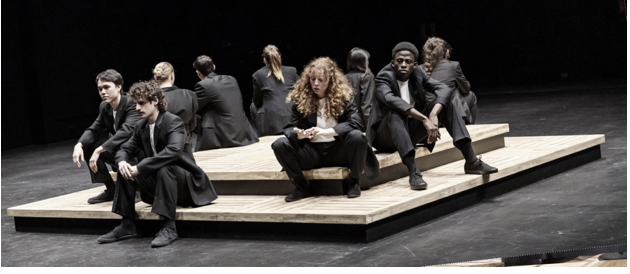
Willing suspension of disbelief

Phrase coined by Samuel Taylor Coleridge to describe the conscious acceptance of the illusion or unreality of drama by audiences; although it is clearly an actor on a performance space, members of audences suspend or hold at bay their scepticism or sense of reality in favour of believing the imagined dramatic action.

Excerpt from Drama Key Terms and Concepts

Devising Performance through Process Drama

After a workshop in Zhuji at IDEA IDEC Regional Drama Education Conference, introducing participants to using process drama strategies to teach drama, I received an email from one of them: I understand how you might use process drama strategies as one-off activities or lessons. but how does that help me meet the expectations of my school and parents for a performance as a result of the drama classes?

What is Process Drama?

Process Drama is a method of teaching and learning drama where both the students and teacher are working in and out of role (definition from the Australian Curriculum: The Arts, https://www.australiancurriculum.edu.au/f-10-curriculum/the-arts/Glossary/?term=process+drama.

Process Drama is a term coined by John O’Toole, Cecily O’Neill and others to describe contemporary dramatic explorations – most often in an educational setting – based on extended connected improvisations and structured through a sense of theatre and drama structures and traditions.

Initiated through a powerful pre-text process drama, like improvisation, creates a “dramatic elsewhere”, a fictional world but one that is inhabited for insights, interpretations and understanding of participants rather than audiences.”

Excerpt From: Robin and Hannah Pascoe. “Drama and Theatre Key Terms and Concepts.” iBooks.

Why is it a powerful way of learning drama?

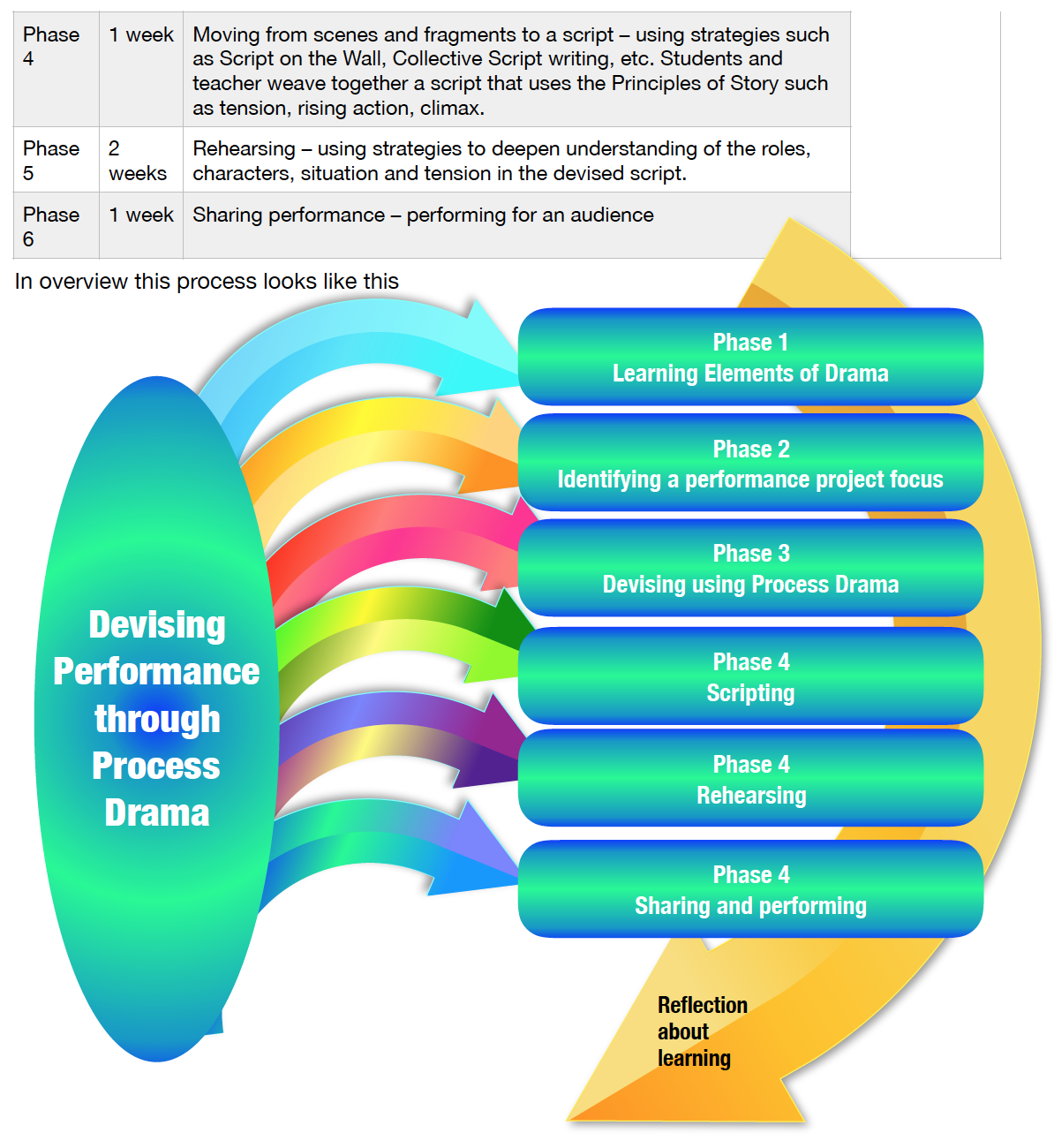
Process Drama is a way of helping students know and learn drama by participating in drama processes themselves – by embodying drama through engaging their thinking, emotions and physical selves. It is one powerful way of students learning in practical ways the Elements of Drama, the Principles of Story, the skills and processes of drama performance and production.

In Process Drama teachers and students use a range of drama learning and teaching strategies such as Role on the Wall, Hot seating, etc. They are tools, fundamental building blocks that help students understand how we can create, first of all, moments of drama. They then learn how to craft those moments into dramatic sentences and paragraphs and shape them into a devised performance involving scripting, rehearsing and sharing for an audience. You can find more about Drama Learning and Teaching Strategies in Learning Drama Teaching Drama (Pascoe and Pascoe 2014).

Devising using process drama is a more complex drama strategy. It is sometimes called Play Building.

In overview, a teacher can develop a term or semester long program involving:

Screen Shot 2019-08-01 at 11.26.57 AM.png
Screen Shot 2019-08-01 at 11.26.49 AM.png

You can find more about devising and play building in Building Plays Simple playbuilding techniques at work (Tarlington and Michaels 1995)

Bibliography

Pascoe, R. and H. Pascoe (2014). Drama and Theatre: Key Terms and Concepts (3rd Edition). Perth, StagePage.

Tarlington, C. and W. Michaels (1995). Building Plays Simple playbuilding techniques at work. Markham, Ontario, Canada, Pembroke Publishers/Heinemann.

Media Term Thursday #14

Romantic Comedy

A film genre that deals with romantic mishaps and mismatches in a humorous way.

A basic plotline:

Despite obvious attraction, the would-be-lovers do not become romantically involved. After various comic scenes (social interactions laden with sexual tensions), they are parted, then realise they are made for each other, meet again and live happily ever after.

Excerpt from Media Key Terms and Concepts

Music Tip Monday #10 - Scale patterns

Why do choir directors and singing teachers so often play warm-ups in major scale patterns?

Have you ever noticed that singing warm-ups nearly always exist in major scale patterns? Why is that the case?

Some singing and music teachers have told me that because they are not keyboard experts, they feel most comfortable playing in 5 note major scale patterns. And that is okay, except that it reinforces the same sequence of whole and half step intervals (tones and semitones) in the ear of the singer. And then when that singer does a music exam where other scales are required as part of the technical work, more complex scales like the chromatic and whole tone become aural challenges. Why not instead make a habit of mixing up the scale patterns from the beginning stages of training?

With limited piano or keyboard skills most music and singing teachers can play a major scale from middle key – it is simply 8 white notes ascending.

Finding the natural minor scale (also known as the Aeolian mode) is as simple as playing 8 white notes from the A two notes below middle C. Immediately a new tonality and pattern of tones and semitones is available to the student’s ear.

You could try all your favorite warm-up exercises in both major and natural minor keys. By using only the black notes on the keyboard you can play and explore the pentatonic scale – a scale which works whichever note you start on.

The less predictable your warm-up patterns are, the more attuned your students’ ears will become.

Give it a go!

Drama Term Tuesday #13

Lecoq (Jacques Lecoq)

Jacques Lecoq (1921 - 1999) was a French acting teacher and theorist who developed a method of physical theatre training based around the principles of le jeu (playfulness), complicité (togetherness) and disponsibilité (openness).

Working with mask and improvisation to simplify and then amplify the physicality of the actor, Lecoq’s work encourages actors to develop their own sense of play and discover new forms of creative expression.

Excerpt from Drama Key Terms and Concepts