

Music Monday - Holiday time
/The Easter weekend is ending, and in most Australian states, schools are in the holiday break between terms. After a short term of only 9 weeks here in Western Australia – which was then shortened further by a one -week Covid lockdown at the start – I am surprised by how tired I am at the end of this term. My teacher colleagues and friends (in all age groups) have echoed this sentiment. Perhaps we all over-compensated for the short teaching term by trying to reach targets meant for a normal term length?
Anyway, this post has no discussion of teaching approaches or anything at all serious.
Instead, I have been thinking of a birthday card I received from a friend a couple of years ago. The front read “Things Musicals Taught Me” and then there were a bunch of song references, including:
It’s a hard knock life
Give ‘em the old razzle dazzle
There’s a place for us
There are 525,600 minutes in a year
All you’ve got to do is dream
You can’t stop the beat
You can love the life you’re living; you can live the life you’d like
You’re never fully dressed without a smile
Can you add to the list? Post in the comments below.
And enjoy your holidays!
How is drama travelling a year into the Pandemic?
/
We are a year into the Coronavirus COVID-19 Pandemic. Even though the roll out of a vaccine is happening in countries around the world, there are still students not in classes – not in drama classes. In many places, theatres remain closed and creatives are out of work.
The immediate responses to the Pandemic are one sign of the vital concerns felt in the drama education community – a pragmatic response.(See, for example, the support from IDEA: https://www.ideadrama.org/Supporting-teaching-drama-and-theatre-in-these-times)
But how are we travelling now 12 months on?
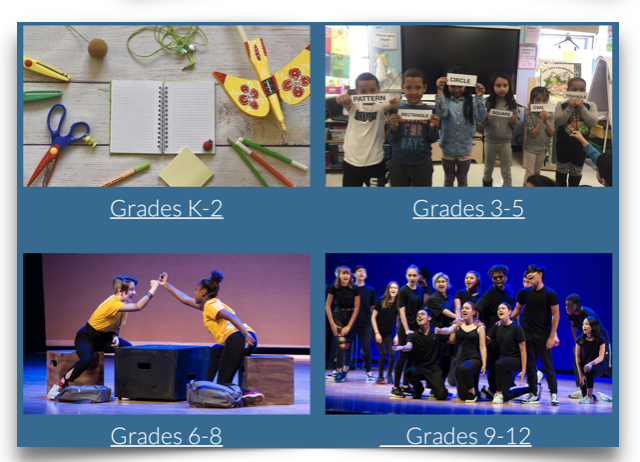
If anything, the Coronavirus COVID-19 Pandemic has provided increasing opportunities for these alternatives to drama teacher education to flourish. In the midst of disruption there are entrepreneurial openings (for example, Roundabout Theatre Company, 2021. https://sites.google.com/schools.nyc.gov/theater-ralp/home).
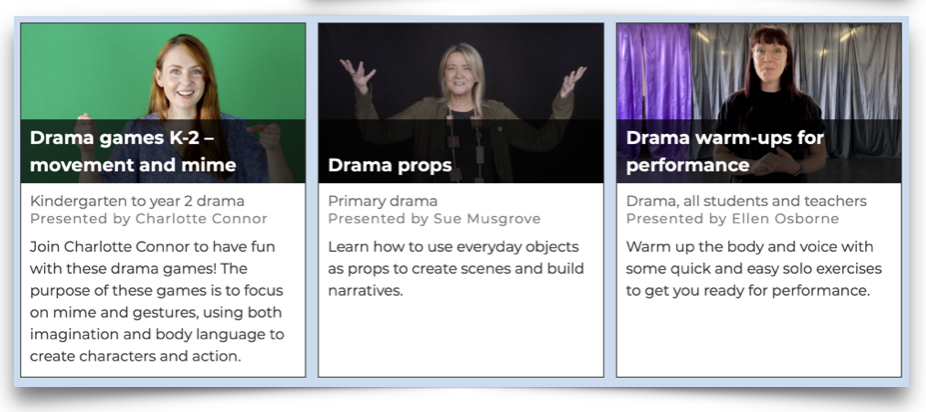
The rescue has two modules – with grade related resources. Module 1 focuses on using your voice; Module 2 is an Introduction to Design. There are lesson plans and video resources to support instruction as well as independent student learning.
There are professionally produced videos with personable presenters published in a YouTube channel. Check out the Using Your Voice: Vocal Warmups video to see if it will work for you.
For teachers working in Zoom environments these are valuable resources.
As always, check that these resources are suitable for your students. also, question whether the US accents are useful or helpful.
Australia
Closer to home, the Inclusive Creative Arts digital teaching resources produced by the New South Wales Arts Unit are also worth considering.
https://digital.artsunit.nsw.edu.au/the-arts-unit-home/art-bites?subject=drama
These Arts Bites are another source for stimulating drama activities. The accents are Australian and the presenters are enthusiastic and focus on speaking directly with students.
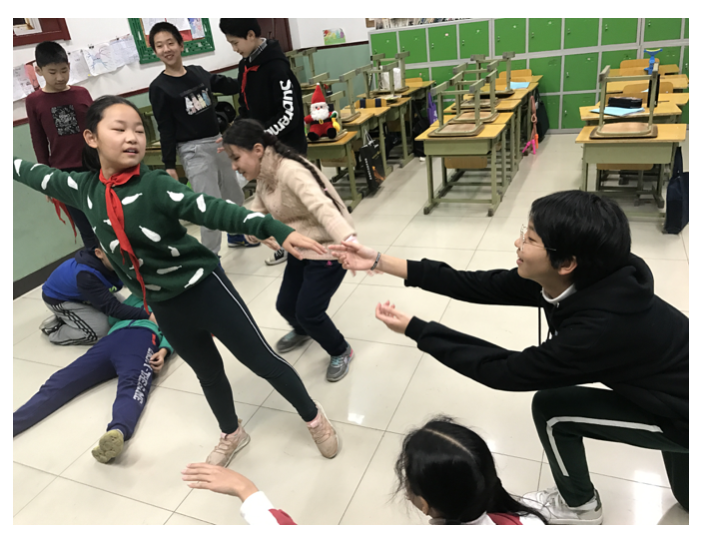
The question still remains
What is unclear is how they present antidotes to trends towards dis-embodied drama education. The lure of the on-line world and the ZOOM meeting present traps for embodied drama learning and teaching.
Drama is practical, hands on, embodied learning. How does that change in the “new normal”?
Whatever approach is taken to drama teacher education, there needs to be an underlying robust, durable, practical schema to serve as a living and responsive guide to our work.
Learning to teach drama focuses on embodied learning in the arts (Bresler, 2004). Through practical, hands on experiences in the drama we model the ways that your students learn the arts and ways that you teach the arts. This engenders embodied teaching.
Bibliography
Bresler, L. (2004). Knowing Bodies, Knowing Minds - Towards Embodied Teaching and Learning. Dordrecht: Kluwer Academic.
Music Monday - More about Practice
/Last week’s post about music practice generated some interesting discussion. Thank you to those who contacted me with anecdotal stories about students young and older.
I’ve been thinking and reflecting further on this essential component of successful music performance.
Our daughter, Hannah had an outstanding piano teacher. Sue’s students were typical suburban kids, but consistently achieved above - average results in their AMEB piano exams. Her own daughters all went on to become professional string players. The family are clearly extremely talented in music, but I have often wondered if a significant part of their professional success was their mother’s guidance about practice routines from an early age.
I have been searching (without success) for one of Hannah’s old practice books, but my recollections of a typical page would read something like this:
D major scale. Practise hands separately 3 times then together, slowly, 3 times
Gavotte. New. Try page one slowly, separate hands. 3 times each practice.
Revise List A and D pieces once each practice.
List C. Check bars 43-49 (wrong today) and practice slowly 3 times each practice
And so on.
Very specific.
This week with my Year 8 boys’ singing group, I quizzed them about their practice since the last lesson. Interestingly - but unsurprisingly - the boy who scored highest in a technical work assessment had the most specific practice routine. Here is what he reported as being his practice routine:
“I sang each of our (5) scales 5 times to warm up.
Then I sang the vocalise, checking the breathing and the dynamics.
I practised the song, checking the rhythms at the bars you told us to.
I recorded myself singing to make sure that I wasn’t scooping or sliding.
Then I went through my parts in Matilda (their current school musical).”
Again, very specific and ordered.
We are living in an age where technology provides so many tools for practice – warm up apps, recording devices on our phones, backing tracks with or without voice / piano / orchestra. The list goes on.
But as music educators we still need to train effective practice habits.
Drama Thinking - Part 6
/Finding the stories for drama
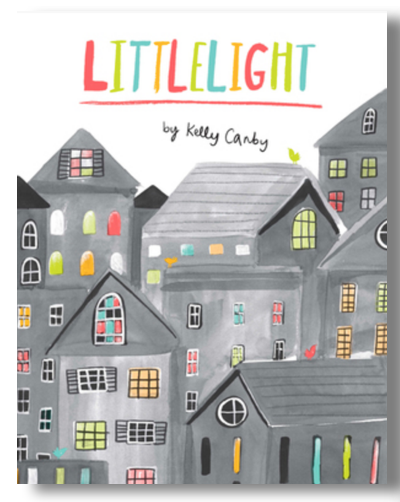
The town of Littlight and its people live in a grey and lifeless community, dictated to by the Mayor, an autocratic man who fears change and difference. Mysteriously, the brick walls surrounding the town start to disappear and as they do so, light, colour, sound and eventually people start to appear through the every enlarging holes.
This is a story about one person setting of a change reaction - about celebrating difference, tolerance and not just being open-minded to those who live different lives, but being open enough to embrace and enjoy their differences.
The illustrations are simple and stylistic - quite childlike. Stark shades of grey depict the township except for one bright, colourful girl and a ladder. As the bricks disappear psychedelic colours leech through along with small differences to start with - as brightly coloured birds start to emerge. As the holes in the wall grow larger we get glimpses of different people doing different things - cooking, dancing etc with different senses being awoken but the Littlelight townsfolk. The Mayor is angry, and at first the people are frightened of something new and different but as the colours take over their community they become happy and cheerful. The vivid endpapers are filled with bright and colourful houses side by side and provide a good talking point.
A frequent question I am asked is about the stories I use in drama workshops: where do you find the stories?
I find stories for drama literally everywhere.
I am always looking for stories for drama.
You might find me in the children’s picture book section of the book store. Or, I might see something in a newspaper clipping. Or, a friend might tell me a story from local history.
For example, in the children’s section of a bookshop and found a new book by a Western Australian author, Kelly Canby, called Littlelight (2020). Immediately, I could see the situation – a town that is walled in – and the roles – the pompous mayor and the fun-loving stealer of the bricks in the wall. I could use the Drama Thinking processes described in earlier posts to generate dramatic action that can help students understand important life issues.
A little boat sets out to sea and begins its voyage toward home. To get there it must travel across many strange, beautiful oceanscapes, full of fantastic cr...
Another time the same bookstore I saw The Wanderer by Peter Van den Ende (2020).
At once I could see a starting activity of making paper boats and talking about them – an activity outside the frame that enables us to edge into the drama where we take on roles.

A little boat sets out to sea and begins its voyage toward home. To get there it must travel across many strange, beautiful oceanscapes, full of fantastic creatures and deadly monsters, swept by terrifying storms and sailed by mysterious ships. Can the Wanderer pick a path through all these perils to a safe harbour?
The story itself is so open ended. We could springboard from images in the book itself. Each of the images could provide an episode for a drama activity.
Or, we could invent our own adventures and places for the little paper boats to be travelling.
These sorts of picture books are so great for generating drama thinking ideas.
Generative stories are rich with potential drama.
They enable us as drama teachers to work between the
narrative threads to find the drama.
They focus on human experience that can be shared in embodied ways.
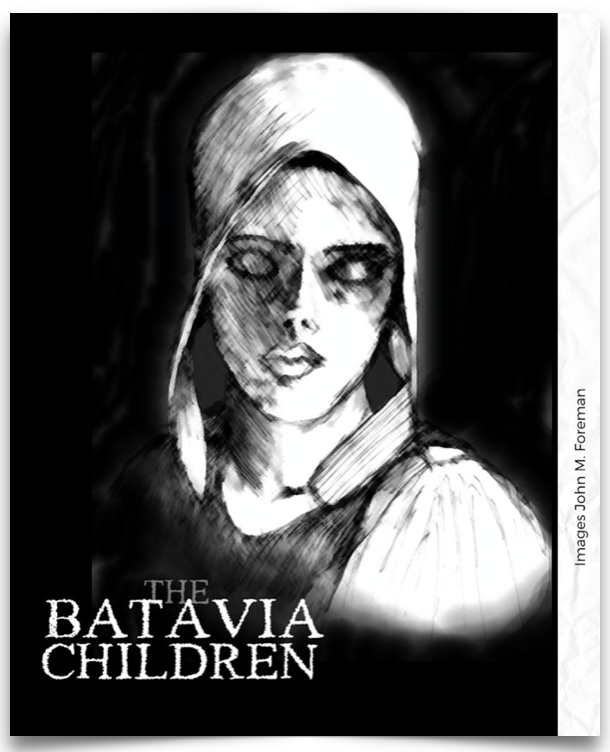
Similarly, a friend told me the story of the shipwreck off the coast of Western Australia – quite infamous for the bloody insurrection and mutiny and the terrible justice imposed on the mutineers.
what her was fascinated about was that in the party of several ships in the convey making the journey from Amsterdam to the Dutch East Indies, there were many children.
I thought about the potential for drama in this story from our shared history.
Stories don’t have to be written down or published in books.
Just as Drama reflects life, so too, all of our lives can be the source for good drama lessons.
They open doors to Process Drama activities.
With my teacher education students we worked through the Process Drama of the Batavia Children, to learn about Process Drama.
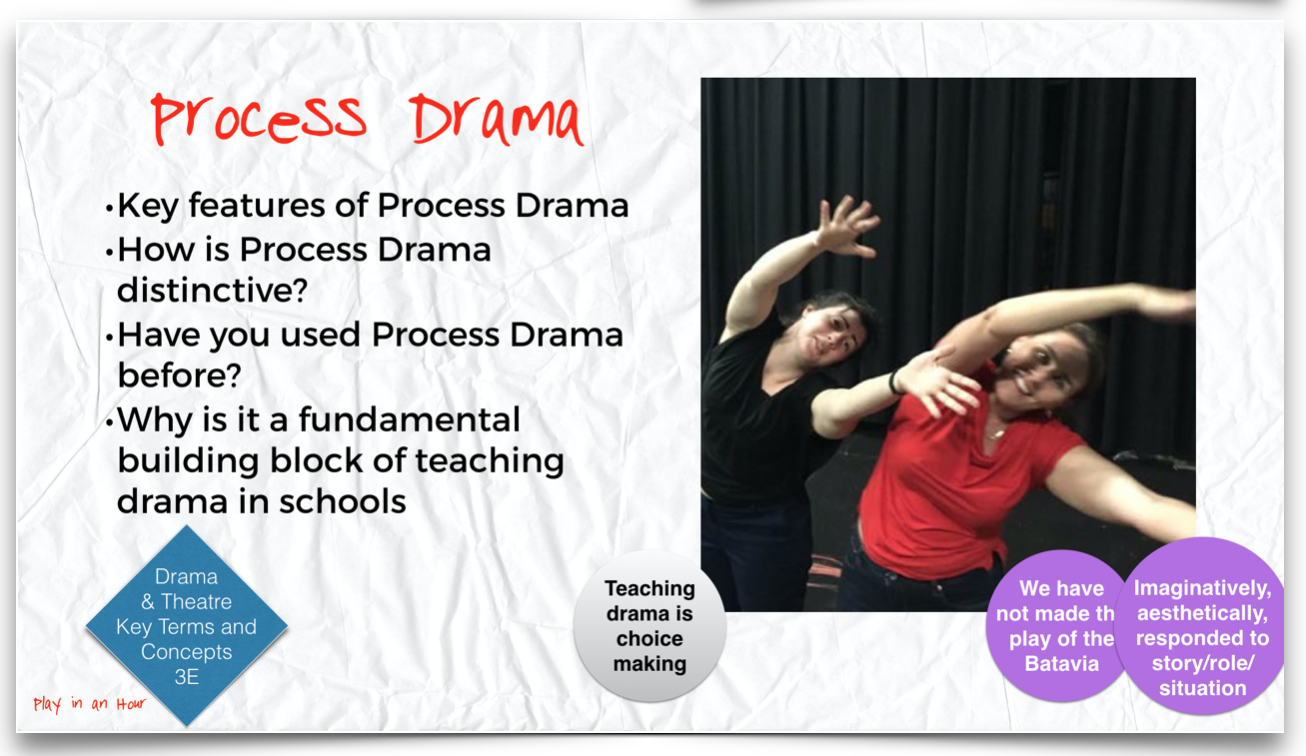
An associated question I am sometimes asked: Why do I use stories for drama?
My job as a drama teacher is to help students learn about drama - using the Elements of Drama to express and communicate ideas and feelings as well as to understand and respond to drama.
Stories are ways of embedding these important elements into packages that. Help students learn.
Of course, there are times when I plan a drama based on a concept – such as using voice dynamically to create character. Or, teaching about the important ideas of Brecht as a playwright and director that have influenced contemporary drama. So there are drama lessons that don’t necessarily start with a story. I can start with a specific lesson concept in mind. But even then, I try to find a way of bringing it to life through including part of a story.
But there is nothing to match the power of a generative story to hook and engage students. Into that story, I can embed important conceptual and practical learning.
In overview, this series of posts have focused on the ways that we as drama teachers move from a starting point – often a story – through processes of drama thinking linked with my portfolio of Drama Teaching and Learning Strategies. Through these processes, I am in a position to create a specific drama lesson plan.
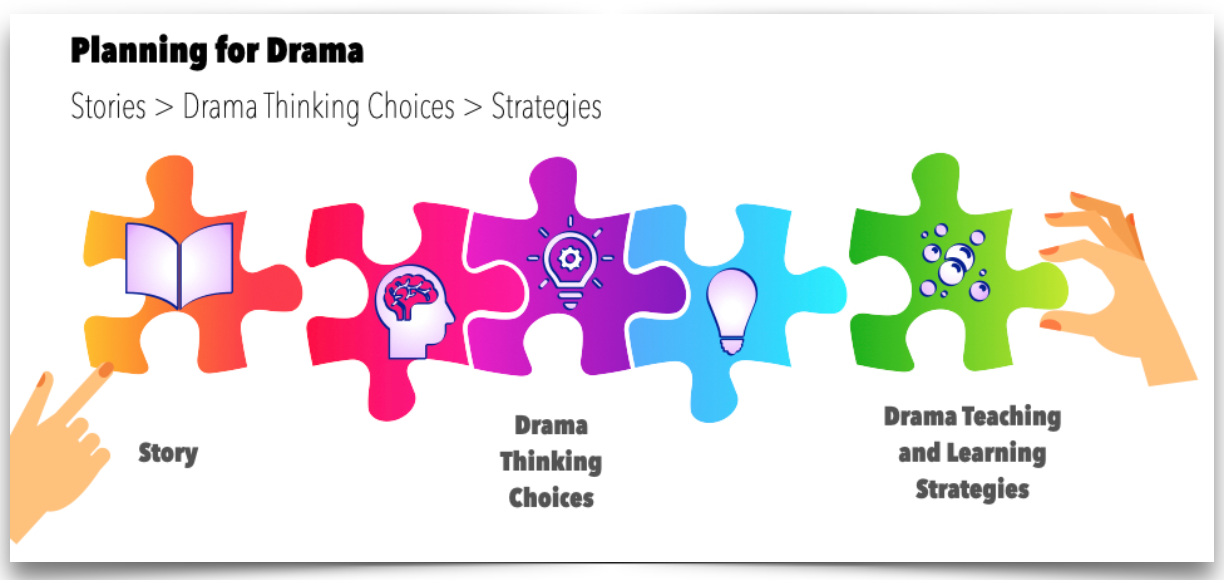
My planning often looks something like this:
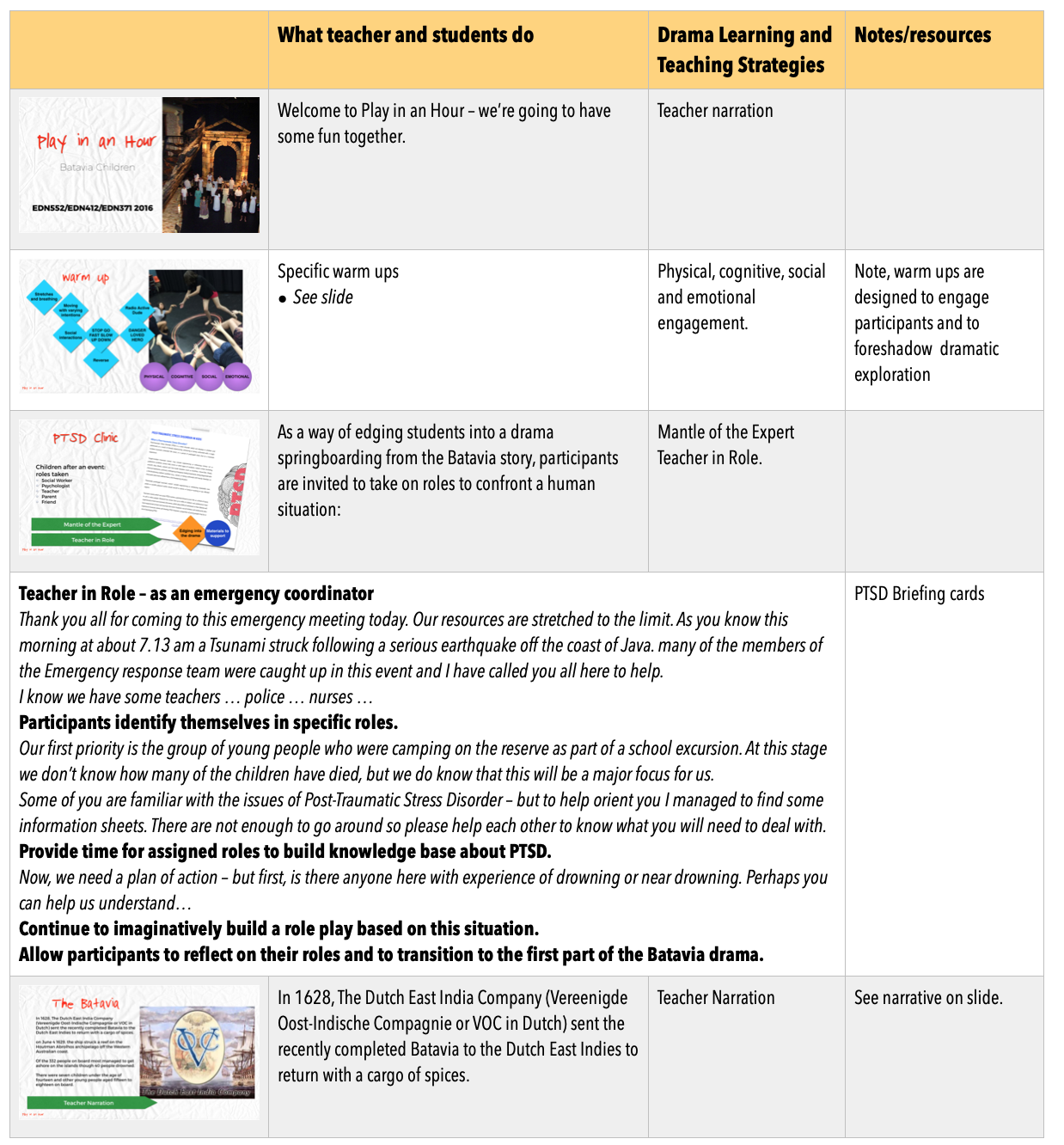
Excerpt from Batavia Children Process Drama Planning
Bibliography
Canby, K. (2020). Littlelight. Fremantle, Western Australia: Fremantle Press.
Peter Van den Ende. (2020). The Wanderer. San Francisco: Chronicle Books.
Music Monday - Practice
/A couple of weeks ago I was shocked when a tertiary singing student confessed to me that she had never done any singing practice. Never. Not in the 15 months I have been teaching her and not at any point during her secondary schooling, which is when she started formal singing lessons. What was even more galling to me was that I hadn’t realised. This student is naturally talented and learns new song repertoire easily. She had recorded her lessons with me, including exercises to teach and reinforce new aspects of vocal technique. In my turn, I had observed that her progress with new vocal technique concepts was slow; however her strong natural instincts for ‘selling’ a song, as well as a naturally robust vocal instrument had enabled her to get away with it to a certain extent. Her confession came in response to my observation (at this particular lesson) that she was taking a long time to develop a secure head dominant mix.
In our frank discussion which followed, the student confided that she had always had a lazy attitude towards work, but more than that, no one had ever told her how to practice. That really set me thinking.
With my young beginner singers, I always make explicit instructions- “do this exercise 5 times each day”, “sing through the song then go over the problem phrases”, “check in the mirror to see that you are….”. The younger students have a journal in which to write instructions and record their practice times and at each lesson there is discussion about how they have fared since the previous lesson.
With tertiary / adult students, I have, until now, verbally suggested the recommended number of repetitions of new exercises and techniques, but I have assumed that these were practised at home. Clearly this has not always been the case.
Since that lesson, I am now quizzing students in more detail. Instead of a generic “how has your practice gone since the last lesson?” I am asking, “How many times did you do the … exercises?” etc.
And what of the student who started this? Well, in the past week she has practised in detail twice. Not yet ideal, but baby steps towards a more effective artistic practice routine.
Drama Thinking - Part 5
/In Part 5 I share with you one further Drama Thinking process to help you move from a story to your planned drama lesson. This is a simple strategy. Think about your story in terms of Before, During and After the story.
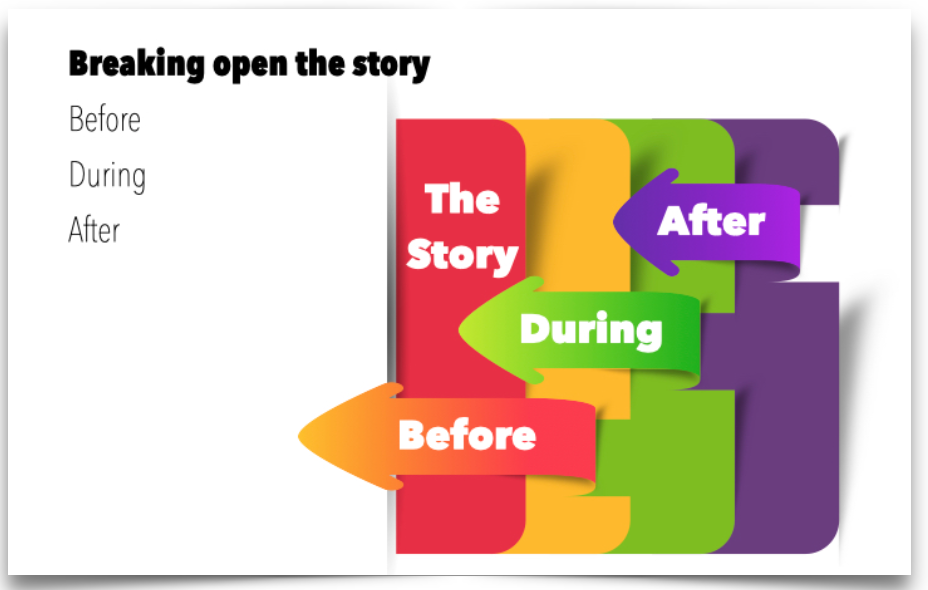
Before During and After
Perhaps the simplest of all these drama Thinking Processes, Before, During and After looks carefully at the story.
What happened before the story starts – to the people in the story. Think about their situation, relationships and what they are thinking and feeling.
Look inside the story – what happens during the story. It is useful to look here at the narrative chain.
Finally, we can look at what happens or might happen after the story ends.
Alternative stories

Sometimes, within a story we can imagine alternatives.
We can asks ourselves what if questions.
If the original story of our travellers to a New World, their adventure begins in Europe and they venture to the Dutch East Indies.
But what if… instead of reaching their destination, their ship is wrecked on rocks on the coast of Western Australia and they must learn to live with the Aboriginal people.
Or, what if… in a huge storm, their ship is swept into outer space and they travel to the Moon.
Stories do not have to go in straight lines.
There are no limits to your imagination. You can make alternative stories.
Introduce new tensions.
Introduce new people and characters.
Change the location. Or, the time. Or the ending of the story.
Story drives drama. The Principles of Stories work along side the Elements of Drama. To plan our drama lessons, we need to understand how story can be unpacked and understood, so that we can make drama with our students
Drama Thinking - Part 4
/In Parts 1, 2 and 3 we unpacked different Drama Thinking approaches to help open the story to drama planning. This post will develop further drama thinking approaches.
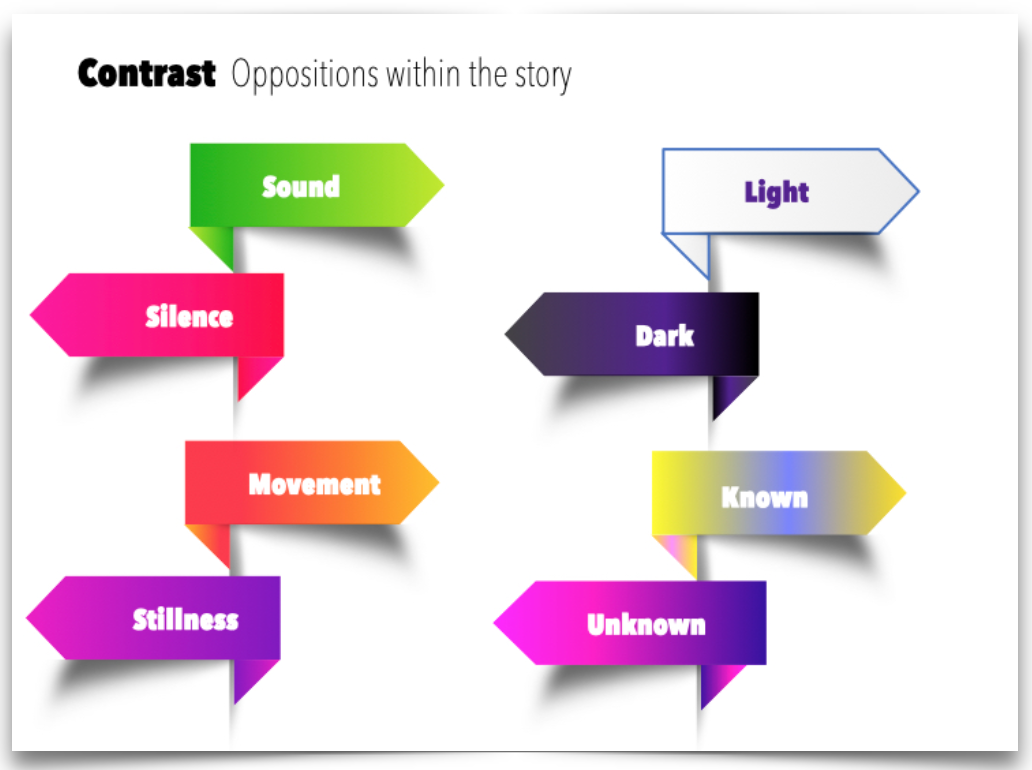
Contrasts and Oppositions
Stories work because there are moments of contrast – something that is strikingly different placed side by side in juxtaposition. In our drama work, we look for these contrast and moments of opposition because they generate dramatic tension
Look within the story to find contrasts or oppositions.
For example, look in the story for when there are sounds or silences. Look for parts of the story where there is movement or stillness.
In the journey of the ship there are moments when there is much activity and excitement. The ship is leaving harbour for the first time; the sails are being unfurled; the wind is carrying them forward on an adventure. There are many sounds to go with this part of the story.
By contrast there are also times of great boredom; perhaps the ship is becalmed and there is no wind blowing. The only sounds that can be heard are the quiet breathing of people waiting for some wind to stir and carry them forward.
Find parts of the story that are known or unknown. Look for moments of lightness or darkness.
In the story of the travellers to the New World for example there will be moments where the travellers are happy and light-hearted; maybe they have successfully reached a safe harbour or they have plenty of food. By contrast there will be times in their story when they are feeling dark threat or danger; maybe there is a storm or they have very little food or water.
There are parts of the story when the travellers know what to expect. But there are times when they are confused and face the unknown. Where they don’t know what to expect.
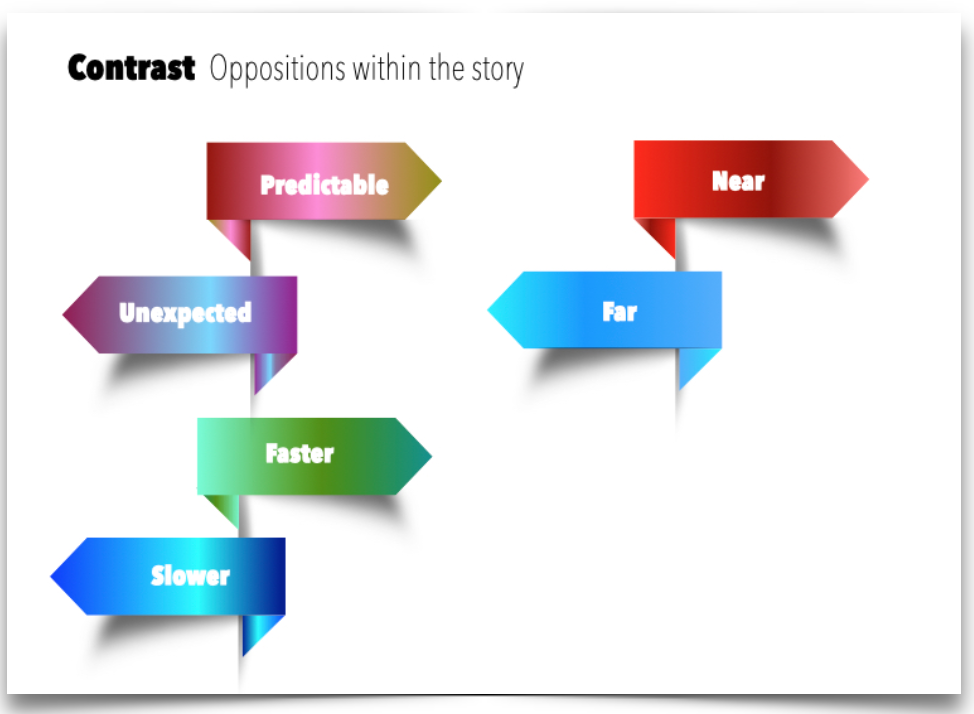
Look within the story to find other contrasts or oppositions.
For example, look in the story for when the action is predictable or when it is unexpected.
Look for parts of the story where there is action moves faster or when it moves slower.
Look for when the drama is near to you or far away.
In this series of posts I have been sharing with examples of Drama Thinking – processes of unpacking stories to use in drama.
Not all stories work for Drama. Not all stories are appropriate for your students. We take great care in choosing the stories we use. We need what are called generative stories. By that I mean stories that have potential to create drama moments.
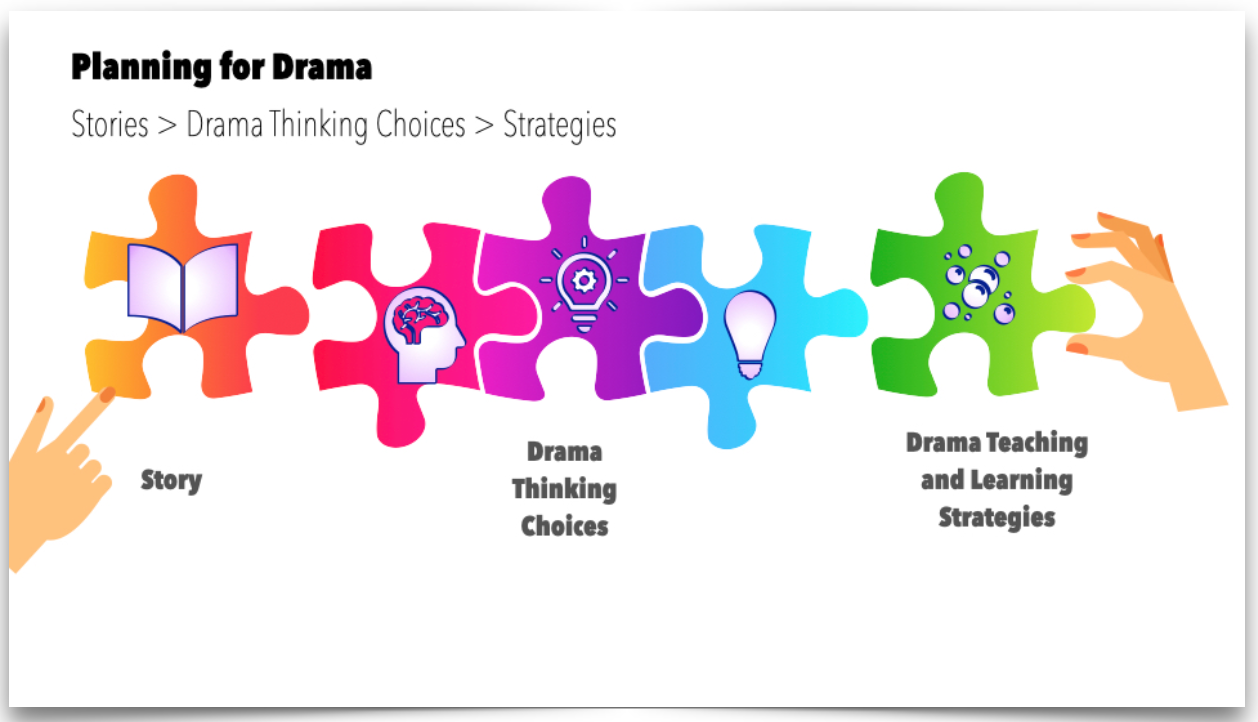
Remember, the Drama Thinking processes are a step in moving from the story to your final, planned drama lesson. The Drama Thinking Processes enable you to identify pivot points around which you can construct your drama lesson using Drama Teaching and Learning Strategies.
Like the pieces of a jigsaw, the story, the Drama Thinking and the Strategies all fit together to provide the basis for you planning of your lesson step by step.
Music Monday - International Women's Day
/On this International Women’s Day, I have been reflecting on gender differences in the various aspects of music and teaching activity I am involved in.
As a registered teacher, I am firmly part of a majority. In 2017-18 the ratio of female to male teachers in Australian government schools was 76% to 24%. ( www.abs.gov.au)
As a registered music teacher, the ratio of females increases further to around 82% female to 18% male.
And in the world of singing teaching and our professional association in Australia, ANATS, the female members significantly outnumber the males. (www.anats.org.au)
Yet when we look at the statistics on singing performance in Australia, males dominate the scene. In radio, for example, solo female artists tend to make up about 28% of the top 100 most-played songs. This kind of statistic is reflected across all aspects of the industry – festival line-ups, board representation, awards, grants.
How do we redress this imbalance? Certainly, there is much being achieved by passionate young musicians of all genders, but there is still a very long road ahead.
Finally, in a post that offers no solutions, I would like to commemorate the composer generally acknowledged to be one of the first female composers – Hildegard of Bingen (12th century).
Check out her biography on www.classicfm.com