Music Monday - Encouraging good practice habits in young singers

Most of my practice these days is incidental. I warm up my singing voice in the car on my way to school or waapa, then sing as required during lessons to demonstrate aspects of vocal technique. On piano, I accompany at least one song per lesson so most of the student repertoire is under my fingers when needed.

However, in these past few weeks I have had to play some new repertoire for exam recitals and audition self-tapes. This has necessitated some more formal practice sessions. One song accompaniment required quite a bit of work to master some tricky rhythmic passages. As always, I recalled the words of past piano teachers – my maternal grandmother and, later, Stephen Dornan. They emphasised the critical importance of regular (little and often) repetition of problem passages. Over a week I did some daily (tedious) slow practice on the accompaniment and was rewarded with the buzz that came when I could get through the whole song without mishap. The reward was quite tangible – without the practice sessions I couldn’t play the accompaniment without a sense of embarrassment. After 5 days I could – and then again, after a few days break from practising that song, the notes were still there under my fingers.

This set me thinking about the difference between motivating young instrumentalists versus young singers. With instrumentalists (young and old) no practice = an obvious inability to play the music and audible wrong notes. However, with young singers the songs are often musically simple. Singers with a good musical ear and quick memory, can sing a song with minimal practice. It might not be a convincing performance, text wise, nor use appropriate registration – but they will be able to find the notes.

So how do we motivate the young singer to practise? 

Classic FM published 10 tips to help you practice.

Most articles on practice emphasise the importance of goal-setting. For young singers, we can set specific and measurable goals around technique -eg sustaining a hiss or hum for a specific number of seconds / being able to produce a light, clear tone / brassy, louder tone, etc.

Bur when it comes to solo song repertoire, we teachers must work a bit harder to set goals that are recognisable by the student. It could be something like aiming for a particular vocal quality at certain phrases or assigning specific acting thoughts (actions) to phrases. Even then, the achievement of those goals is easier to recognise in the reaction from audience than by the singer themselves. 

As young singers mature and tackle harder repertoire, the rewards from productive practice are much more obvious to them. But good practice habits are best started early in life.

What are your thoughts on this? We would love to hear of your success stories!


Drama Tuesday - Stating the obvious

What is the starting point of any drama teacher education course?

A drama teacher begins with a love and knowledge of drama as a way of making meaning, expressing ideas and stories and communicating with an audience. They begin with drama in their own lives. On that basis we begin to build an understanding of drama as learning, drama as curriculum. 

Each year I begin by making drama – a collaborative process drama experience loosely called Play in an Hour – and spring boarding from that to ask drama teacher education students to reflect on their own drama learning in schools and the drama curriculum. 

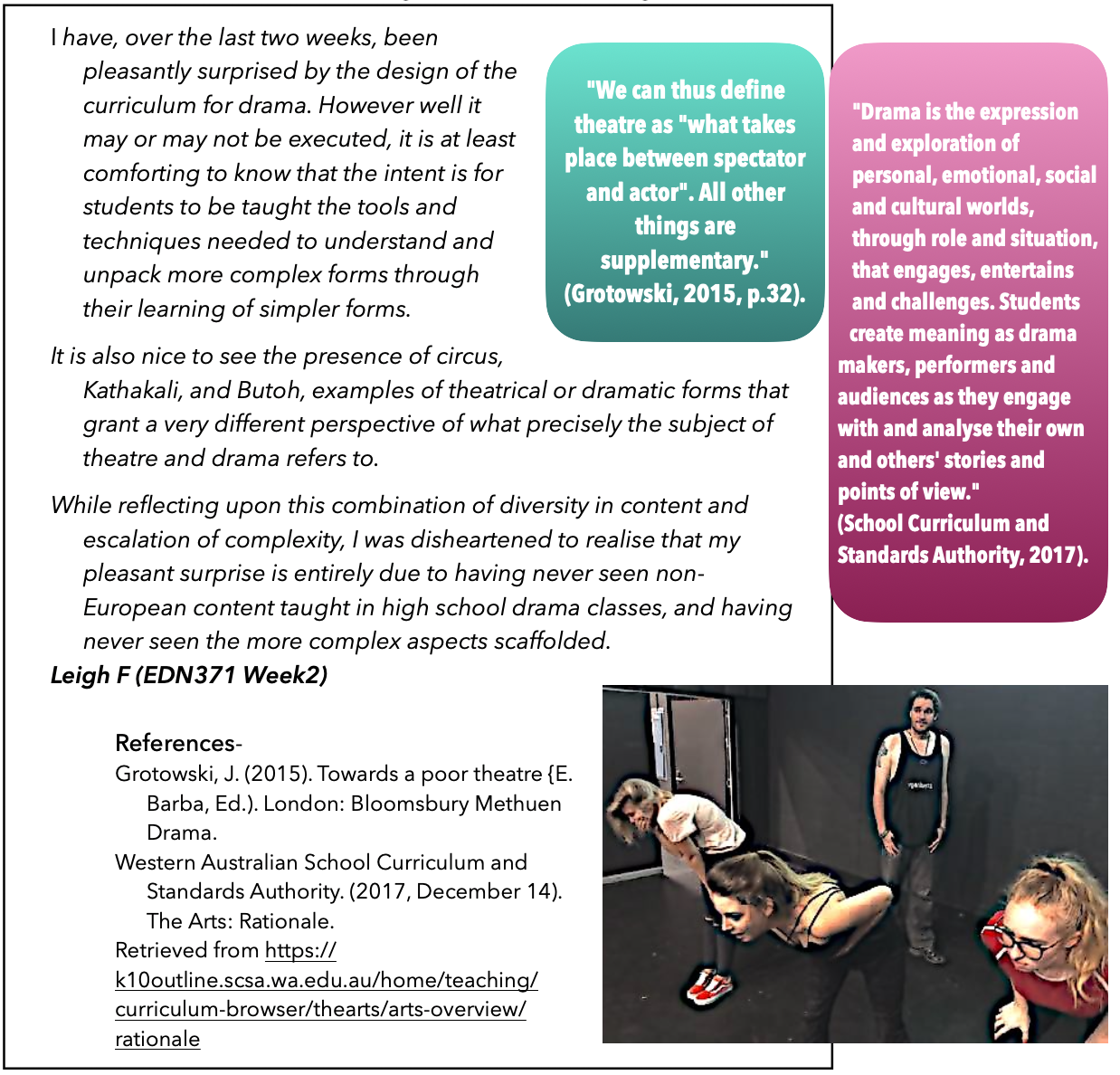
In a Week 2 reflection in 2018, Leigh wrote the following.

What would be your reflection if you reflected on 1) your own experiences of drama in schools; and, 2) your drama curriculum?

Drama Tuesday - A little manifesto from 1996

Education paradoxically is both notoriously conservative and dangerously revolutionary – and mostly at the same time. Who would want to repeat the abject aridity of teaching english without literature, language without context. Who would want to teach the arts without the disciplines, lost in some abandoned contested territory. In affirming the value of conserving values in Arts education, we recognise the strengths of traditions and past contexts and cultures for their power to inform this moment in time. IN looking forward we recognise opportunities in new technologies. We value innovation and engage with it.

Think about the links between societies of impending change. What happened in societies where the sickle was invented. What is happening in our society where other technologies are changing the ways we tell stories, express ideas and communicate.

The world is not schematically simplistic – conservatism on one side dialectically opposed to brave new worlders. If it was, then the future would be written by soap opera outliners. We need a world view that recognises and celebrates complexity and exploits it rather than fights against it. The world is essentially muddy and we need to silt the mirky marshiness to make sense of our ways forward.

In case you haven’t noticed, the ways young people tell stories is changing. 

There are implications for education.

There are implications for the Arts. 

To make judgments we need shift our frames of reference. 

Instead of building a thumping pulpit of judgment – sickling tall poppies – let’s develop a climate that supports innovation, encourages questioning, values divergence and complexity and celebrates those who shift the focus. 

Screen Shot 2021-08-17 at 9.09.54 AM.png

In case you haven't noticed, the ways young people tell stories are changing. The stories are none the less important nor the telling of them. But the influences of video clips, MTV, interactive multi-media, television and other advertising, new and evolving technologies, are re-shaping both the ways young people make sense of the world and the ways they express themselves.

Old hierarchies and orthodoxies are breaking down, new technologies make fresh links and connections, find new pathways; topics, themes and points of view are different; there are marked shifts back and forth along the objectivity-subjectivity continuum; the process of telling the story is as important as the story artefact. There's a useful image doing the popular rounds at the moment - surfing in hyperspace and that is an apt image for the process of developing an original piece of youth theatre for the 1995 Festival of Perth, called somewhat enigmatically: Here! Now!

This joint project of the Leeming Youth Theatre, WA Youth Jazz Orchestra and STEPS Youth dance Company has been an example of some of these key elements. Bringing together young people from three different but related backgrounds was only the beginning of a sustained collaboration.

Over almost eighteen months, participants have been asked to work from within their own discipline to reach out and make connections with other arts forms: dancers to use their voices as well as their bodies, actors to move, musicians to act and move. But more significantly, the process has focused on young people taking a driving role in the creation of the work. Ideas

have been sifted, explored, developed and shaped by the collective work of the members of the collaborative ensemble. The role of the adults collaborators - director, musical director, collaborator and dramaturgs - has been shaped by the driving wave of the ideas of young people.

To make a judgement about this project - and its short and long term effectiveness - we need to make a shift to a different frame of reference. This work has given rise to the awkward but accurate buzz phrase of the moment is "hybrid arts". While there's always a danger of overstating early trend signs, the work on the stage (can we even use that term any more?)

reflects a significant perceptual shift in story. There are implications for education. There are implications for the Arts. The process has been as fascinating as any product on the stage. The impact of the process on the dramatic text is notable. There is that crowding of ideas, conflicting values, elisions of narrative, experimentation with type, archetype and cliche characters from soap opera and worse. 

All involved have had to acknowledge and incorporate the ideas, values and limitations of an empowered group of young people. This has meant an intrinsically different way of working. As young people have been asserting their voice, style and approach to the product, the process has shifted from a hierarchical (sometimes seen as masculine) way of working to a collaborative approach. Writers, dramaturges and: directors have had to come to terms with different ways of working, different ways of telling , different forms and structures of narrative. As young people have been empowered b y the process, there has been a serious re-evaluation of the creative partnerships between adults and young artists. This sort of empowerment will lead to a questioning of the traditionally power laden role of the director - and teacher as director.

Can these young people ever go back to the theatre where actors are cattle (to remind us of Hitchcock's famous quip?. 

What is the role of the actor in the creation of the dramatic text? 

What is now the role of the writer and what are the limits and frustrations that are placed on that role? 

Can we ever again see the playwright as arbitrator on all matters as we find in the, say, the proscriptive and rather quaintly literary scripts of a George Bernard Shaw? 

Can the drama class be a tabula rasa for the teacher to scrawl and experiment on? 

Are drama students to be manipulated and pushed around?

In short, the obvious answer to these questions is no. There has been a significant paradigm shift. The debate that still needs to be faced centres on the question of whether this shift in thinking is desirable, general, irreversible? How will drama courses look if this empowerment of the ideas and values of young people is a general shift? What happens if there develops a number of approaches - ones that favour empowerment and ones that retain a dominant (writer/ director/ etc) and subservient role (the sort of master-student relationship so often seen in the traditional approach in the ballet studio)? What will happen when this generation of young actors enters the profession and runs headlong into that other tradition? Is this case being overstated? What are the limitations of the student actor as writer/creator/participant, controller of the creative text that emerges? Is there sufficient aesthetic distance m the process to enable ideas to be taken in, massaged, developed and realised.

What is happening in terms of the art of story is even more fascinating. The nature of story 1s changing m the face of many pressures. Dramatic texts such as Here!Now! reflect these shifts. By nature, the story is now more dynamic - in jargon terms, it is more interactive: the participants in the process have a role in the creation of meaning and the manipulation of what happens. The days of the "sanctity" of the text are numbered. As reader response theorists win the hearts and minds battle for education, so too do the ways stories are told by young people.

This is a (if not “the') cutting edge of narrative. When people try to apply different more traditional frames of reference, they find themselves confounded or perplexed or even confronted. To a mind set brought up on the well-made story, crafted and honed and even elegant, the roughness and unfinished qualities of stories like Here!Now! are questioned - perhaps even an anathema. But, it is timely to remember Peter Brook's exhortation to rough theatre where immediacy is more important than finish.

If you make an analysis of Here/Now! it is a thin narrative - that is not to say that there is not a throughline or characterisation or resolution of those characters and situation. But it is thin. The narrative can be simply stated:

Styx loses Stephanie to Kirby; there are those inside and those outside; those inside have the illusion of safety and those outside carry threat, but appearances are not reality.

It is a play on the old idea of the musical: boy loses girl; girl gets other boy; first boy is proven right but no one wins the girl. The nature of the throughline is different - there is the use of repetition, extension and variation, and time manipulation that breaks through

expectations of linearity and perplexes. But there is a narrative line, it is simply not the same complex throughline of drama from other perspectives. Does this make it any less satisfying or complete? Perhaps. I also makes it different and underlines the need to approach all drama with a clear understanding of its contexts. The judgements we then choose to make should be, at least, informed.

The depth of the narrative lies in the implicit complexity, not the apparent complexity. The narrative alludes to mythology but doesn't explain it; the action accepts concepts such as street kids, drug culture, etc rather than explains or fleshes them out as if the audience might have difficulty understanding them. These elisions in narrative structure are a problem for people who want to a spoonfed television generation who need resolution in a short time frame.

The dynamic of the group devised piece is different from the well-made play penned by the dominant playwright (with maybe a partner) and delivered through _a traditional, hierarchic system. The group devising process shapes a different sort o! performance piece. Group devised plays are more anarchic, free-form, associational, energetic, tension ridden and driven. They produce narratives of different sorts, derived from within other frames of reference.

Is this just a sign of these particular times - this so called Generation X-ness?

Maybe~ !hough I suspect there are deeper and more interesting, a recognition of the shift ~rom the traditional generational impatience - once cutely called the generation gap - to a more significant expectation from young people, a demand and assertion that they have a right to be heard. As the century has passed there has been a drift towards a different perception

of youth as a concept. As inexorable commercial and media forces have created and invented teenager-hood, so there has been a corresponding growth and acceptance of the idea that this is not just natural and right but expected and mandatory.

The dialogue in this piece does reflect soap opera qualities. In its predictability and triteness there are some hints of the role models and values of the society of young people. In a so-called post modernist society, there is also a questioning of a need for dialogue to be original and novel; there is a reliance on tried and tested language patterns perhaps underlining a need for familiarity and safety in unsafe times. The attempts to heighten the language through the use of repetition, vocal patterning, chorus work and what some call poetic diction, is an interesting response to a world where that very soap opera predictability is the dominant mode. ( And, it is interesting to note how few commented on this aspect of the Here! Now! project!) But there is a tension in this dramatic text between the intention and the result is the dialogue and language simply a reflection of what exists or a questioning. Is this piece a mirror held up to reality? Or does it attempt - and perhaps fail - to be something else?

Similarly, in world where realism is the dominant form of story telling - through film and television - it is interesting to see plays where this approach is questioned. The disjointing of reality in this piece is notable.

Traditionally, fin de siecle society is typified as lethargy, longueurs, entropic looking back through rose or jaundice coloured glasses. By contrast, Here!Now! shows an energy, a commitment, even a fervour that questions such a mannered and stylised approach. When you see the sense of passion and diversity in the face of the blandness of life around them, you can understand the impatience and underlying anger. As the world around them becomes homogenised, globalised and generally duller - the economic imperatives driving the social fabric into designer but duller mass production, is it any wonder that there is a sense of rebellion fuelled by

anger.

When the dramatic text produced is examined closely, it is interesting to draw the parallels. with the ideas and values of playwrights/directors like Brecht who over fifty years ago was advocating a similar dislocation of the conventions of drama m search of awakening the audience. In Brechtian drama, there is a deliberate introduction of distancing elements such as songs, fragments and incompleteness, the use of music, stylised setting and properties, episodes rather than scenes, and a deliberate move away from seeking catharsis. Similar elements are strongly present in Here! Now!

Developing this line .of :thought about the Here! Now! project is not to turn a blind eye to its limitations. Questions I continue to ask include:

• Has _the project been so inward looking that it merely delivers another version of teenage angst?

• Has !here been a narrowing of perceptions to the known, the safely predictable?

• Have the choices made been a reconfirmation of existing prejudices or narratives rather than a genuine opening up of possibilities?

• Has the repetition, use of predictable dialogue and situations been a limiting rather than liberating factor?

• Could there have been a more satisfying approach to characterisation and narrative throughline?

The answers will vary according to your frame of reference.

Reaching towards some conclusions

Education is paradoxically both notoriously conservative and dangerously visionary - and often both at the same time. The Arts are also.

Is this production a sign of something new and visionary? Or is it a blind alley at a time of great societal uncertainty and upheaval.

It is appropriate that dramatic texts such as Here! Now! do question and debate traditional forms and ways of working. However, equally do we want to repeat the abject aridity of that great experiment of English without literature, language without enriched contexts?

While it sounds like having a two bob bet each way, there is a place for education to both affirm and question. In affirming the value of conservative approaches, education recognises the strengths of traditions and past contexts. In looking forward, we recognise that arts education is a powerful opportunity to engage with new technologies and ways of telling. If we don't recognise the past, we abdicate the long trajectory of learning. If we aren't involved in the debate about new ways of structuring, we don’t have the credentials - the street cred - to critique them.

The reviews and reactions of many to this project has been an interesting insight into the limitations of some of those looking - and perhaps, equally, of some of those participating and shaping. It is perhaps typical of this Generation X approach to leave the issue unresolved with a metaphoric and stereotypical, frustrating, youthful shrug of the shoulders. But we should not read this as a sign of disinterest. Behind the carefully cultivated veneer of the young, their apparent insouciant lack of caring is a passionate and burnmg need to be heard and understood. They simply cannot be dismissed. Projects such as Here! Now! have a place, a right and need to be taken seriously - from their own frames of reference.

4 April 1996

Music Monday - Musings on a choral festival

I volunteered at a choral festival yesterday. The festival is an annual event for government schools here in Western Australia and yesterday took place on a beautiful cold, sunny Sunday after weeks of rain.

Over the course of the day, we heard 20+ choirs, all a high standard, and several which were memorable for the best of reasons. Stylistically, the repertoire ranged from Gregorian Chant through to beat-boxing, with lots between.

 How wonderful for students to hear excellence in performance from a choir in quite another style to their own! 

There was a real sense of ‘family’ and inclusivity within each choir.

The day was not without its challenges though. As always, choir directors received last minute emails and text messages from parents who decided spontaneously to do something else on that sunny Sunday. (Would they tell the sporting team coach that their kid was not going to play that day, I wondered?) And of course, sickness precluded some students from attending – and presented stress for the directors when those students were on key parts in the ensemble. One of my colleagues and friends had to stand in for 2 missing parts in a beautiful 11 part unaccompanied ‘Magnificat’.

The festival is non-competitive. Choirs receive comments from an adjudicator and receive a ‘grading’ – good, excellent, outstanding. But there are no winners – a healthy thing, since the point of the festival is the opportunity to perform and hear choral singing in many genres. 

However, the grading system creates an unofficial sense of competitiveness which is not always in the spirit of the festival. A grading of ‘excellent’ is interpreted as ‘average’ (since it is the middle grade in a scale of good, excellent, outstanding). If an adjudicator’s comments included something like “this was excellent singing” there would be a sense of achievement – but as a grade it can bring disappointment. 

Are we so geared to grading in arts education that we can’t accept just a critique from an adjudicator?

In conclusion, another colleague remarked that the football derby playing that day (a game between the two state teams) had attracted much news coverage and thousands in attendance at the stadium. But here we were running a government run music festival with zero news cover. Yet another indication of arts v sports in Australia? Wouldn’t it be fantastic to have arts + sports!


Drama Tuesday - The past empowers us for the present

Screen Shot 2021-08-10 at 8.43.33 PM.png

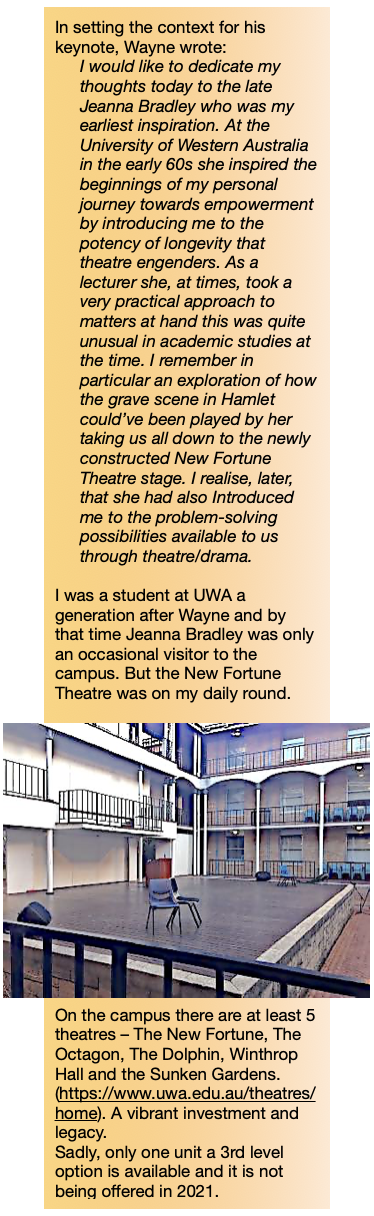
 In 1994 Wayne Fairhead was keynote speaker at The NADIE (National Association for Drama in Education – now Drama Australia) National Conference in Perth. Wayne spoke from his experience of drama education in Ontario, Canada but also from a local perspective as he was once a local lad. 

In 2021, as drama educators in Australia face a Review of the Australian Curriculum: The Arts being conducted by ACARA the Australian Curriculum, Assessment and Reporting Authority, it is timely to reconsider some of the ideas that Wayne spoke about back in 1994. There are powerful resonances 

Curriculum is in a state of profound and constant change all around the world. We are being asked to be totally accountable by a society that sees our tasks in contradictory terms. Hence the jargon and whatever you want to call these action objectives – learning outcomes, standards, targets, etc. As teachers I think one feels powerless when changes happened so suddenly and then so called experts suggest a seemingly new direction.

Educators who tackle restructuring are caught in a time warp between the old and the new. On the one hand teacher teachers are being asked to teach the students to think – to forsake superficial coverage of content for depth and understanding. On the other hand they are still judged publicly and privately by standardised tests that emphasise isolated facts, wrote learning and content coverage.


I am hoping that we can find ways of sharing Wayne’s whole keynote with the wider drama education community. His theme was EMPOWERMENT AND A CHANGING CURRICULUM. 

Screen Shot 2021-08-10 at 8.43.39 PM.png

I don’t think that what effective teachers, and I mean drama teacher specifically, actually do in their classroom needs to change all that dramatically. What we have to learn to accept is firstly to live with ambiguity and secondly develop an ability to clearly state what it is we expect our students will learn. The ambiguity is not going to go away – change is too rapid and individual countries do not control their economies. No one has all the answers therefore the team becomes increasingly more important. We can only solve problems together locally nationally and internationally. This is where I wish to affirm the statement that NADIE is “pulling a lot of strings” at the moment. It is! Here in Oz you are indeed lucky. You are a national team to be reckoned with. In Canada it’s a constant struggle because of the regionalism that exists. 

And so where do learning outcomes fit into all of this-the empowerment process and ongoing curriculum change. They are an attempt to CLARIFY what it is we do in our classrooms. They endeavour to provide an OPEN agenda for students. 

Screen Shot 2021-08-10 at 8.43.44 PM.png

The focus on students is a timely reminder. 

There is so much more in Wayne’s keynote (which I re-found in a fax from him after the conference and which I have now transcribed for, hopefully, another generation). 

There are many connections with Wayne as he visits his family here (when – in pre-COVID-19 times – he could) and we met on many occasions around the world through IDEA. In 2004 Wayne was the Director of the IDEA Congress in Ottawa, Canada and continues his life long support for drama education.  

It is important that we do not lose sight of the shared wisdom of the past particularly when it can enlighten us about the present and future. 


And the peacocks that rule the roost in The New Fortune, still parade themselves across the stage as a descant on Hamlet’s lament for Poor Yorick. And my sad commentary on what the University has lost. 

The New Fortune Theatre, University of Western Australia

The New Fortune Theatre, University of Western Australia

Schmigadoon!

I discovered this last night, after urgings from son Ben (not a particular music theatre fan) and conversations with several music theatre students in recent weeks.

It is an American musical comedy TV series of 6 episodes created by Cinco Paul and Ken Daurio. It premiered on Apple TV+ on 16th July this year.

Broadly, it is a parody of the Golden Age musical, Brigadoon, but it goes much further in also parodying famous musicals of the 1940s and 1950s – Oklahoma, The Sound of Music, The Music Man, Finian’s Rainbow, Carousel, and many more. (You can play the game ‘spot the reference’).

The cast line-up is stellar- Kristin Chenoweth, Alan Cumming, Martin Short, Aaron Tveit, Ariana DeBose – to name only a few. It’s as if all these stars wanted to fill their downtime during Covid – if so, lucky us!

At all levels it tries to parody the Technicolor palette from the golden years of Hollywood, while using a contemporary sensibility. It is firmly tongue in cheek.

It would be an interesting classroom challenge for music theatre students to identify, not just the sources, but also the cliches and habits of music theatre writers. 

Sidenote – will they ever parody Sondheim?


Drama Tuesday - A Trip to the Theatre Remembered

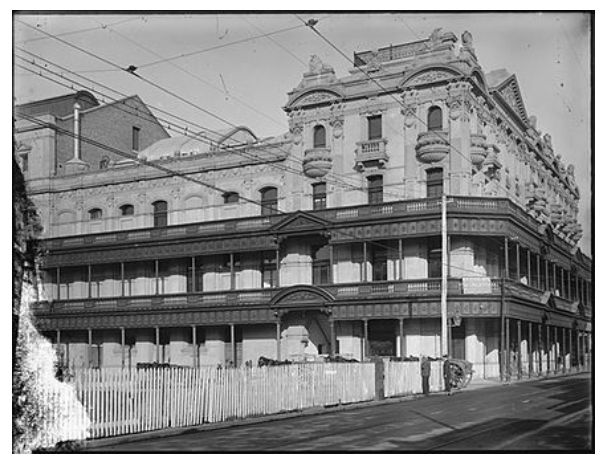
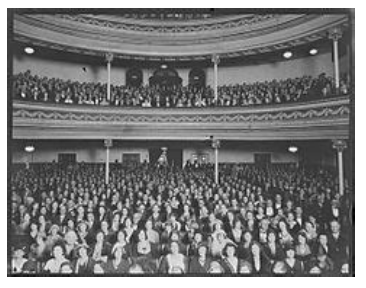
The Maj, Hay Street Perth

The Maj, Hay Street Perth

When I was sitting in The Maj for the WAAPA production of Crazy for You, I was reminded of the first time that I went to that theatre. I was maybe 12 or 13 visiting Perth for the summer holidays with my family. As a thanks for putting us up in Perth, my Mum bought tickets to the hot show of the year My Fair Lady on the tail end of its Australian tour for JCW. I somehow  managed to wheedle my way into going with them. 

The Maj in those days was not the plush ruby velvet smoothness of the refurbished theatre today.

The Maj, Hay Street Perth

The Maj, Hay Street Perth

It was late January. Summer heat beating on the asphalt drum of Hay Street. No air conditioning.  And worn saddle haired seats in the stalls, with a squint around the infamous pillars. The theatre was sweaty full, heaving. The audience laughed and loved the show. Stuart Wagstaff played Henry Higgins but I can’t tell you anyone else in the cast.

Screen Shot 2021-08-03 at 5.17.13 PM.png

I was fascinated by the experience. In particular, I remember taking note of the senses where a scrim curtain was drawn across to a scenery piece on a trick from the wings while a scene change was happening behind. I think it was for On the Street where you live and maybe Get me to the Church on time. Even at that age I was interested in how the stage magic all happened. Even now, I continue to be looking through the performances to  how they happen.

The performances were raw, natural and energetic. This is by contrast to the WAAPA production where all the actors on stage were miked; where the lights automated, plotted to follow the dancers. Theatre is vastly different nowadays. And the training of actors sits in the lap of universities; by contrast those actors I saw in the JCW production would have come through the apprenticeship of hard knocks and handed-down advice: always turn on your downstage foot

Screen Shot 2021-08-03 at 5.17.18 PM.png

There is a coda to this story. On the journey home from Perth on the Transcontinental there  was a group of young actor types gathered around the piano in the club car exuding cheery bonhomie. It was a different time when actors didn’t fly but took the leisurely cross continent journey home.  

As a brash teenager I nervously accosted one of them in the waves corridors and asked  if they were in My Fair Lady? I saw he production! A little taken aback he said he was and I had my moment of fandom. But the after effects of seeing that production lingered long after that fleeting moment. I   look at  productions to see how the performance is made. Behind the magic of being in the moment is the ticking of process.

Music Monday - Broadway Junior Musicals

I have just had my first experience with a Broadway Junior musical, in this case, “Matilda”. Everything is provided – scripts, piano / vocal score, backing tracks with and without the vocal lines – and even instructions for bringing it all together. The cynical side of me approached the start of the rehearsal process thinking that it was a ‘paint by numbers’ approach to putting on a show. But I must admit that by the end of the process, I could see benefits, particularly for younger high school students doing their first show.

For starters, as inexperienced performers, there is so much to learn about standard theatre practice, eg signing in backstage, stage directions, the role of the stage manager, sound checks, tech rehearsals, etc. (Things which we take for granted but which 13 year olds take some time to remember!) Taking away the additional layer of the Sitzprobe and a live band / orchestra can be helpful.

In early rehearsals I encouraged the kids to sing along with the voices on the track, mainly to build confidence. Then I worked on the songs from the piano, with the students (who are all music theatre students) looking at the notation on their page. Once we returned to the track – now minus the voices – the songs were musically secure and ready for the next stage of thought changes, choices and so on – all the interpretive textual stuff.

I certainly would not want to see this format replace the more traditional approach we use for the senior school musicals at this school. But I have learned that there is a valuable place for them.

As a footnote, I recall my excitement many years ago, to receive an LP record “Music Minus One Piano” on loan from my piano teacher, Stephen Dornan, to practise Mozart’s C minor concerto K491. The excitement of having an orchestra in the room with me as I played was indescribable. These days, of course, we can all have backings of every shape and size from our phones.


Drama Tuesday - The Empty Space is calling

Screen Shot 2021-07-27 at 10.54.32 AM.png

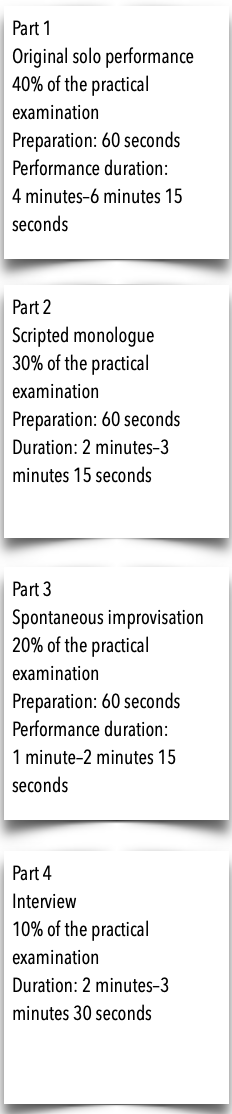
In Western Australia Year 12 drama students complete a Practical Examination with four parts in 20 minutes. As the Examination Guidelines stipulate, “All examination rooms will be set up in a consistent manner in terms of lighting, access to power supply for sound equipment and the placement of the markers as shown in the diagram below. Candidates are required to work within the marked performance area.” ( Drama ATAR course Practical (performance) examination requirements).

It is important to prepare and inspire students for this challenge. 

The following notes are taken from a workshop developed by the Western
Australian Youth Theatre Company and then Artistic Director, Jenny Davis, to help students orient themselves to the task.

Screen Shot 2021-07-27 at 10.54.42 AM.png

The practical workshop had four parts and included examples of performances from students who had completed this task in the previous year. It focused on helping students develop Part 1 of the Exam – Original Solo Performance.

Screen Shot 2021-07-27 at 10.55.15 AM.png

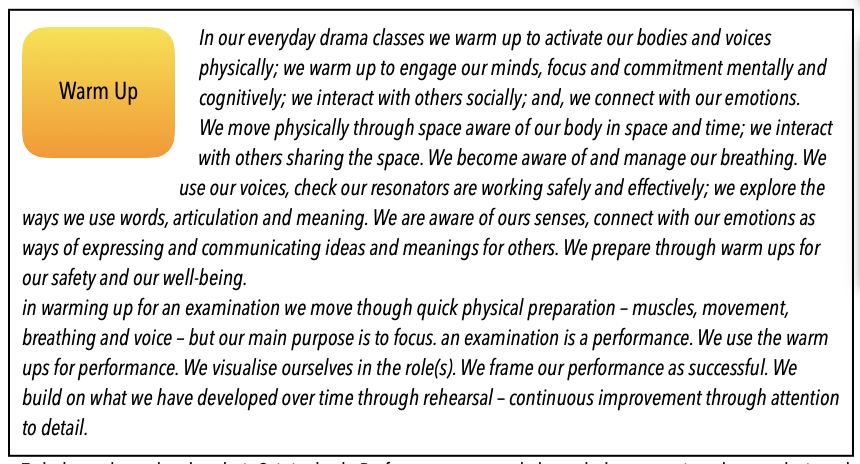
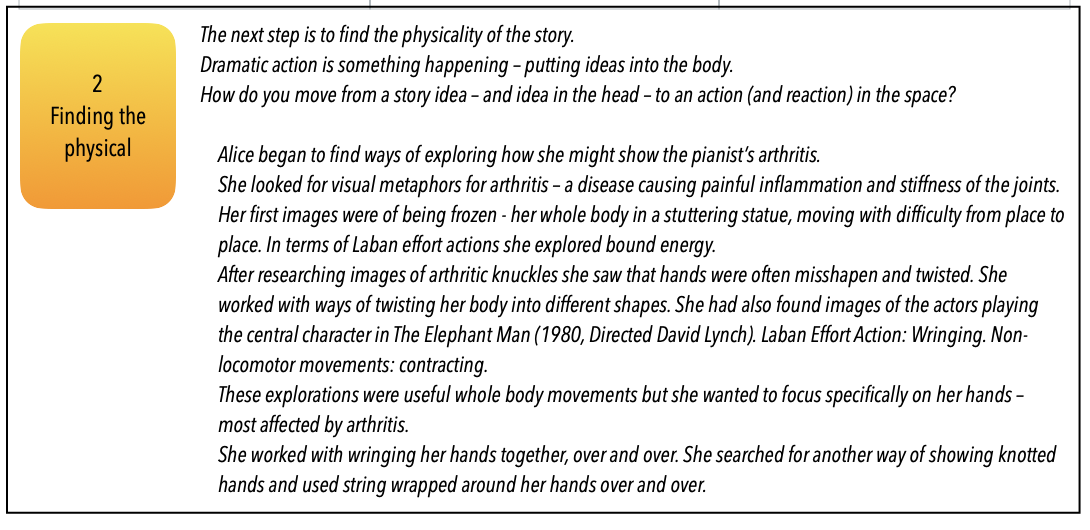
To help students develop their Original solo Performance, we work through three exercises that are designed to help crystallise dramatic action in the specific format and limits of the exam.

Successful original solo productions are the result of a process of making effective choices.


They need:

  • Dramatic action – drama tells stories but it is not storytelling. Nor is it standup comedy. Something happens to someone.

  • Dramatic tension – driving the dramatic action is something at risk, some obstacle to overcome, some conflict to bring to a point of climax.

  • Characters – people in a situation

  • Characters on a journey – at a turning point in their lives, at a moment of transition or discovery, where things change

  • Characters we as audience care about, are interested in, fascinated (or horrified or moved by or…); people for whom we feel emotion and identification

  • Embodiment using space, time and energy; these characters in the situation create dramatic action through contrasts of movement and stillness, light and darkness, loud and soft, varying pace, getting faster and slower as the action unfolds.

Screen Shot 2021-07-27 at 10.59.06 AM.png
Screen Shot 2021-07-27 at 10.59.36 AM.png

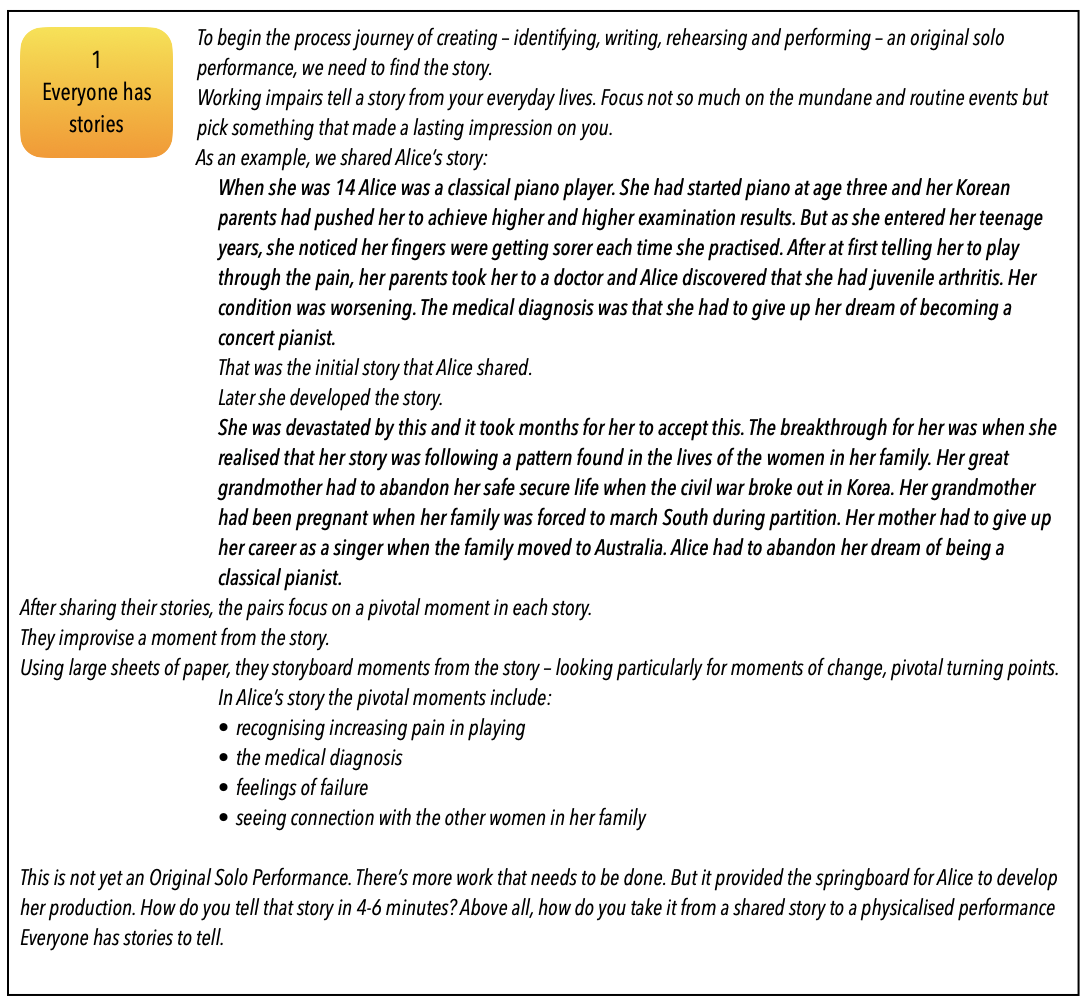
In the workshop participants were asked to find physical ways of showing their ideas in images.

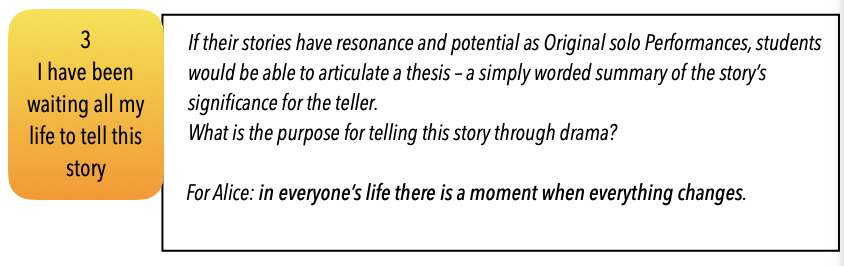
The next stage was to develop a Thesis Statement for their idea.

A thesis statement offers a concise summary of the main point of the Original Performance. It is usually expressed in one sentence. It contains the topic and the controlling idea.

The thesis statement is developed, supported, and explained through the Original Performance. Thesis statements help organise and develop the body of the piece. They let audiences know the writer/performer’s purpose..

Adapted from From Wikipedia 

Screen Shot 2021-07-27 at 11.00.11 AM.png

These three activities were the focus of the workshop. Participants were sent away with other possible explorations:

Exploring character traits. They explored the physicalisation of the characters in their stories. They worked from direct large opposites – boisterous/quiet; kind/cruel; trusting/suspicious. They were then asked to use observational detail that specified actions and reactions. 

Finding form and style. Participants worked with the broad categorisations of Representational and Presentational drama. They are asked to work through their Original Solo Performance as if it is completely representational. In other words, to show the action as if it is actually happening. Then they work through their idea using presentational forms and styles: abstracting movement, reducing movements to minimal, challenge actor-audience relationships, etc. 

Screen Shot 2021-07-27 at 11.17.03 AM.png

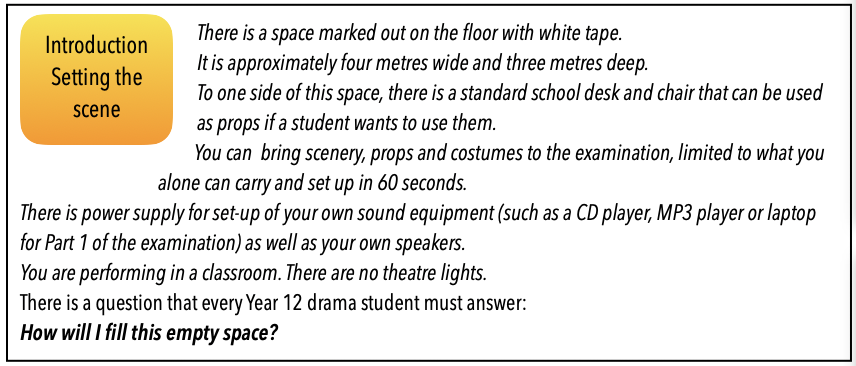
There is a space marked out on the floor approximately four metres wide and three metres deep. The question every Year 12 Drama student must answer:

How will I fill the empty space?